
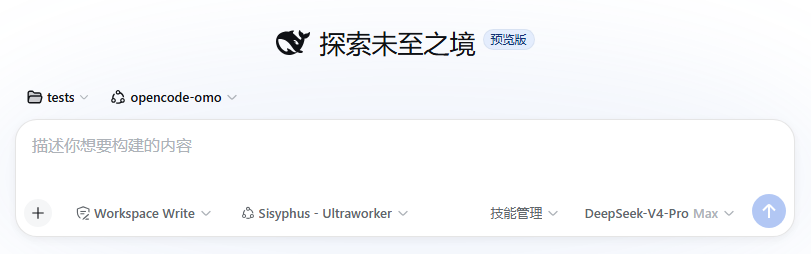

A DeepSeek Harness plugin that adds an opencode-omo agent preset (mode) to the web profile. The mode replicates the behavior of opencode + the omo plugin (oh-my-openagent), scoped to this mode only — other presets (standard/…) keep the default dsh loop, sandboxed fs, and no omo hooks.
- opencode + omo system prompt — the real opencode
default.txtpersona (tone, style, proactiveness, conventions, code style, task guidance) + omo's Sisyphus orchestrator identity, declared as the complete system prompt: the dsh harness identity and runtime-context snapshot are suppressed for this mode. The loop shim additionally prepends opencode's live environment block (exact model id, working dir, workspace root, git, platform, date, recomputed every step). - omo role picker in the composer — in dsh's existing
conversation.input.lefttool-row slot (after the access/plan chips), the primary/all rolessisyphus,hephaestus(Deep Agent),prometheus(Plan Builder),atlas(Plan Executor), andsisyphus-junior. Selecting one swaps the session's complete system prompt and applies that role's configured model. Specialist roles (athena,athena-junior,council-member,metis,momus,oracle,librarian,explore,multimodal-looker) are reached throughtask(subagent_type=...), not the composer picker. - Global "Role Settings" in the dsh settings panel (
settings.section): per-role primary model dropdown (follow current / omo default / fixed) under a centered "Primary model" label; a dsh-style circle "+" button opens a fallback model list below the role box (repeatable additions, cancel/close adds nothing), persisted in theopencode-omosettings entry. On request failure the loop shim advances through the role's fallback chain before the harness retry policy runs. - opencode toolchain (complete) — persistent
bash,read/write/edit/read_image,apply_patch,glob/grep,todo_write,skill,web_fetch/web_search, the LSP navigation surface (lsp_goto_definition/lsp_find_references/lsp_hover/lsp_go_to_implementation; rawlspis hidden),exit_plan_mode(plan),ask_user_question.tool-surface.mjsoverwrites the model-visible descriptions/parameters with opencode'stool/*.txttext and shimsread/edit/write/web_searchto opencode's parameter names (web_search.query→ dshqueries). - omo
task()surface —task-shim.mjsregisters the omo-styletask(category/subagent_type/load_skills/run_in_background/task_id)invocation, mapping it onto dsh named subagents + generic delegation. - omo multi-role subagents —
oracle(write-tool-restricted advisor; shell retained, not a sandbox),librarian(external docs/code search),explore(codebase grep),metis(pre-planning),momus(plan reviewer),multimodal-looker(media), plus genericsubagent/subagent_fork+workflow/ralph. Delegated children keep dsh'ssend_messagereturn channel (the harness appends that instruction to every continuable child); the primary surface still hides it behindtask()/background_output. - omo context injection — AGENTS.md/CLAUDE.md walk-up +
skills/+ omo'srules-injector(.omo/rules,.cursor/rules,.github/instructions,copilot-instructions.md). - omo hooks —
comment-checker(rejects AI-slop comments on write/edit),hashline(read taggingN#HH|content+hashline_editstale-ref guard). - per-mode execution backend — local filesystem (
dsh-fs-local) + persistent PTY shell, isolated from other modes' sandboxed fs/shell. - native-seam loop shim — no dsh-side driver seam.
driver.mjsis an ordinary preset plugin using the shipped seams: a dynamicctx.systemPrompt.section({ complete: true })recomputes opencode's env block and the selected omo role prompt per assembly;system-prompt/assembleapplies opencode's model tool gating, and both the request catalog and the prompt's generated tool table run through the same hidden-name/model-family/role filter;agent/inbox/claimed,agent/pre-step,agent/request, andagent/request-errorprovide ultrawork detection, maxSteps, role model routing, and fallback retry. Other presets are untouched by construction.
cordis.patch.yml                 # bundle patch: host row + official agent-preset declaration
patches/                         # dsh-side patch(es) still required for the complete surface
install.py                       # idempotent install/uninstall (manifest + missing runtime/LSP links)
src/                             # host + client plugin halves (role registry, settings, picker UI)
lib/                             # built host/client bundles (npm run build)
scripts/build.sh                 # architecture check + typecheck + tsdown build
presets/opencode-omo/
  agent.cordis.yml               # the composition (tools, roles, hooks, LSP)
  preset.yml                     # display metadata
  persona.md                     # opencode default.txt + omo Sisyphus persona
  roles/*.md                     # subagent personas (also main-role prompts)
  roles/prompts/*.md             # primary-role complete prompts (hephaestus/prometheus/atlas/…)
  skills/                        # omo shared skills
  driver.mjs                     # native-seam loop shim (prompt/route/fallback/maxSteps/ultrawork)
  delegation-restrictions.mjs    # single tool capability/role restriction table
  patch-parser.mjs               # shared apply_patch parser for execution + permission
  background-state.mjs           # closed background activation lifecycle
  rules.mjs                      # rules-injector
  comment-checker.mjs            # comment-checker hook
  apply-patch.mjs                # apply_patch tool
  hashline.mjs                   # omo hashline read-tagging + hashline_edit
  lsp-optional.mjs               # LSP trio when installed; self-disables otherwise
lib/ is generated locally and is not committed. install.py always builds the repository's own toolchain first (npm ci when the toolchain is missing or package-lock.json is newer than the installed lock, then npm run build) and exits with an actionable error if npm, the build, the artifacts, or a required harness link is missing:
python3 install.py install --profile web              # install (idempotent)
python3 install.py uninstall --profile web            # remove
install.py symlinks the package into ~/.dsh/profiles/<profile>/node_modules/, mirrors runtime packages only when absent, ensures/repoints the LSP links (refusing real directories), and edits the profile's package.json (adds/removes the dependency + bundle entry). The bundle patch declares both the host row and the official @deepseek-ai/dsh-agent-preset row, so there is no separate user-preset-root copy.
Manual alternative — the package is a dsh bundle: it declares dsh.bundle.patch and ships the preset. dsh plugin reconciles dsh.profile.bundles from the installed package automatically:
dsh plugin --profile web add link:/path/to/dsh-plugin-opencode-omoThe bundle patch declares the official @deepseek-ai/dsh-agent-preset row for opencode-omo, so no $DSH_HOME/.agent-presets copy is published. Restart dsh and select opencode-omo from the mode picker.
Upgrading from the pre-0.2.1 row id. Existing profiles used the
opencode-omo-roles settings entry; rc.2's legacy importer preserves that
unknown entry in $DSH_HOME/settings.yaml.imported. On boot the host row reads that backup once per profile and merges its
role/session maps into the active opencode-omo entry, so old role models and
fallbacks are not silently reset. Profiles migrated by the pre-release
9ad557c home-global marker may re-import once because that marker had no
profile identity; review the merged roles after upgrading.
Optional LSP server. The preset preconfigures typescript-language-server for the lsp_* navigation tools. install.py checks PATH and warns when it is missing; the optional LSP module then mounts without a provider so the mode still loads (LSP queries fail gracefully instead of blocking the whole preset). Install it to enable LSP:
npm install -g typescript-language-server typescriptthen restart dsh.
web_fetch provider. The preset enables dsh's native web_fetch tool (fetch: true). Official 0.2.1 already registers @deepseek-ai/dsh-web-fetch-http in the base bundle, so this plugin does not insert a second fetch row (that would throw WEB_DUPLICATE_PROVIDER). web_search keeps using the existing DeepSeek search provider (DEEPSEEK_API_KEY). Other presets keep fetch: false, so their tool surface is unchanged.
One patch is still required for the complete opencode surface:
patches/0001-agent-pre-step-assistant-prefill.patch (rebased onto
dsh-v0.2.1-rc.2) adds PreStepDecision.assistantPrefill, a request-only
assistant tail. The loop logs it on request/header, appends it to exactly the
request that asked for it, and prices it in token pressure; it is never a
session assistant/message, so transcript, compaction, and stats stay clean.
Apply it to the dsh checkout with the instructions in
patches/README.md; install.py does not modify the harness
checkout. Without the patch the preset still loads and uses the fallback below.
Why the patch is still required. opencode appends MAX_STEPS_PROMPT as an
assistant-role continuation on the ceiling step. Official 0.2.1
PreStepDecision is still reject | { kind: 'enter', messages, startsRequestSeries? },
and agent/request cannot mutate request messages, so no official extension
point can express a request-only assistant tail. Upstream request:
discussion #2407.
The plugin probes the runtime capability
(ctx.agentLoop.supportsAssistantPrefill). On a patched host the ceiling text is
an assistant tail and no system-prompt section is added. On a stock host it
keeps the same text and trigger as a system-prompt section (see the fallback
table below); that is survivability, not the complete opencode surface.
| Surface | opencode / patched harness | This plugin on a stock 0.2.1 host |
|---|---|---|
Role of MAX_STEPS_PROMPT |
Assistant-role continuation at the end of the request | System-prompt section for that step |
| Session transcript / stats / compaction | Request-only (header), not a session message | Also not a session message (system section is reassembled) |
| How strictly models stop / wrap up | Tuned for an assistant tail | May treat a system reminder more weakly or more strongly |
| Token placement | Extra assistant tokens on that request | Extra system tokens on that request |
| Reconstructable requests | Logged on request/header |
Rebuilt from the live prompt assembly |
The fallback is selected at runtime; the patch is not dropped when a host can run without it.
Provider-visible format/toolChoice remains an unpatched proposal; omo's
regular path does not use it.
Everything else runs on unmodified dsh seams: the preset is declared by the
official @deepseek-ai/dsh-agent-preset row, the role picker occupies the
existing conversation.input.left slot, and role settings use the official
settings form Remote.
Runners and reproduction notes live in tests/benches/; reports are written to docs/exps/. The scientific methodology (paired design, McNemar/bootstrap/TOST, A/A noise floor, trace alignment, cache and latency protocols) is documented in docs/exps/2026-08-16-scientific-bench-methodology.md. Design highlights:
- Run an isolated-port dsh (
opencode-omomode, isolated$DSH_HOME) and the machine's installed opencode + oh-my-openagent (isolatedXDG_CONFIG_HOME). - Both use
deepseek-official/deepseek-v4-pro(dpsk v4 pro); the API key comes from theDEEPSEEK_API_KEYenvironment variable. Scripts hardcode no machine paths or secrets. - Tiered benches: L1 HumanEval, L2 MBPP, L3 SWE-bench-verified-mini (sampled), comparing pass@1, CoT/reasoning exposure, tool-call chains (read/edit/write/bash/test/subagents), and final patches/answers.
- Performance:
bench_metrics.mjsnormalizes token usage (includingcacheRead) and tool timestamps on both sides;eval_perf.mjs/eval_swe_perf.mjsproduce cache hit rate, TTFT, step duration, and per-tool timing offline (see report §5). - MBPP fix: MBPP rows have no
entry_point; the scripts infer the function name from the firstassert fn(...)or the referencedef fn. The old implementation hardcodedFunction name: undefined, which was the root cause of MBPP behavioral divergence (see report §0 and §6.4). - Raw bench data is downloaded to
tests/benches/.data/and is not versioned;fetch-benches.shreproduces the downloads andsetup-homes.shreproduces both isolated homes.
| level | dsh pass@1 | opencode+omo pass@1 | per-item agreement |
|---|---|---|---|
| HumanEval (30 tasks × 3 repeats) | 1.00 | 1.00 | 1.00 |
| MBPP (corrected entry_point, 5 tasks × 2 repeats) | 1.00 | 1.00 | 1.00 |
SWE-bench-verified-mini sample (sphinx-doc__sphinx-10323) |
same patch | same patch | byte-identical git diff |
Full report: docs/exps/2026-08-15-opencode-omo-equivalence-bench.md; raw transcripts are under tests/benches/.runs/.
Active combination: opencode-1.17.11+omo-5.0.0-beta.31.
alignment.json is the machine-readable registry;
presets/opencode-omo/roles/prompts/variants/MANIFEST.md records prompt sources.
| Upstream | Version | Commit | Used for |
|---|---|---|---|
| opencode | 1.17.11 |
67aec221 |
tool descriptions, persona, plan/build/MAX_STEPS text |
| oh-my-openagent | 5.0.0-beta.31 |
62ed7952 |
Sisyphus family, Atlas, Hephaestus, Oracle/Metis/Momus prompts |
| oh-my-openagent | 4.19.0 |
14083b89 |
librarian / explore / multimodal-looker prompts |
| dsh | 0.2.1-rc.2 |
687f282 |
host peer target |
explore and multimodal-looker are identical in both omo versions;
librarian stays on v4.19.0 until the context7-specific v5 diff is adapted to
this harness. npm run check:alignment validates the active combination.
Tracking: #17.
- Provenance: per-combination manifest and content hashes.
- Deterministic contract: scripted-catalog prompt/tool rendering compared with upstream sections and names.
- Recorded traces: record real opencode+omo traces once per pin, then replay only this plugin and compare normalized events.
- Aligned: opencode default persona (complete system prompt + live env block whose provider/model follow the same assembly-time route as the request — session live model selection or the role primary/fallback (an in-step fallback retry reuses that assembly while the request route advances); workspace root now derived as the git root); opencode tool families + gpt apply_patch/edit-write tool gating enforced on BOTH the model-visible schema and execution (
tools/pre-executedeny mirror); opencode maxSteps + verbatim MAX_STEPS_PROMPT; verbatim opencode plan.txt / plan-mode.txt with dynamic${planInfo}and the plan→build BUILD_SWITCH reminder; omo role catalog/display names; sisyphus/hephaestus/atlas/sisyphus-junior + specialist subagents; comment-checker/hashline/rules-injector hooks; generated Sisyphus routing sections; extracted omo Sisyphus model-family templates (GPT-5.5/GPT-5.4/claude-opus-4-7/claude-opus-4-8/claude-fable-5/gemini/kimi-k3/kimi-k2-7/kimi-k2-6/glm-5-2, with the dynamic Sisyphus fallback for unknown families) plus hephaestus GPT variants, all 8 atlas variants, and specialist model variants (oracle/metis/momus); omo-default per-role PRIMARY model resolution (provider-scope ordered) and fallback chains that start AFTER the primary; omo role sampling defaults (sisyphus/hephaestus GPT effort medium, atlas temperature 0.1); omo-style retryable-error gating before fallback advance; reasoning-effort selectors in role settings; ultrawork keyword override;/start-work,/remove-ai-slops,/refactor,/stop-continuation,/handoff,/hyperplan,/team-modecommands; composer role picker + global per-role model/fallback settings; omo skills published asuser-dshso the third-party skills-manager can manage them. The omo rules-injector text is now folded into the complete system prompt (driver.mjs+rules.mjs) instead of being dropped bysuppressRuntimeContext(); approved plans are persisted at.opencode/plans/<created>-<session>.md; specialist subagent personas now load the extracted reference prompt files (oracle/librarian/explore/metis/momus/multimodal-looker). - MCP: separate plugin
dsh-plugin-mcp-supportmounts native@deepseek-ai/dsh-mcp-clientservers from its bundle-row config or the persistedmcp-supportsettings namespace. - Structured output: separate plugin
dsh-plugin-structured-outputprovides opencode-style/json-schema+StructuredOutputvalidation on native seams (no dsh-side format field). Its visibility is opt-in per preset via Settings → 结构化输出工具 (Structured output); no mode is enabled by default. - Partial: extracted family templates keep dynamic sections filled by dsh-native data rather than omo's builder output; structured output is tool-enforced rather than
tool_choice: required; hooks are regex/simplified ports; AGENTS.md injection is dsh-native; child subagents inherit the session model because dsh child headers/descriptors do not carry the subagent role id (primary-role sampling defaults ARE applied). - One dsh-side patch in this repo.
patches/0001-agent-pre-step-assistant-prefill.patchrestores opencode's request-only assistant ceiling text; stock hosts keep the system-section fallback.format/toolChoiceremains a proposal; the standalone structured-output plugin covers the common route.
- maxSteps role (patched seam + stock fallback):
patches/0001gives the assistant-role request tail on a patched host. A stock 0.2.1 host still gets the sameMAX_STEPS_PROMPTtext and trigger as a system-prompt section, so models may treat the role differently. Tracked upstream as discussion #2407. - dsh-side (proposal, medium):
GenerateOptions.format/toolChoice. omo's regular path does not use them; the standalone structured-output plugin covers the common route. - Child subagent per-role sampling cannot reliably resolve the role id (dsh child headers/descriptors do not carry it); primary-role sampling defaults ARE applied and children inherit the session model.
- Plan files: dsh itself does not persist them; the plugin writes
.opencode/plans/*afterexit_plan_modeapproval. A first-class plan-file seam remains an optional improvement. - team-mode TUI, comment-checker CLI, and hashline diff enhancer remain non-LLM/editing experience differences.