Show Ethereum's in-use beacons alongside Base's - #118
Conversation


The scanner was Base-only end to end: one hardcoded endpoint set, one beacon
block. Ethereum carries its own production deployment at different addresses,
owned by a different Safe, so none of it was visible on the dashboard.

The chain now travels with the RPC session rather than being implied by the
caller. An address that exists on one chain and not the other, answered by
the wrong endpoint set, reads as "not deployed" — a silent downgrade rather
than an error, which is exactly the failure a second chain invites.

Ethereum's in-use beacons are the 0.1.1 generation. Only the wrapped-token
vault beacon has a generated address pin; the other two are created inside
the 0.1.1 beacon-set deployer's constructor and exist nowhere as a constant,
so they are resolved live from its getters.

deploymentBeacons becomes one block per chain, and a chain whose read failed
is dropped rather than emitted as null.

Co-Authored-By: Claude Opus 4.8 <noreply@anthropic.com>

|
Warning Review limit reached
Next review available in: 42 minutes Enable usage-based reviews in Billing to review now. Otherwise, wait until the next included review is available. How can I continue?After more reviews become available, a review can be triggered using the To avoid repeated limits, reduce automatic review volume by pausing incremental auto-reviews earlier, using label-based review opt-in, excluding WIP or generated PR titles, or requesting reviews manually when the PR is ready. If your team needs uninterrupted high-volume reviews, an organization admin can enable usage-based reviews. How do review limits work?CodeRabbit enforces per-developer PR review limits for each organization. Most developers receive the normal plan review availability. For paid Pro and Pro+ PR reviews, CodeRabbit uses adaptive limits for sustained high-volume activity. When a developer's recent PR review activity reaches the 95th percentile or higher among CodeRabbit users, additional reviews become available more gradually as earlier reviews age out of the rolling window. Please refer docs for additional details. Review details⚙️ Run configurationConfiguration used: Organization UI Review profile: ASSERTIVE Plan: Pro Run ID: 📒 Files selected for processing (5)
✨ Finishing Touches🧪 Generate unit tests (beta)
Thanks for using CodeRabbit! It's free for OSS, and your support helps us grow. If you like it, consider giving us a shout-out. Comment |

A chain whose beacon read failed was filtered out of the list, which renders
as no section at all — indistinguishable from "this chain has no production
beacons". That is the same silent vanish that hid the token registry, so the
chain now keeps its identity and the dashboard states the reason.

The Ethereum endpoint set is cut to the four verified live against the 0.1.1
beacon-set deployer: each answers the getters with the addresses the Solidity
lib resolves. The two dropped endpoints answered 521 and 429, and an endpoint
that cannot answer fails the whole chain's read.

The getter selectors are pinned against their signatures. A wrong selector
reverts on-chain, which the scan reports as an unreadable beacon rather than
as a bad selector, so nothing else would catch it.

Co-Authored-By: Claude Opus 4.8 <noreply@anthropic.com>

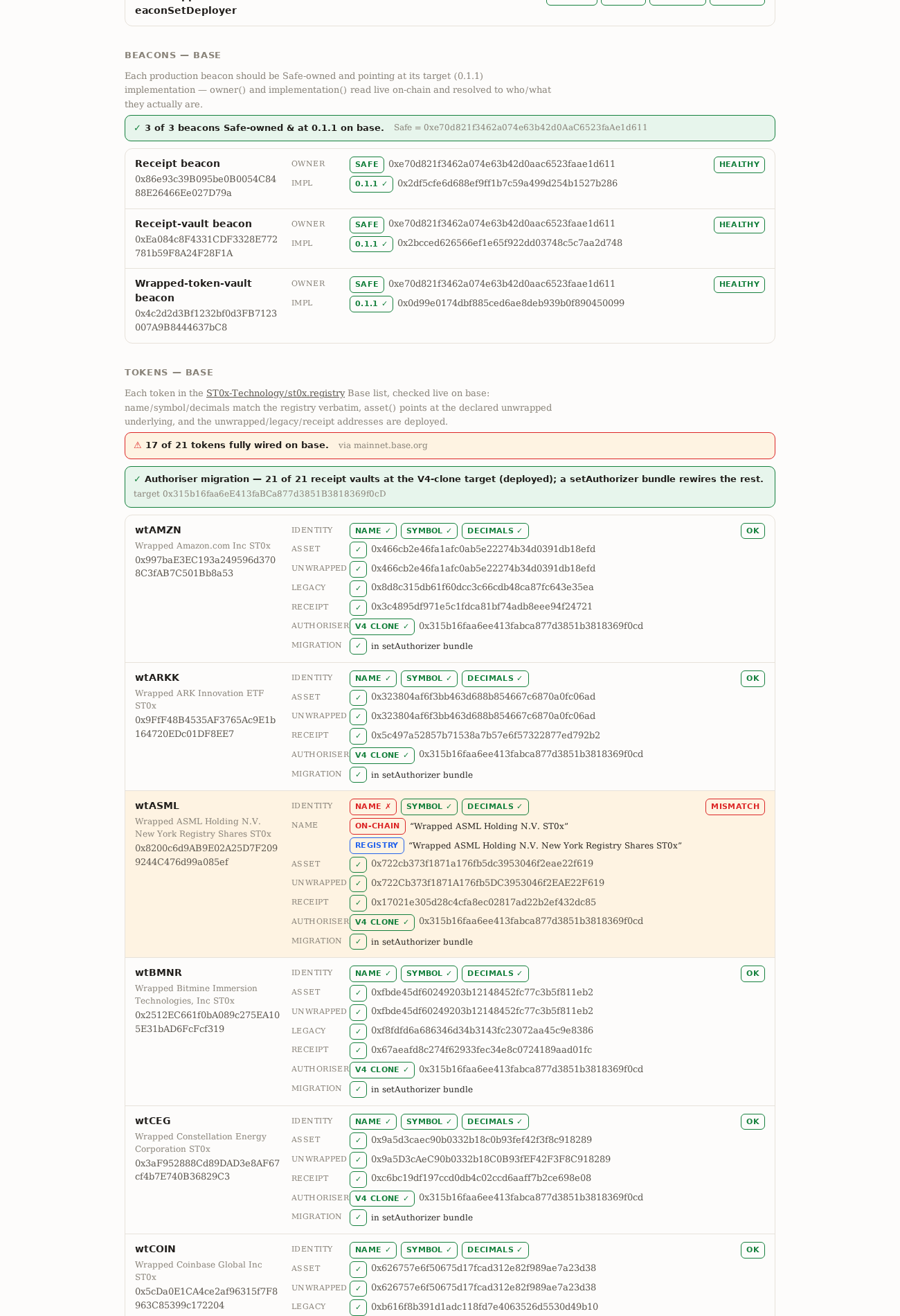
RendersBefore — today's prod.
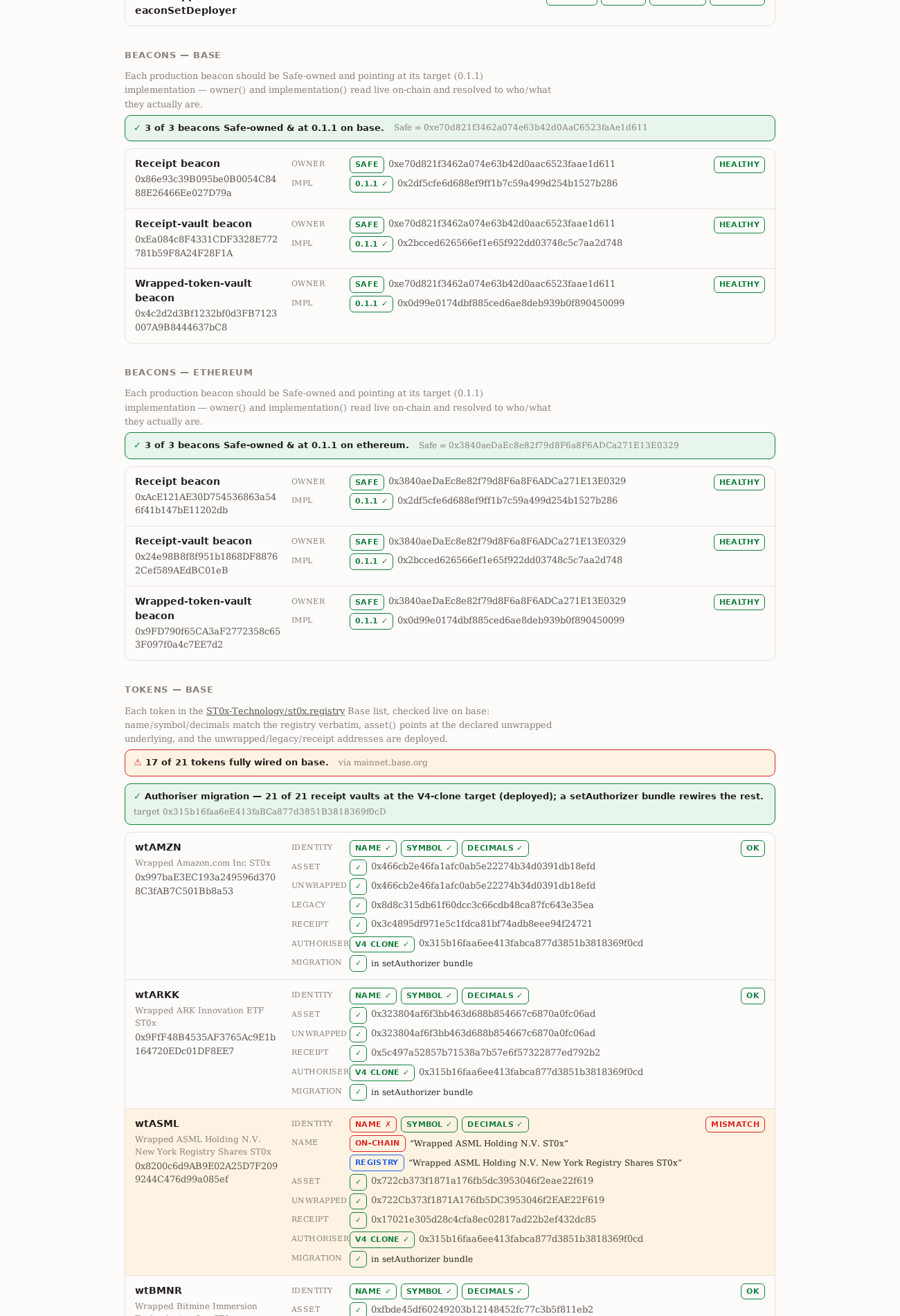
After — both chains. Ethereum's three beacons, all
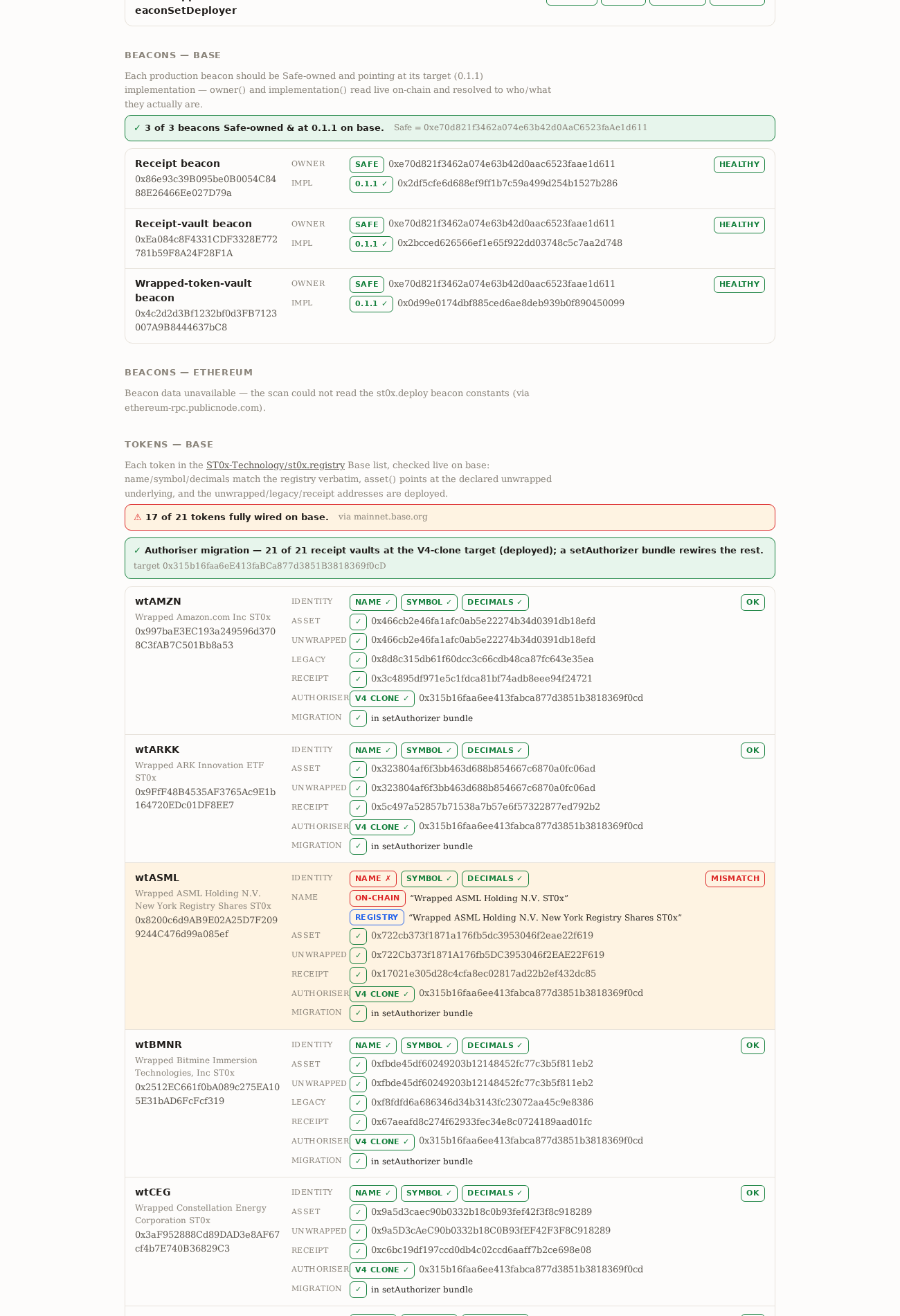
Ethereum unreadable. The failure mode that matters: the chain keeps its heading and states the reason instead of the section disappearing. A dropped chain reads as "Ethereum has no production beacons" — the same silent vanish #117 just fixed for tokens, which my first version of this PR reintroduced.
Full pages: before · after · unavailable How these were producedThe Base half and everything outside the beacon sections is a real scan (
All four endpoints in Unrelated but visible now that #117 is live: wtASML is a |



Co-Authored-By: Claude Opus 4.8 <noreply@anthropic.com>
|
Reviewed 48850b5: approve Adds Ethereum's in-use beacons to the deployments dashboard, mirroring what S01-Issuer/st0x.deploy#266 establishes on the contract side: the beacons that matter are the ones a chain's production tokens actually run on, and that set is per-chain. The chain now travels with the RPC session rather than being implied by the caller — a Base address asked of an Ethereum endpoint answers "no code here", a silent downgrade to An unreadable chain reports itself instead of being filtered out. My first version dropped it, which renders as no section at all — the same silent vanish #117 had just fixed for tokens. Verified: rust 179, deno 75, Merging over one still-running macos |

1 participant

The deployments dashboard showed Base's beacons and nothing else. Ethereum carries its own production deployment — different addresses, different Safe, a different beacon generation — and none of it was visible.
This mirrors what S01-Issuer/st0x.deploy#266 establishes on the contract side: the beacons that matter are the ones a chain's production tokens actually RUN ON, and that set is per-chain.
The chain travels with the session
roh-scanwas Base-only end to end —curl_jsoniterated a hardcodedBASE_RPCS, and everyeth_callinherited it. A second chain cannot be bolted onto that safely, because an address that exists on one chain and not the other, asked of the wrong endpoint set, answers "no code here". That is a silent downgrade tonot deployed, not an error — precisely the failure a second chain invites, and it would look identical to a real outage.So
rpc_session()now takes aChainand returns aSession { chain, cursor }. Every read carries its chain with it; there is no way to reach an endpoint the caller did not choose. Call sites are unchanged beyond the session construction.Ethereum's in-use set
Ethereum bootstrapped at 0.1.1, so that generation IS its production set (Base kept its V1-generation beacon addresses through every implementation upgrade). Only the wrapped-token-vault beacon has a generated address pin — the receipt and receipt-vault beacons are created inside the 0.1.1 beacon-set deployer's constructor and exist nowhere as a constant, so they are resolved live from
iReceiptBeacon()/iOffchainAssetReceiptVaultBeacon(). Expected owner isSTOX_TOKEN_OWNER_SAFE_ETHEREUM, which I confirmed live: all three Ethereum beacons are held by0x3840aeDa….There is no previous generation to fall back to on Ethereum, so an implementation that is not the 0.1.1 target is reported as unrecognised rather than as "behind".
Shape
deploymentBeaconsbecomes one block per chain. A merged table would put rows from two chains side by side with nothing distinguishing them; a chain whose read failed is dropped rather than emitted as null, so the dashboard never renders an empty section that reads as "this chain has no beacons".renderBeaconsaccepts either an array or a single block, so it keeps working against ahealth.jsonwritten before this change.Verification
cargo buildclean, 177 rust tests pass,cargo fmt --check+clippy -D clippy::allclean.