


If this project is useful to you, you can support its continued development:

Run Codex CLI against your Home Assistant configuration folder from Home Assistant.
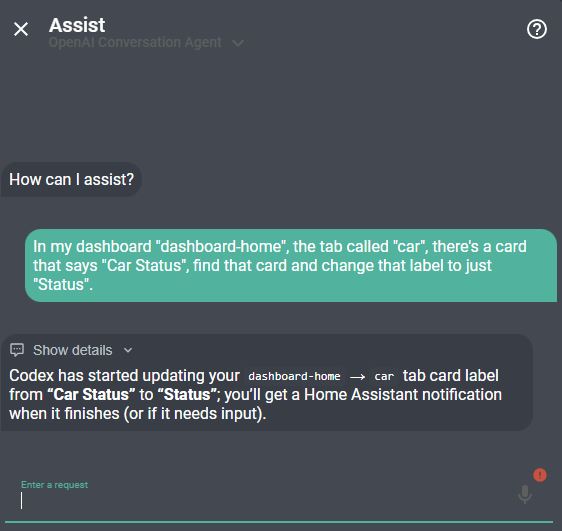
Ask Home Assistant Assist to make a configuration or dashboard change:
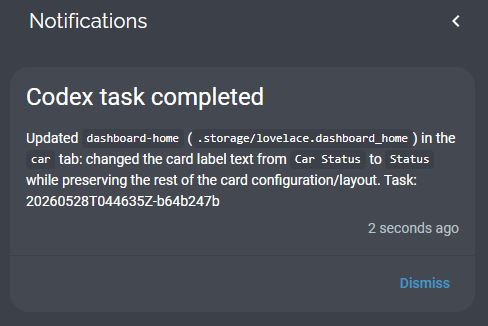
Codex runs the task and sends a Home Assistant notification when it finishes:
This repository contains two pieces:
codex-cli-worker: a Home Assistant app/add-on that runs Codex CLI with read-write access to/config.custom_components/codex_cli: a Home Assistant custom integration that exposes entities and actions for starting tasks, checking status, signing in, cancelling work, and continuing saved conversations.
- Starts Codex tasks from Home Assistant actions, scripts, automations, or Assist/LLM tools.
- Keeps saved conversations so you can return to an earlier chat and continue with its context.
- Provides a chat UI with a resizable sidebar, mobile navigation, and light/dark themes.
- Mounts the Home Assistant config folder as
/configinside the worker app. - Runs tasks non-interactively and stores task logs/results under
/config/codex_tasks. - Supports Codex device-code sign-in through Home Assistant persistent notifications.
- Reports active task count, latest task status, auth status, and task-running state.
- Uses Home Assistant Ingress for the app UI; the worker HTTP port is not exposed to the LAN.
This app is powerful by design. It gives Codex access to your Home Assistant config folder so it can edit automations, scripts, dashboards, integrations, and related files.
The packaged worker follows the current Home Assistant app security guidance:
- No published LAN port.
- Ingress enabled for the web UI.
- Exact Ingress proxy source validation.
- Token-protected worker API for non-Ingress calls.
- AppArmor enabled with a custom profile.
- Bubblewrap namespace setup is isolated in a nested AppArmor profile, and sandboxed commands start with all Linux capabilities dropped.
- No Docker API access.
- No host network.
- No host PID/UTS access.
- No
full_access. - No elevated Supervisor role.
The /config mount is intentionally read-write because editing Home Assistant configuration is the core purpose of the project.
Use this project at your own risk. Codex for Home Assistant can read and modify your Home Assistant configuration, dashboards, scripts, automations, and related files. AI-generated changes can be incomplete, incorrect, unsafe, or incompatible with your setup.
You are solely responsible for reviewing changes, keeping backups, testing safely, and deciding whether to run this tool in your environment. The maintainer is not responsible or liable for damage, data loss, service interruption, security issues, misconfiguration, broken automations, device behavior, or any other loss or claim arising from installing, configuring, or using this project.
This project is provided "as is", without warranty of any kind, express or implied. See the repository license for the full warranty and liability disclaimer.
Prebuilt app images are published for:
amd64aarch64

Use the button above to add this repository to Home Assistant's Apps store.
If you prefer to do it manually:
In Home Assistant:
- Go to Settings -> Apps.
- Select Install app.
- Open the menu in the top right.
- Choose Repositories.
- Add this repository URL:
https://github.com/moryoav/home-assistant-codex

Use the button above after adding the repository. It opens the Codex CLI Worker app page.
- Install Codex CLI Worker.
- Review the app options.
- Start the app.
The app keeps an internal worker API token in private app storage. The Codex integration provisions and rotates that token automatically through Home Assistant's Supervisor-managed app stdin, so you do not need to view, copy, or configure a token.
The app's web UI is available through Home Assistant Ingress. Do not try to open port 9123 directly; it is intentionally not exposed.
The app options include dropdowns for the Codex model and model reasoning effort. The default model selection lets the installed Codex CLI choose its current recommended model. You can also select GPT-6 Astra or GPT-5.6 Sol, Terra, or Luna explicitly, with GPT-5.5 retained as a previous-generation fallback. Model availability depends on your account. medium reasoning is the default balance; high and xhigh can spend more time/quota. For GPT-6 Astra, select low, medium, high, or xhigh.
The app web UI can view and save /config/AGENTS.md. You can also set the masked HA_TOKEN option when Codex tasks need a Home Assistant token in their environment.
Before starting sign-in, enable Enable device code authorization for Codex in ChatGPT:
- Open the ChatGPT website.
- Click your profile.
- Go to Settings -> Security.
- Turn on Enable device code authorization for Codex near the bottom of the page.
This setting is in ChatGPT, not the Codex website.
Open the app web UI and click Start login, or call the codex_cli.start_login action after the integration is installed.
The app sends a Home Assistant persistent notification with:
- A QR code.
- A sign-in link.
- The one-time device code.
Scan the QR code or open the link, then enter the device code shown in the notification.
Codex CLI sign-in uses your ChatGPT/OpenAI account. It may work with a free ChatGPT account, but ChatGPT Plus or higher is recommended for more reasonable usage limits. This project does not use OpenAI API keys for Codex tasks.

Codex is available in the default HACS catalog, so no custom repository setup is required.
- Select the button above, or open HACS and search for Codex under Integrations.
- Select Codex and choose Download.
- Restart Home Assistant.
Copy:
custom_components/codex_cli
to:
/config/custom_components/codex_cli
Then restart Home Assistant.

Use the button above after Home Assistant restarts. It opens the Codex integration setup flow.
In Home Assistant:
- Go to Settings -> Devices & services.
- Add integration Codex.
The integration auto-detects the installed worker app and provisions its internal worker API token. There is no worker URL or API token to enter.
The integration exposes these Home Assistant actions:
codex_cli.start_taskcodex_cli.start_logincodex_cli.logoutcodex_cli.get_login_statuscodex_cli.list_taskscodex_cli.get_taskcodex_cli.cancel_taskcodex_cli.reply_taskcodex_cli.continue_task
The integration also provides diagnostic sensors for auth status, active tasks, last task, and the usage windows reported by Codex /status. Depending on the account and plan, Codex may report both 5-hour and weekly limits or only a weekly limit. The existing 5-hour entities remain available for automation compatibility; when that window is omitted their state is unknown and their reported attribute is false. Reported usage sensors expose numeric percent states plus ISO datetime reset attributes when reset times are present.
When a Codex task completes, fails, or needs input, the worker fires a Home Assistant event named codex_cli_task_result in addition to the notification. Automations can listen for that event and read fields such as task_id, status, summary, question, details, attachments, and the nested response object from trigger.event.data.
Example:
action: codex_cli.start_task
data:
  prompt: Check my Home dashboard for broken cards and suggest fixes.
response_variable: codex_resultOpen the worker web UI to browse saved chats in the left sidebar. Select a chat to read its messages and continue with the same Codex context, or choose New chat to start a separate conversation. Drag the sidebar divider to resize it, or focus it and use the arrow keys. On phones, use the menu button to open the chat list. Account sign-in and the AGENTS.md editor are under Settings.
The sidebar shows recently active chats first and includes Load older chats. Messages, responses, and per-exchange results are saved across worker restarts. Older tasks remain available, but responses overwritten before this feature was added cannot be recovered by the new history view.
From 0.1.47, the sidebar also shows the remaining 5h and 7d account quota below Home Assistant workspace. Values refresh automatically; hover over a percentage to see its reset time when available. While a task is running, the display identifies the last known quota.
From 0.1.48, choose a model and reasoning level for each conversation using the pill below the message box. Click the model name to open the model menu, or the reasoning label to open the blue slider. Choices are saved for that chat and apply to its next message, including when continuing a saved conversation. New chats start with the add-on defaults. Choose Default in the model menu or the reset button in the reasoning picker to inherit the corresponding add-on setting again.
The reasoning slider adjusts to the selected model: GPT-6 Astra and GPT-5.6 Sol/Terra support Low through Ultra; Luna supports Low through Max; GPT-5.5 supports Low through Extra High. Ultra allows automatic task delegation. With an unspecified default model, the slider offers Low through Extra High. Switching to a model that does not support the current reasoning selection resets reasoning to the add-on default, or Medium if that default is incompatible. Model access depends on the signed-in account. Settings can be changed while the conversation is idle.
From 0.1.49, images generated by Codex appear in the chat. Ask for an image in a conversation and it is shown under the response, with a full-size link and a Download button. Images stay with their exchange across reloads and worker restarts, and follow-up messages can refine them in the same conversation. Generation uses the built-in Codex image tool with your ChatGPT sign-in; no API key is needed, and availability depends on your account. Images are served only through the authenticated worker, and the attachments metadata is available through codex_cli.get_task and the result event.
Available from 0.1.46. Update both the Codex CLI Worker app and the Codex HACS integration for the new actions.
Screenshots use demo conversations from the local test fixture.


List the 10 most recently active tasks:
action: codex_cli.list_tasks
data:
  limit: 10
  order: updated_desc
  summary: true
response_variable: recent_chats
Optional filters are limit (1–500), offset (zero-based), status, order (created_asc or updated_desc), and summary. The response includes tasks, total, next_offset, and active_task_id. With no options, the action keeps returning all tasks, oldest-created first. Use codex_cli.get_task with a task_id to retrieve the full conversation in task.turns.
Continue a previous task:
action: codex_cli.continue_task
data:
  task_id: "YOUR_TASK_ID"
  message: "Apply the first suggestion from your previous answer."
response_variable: continued_chat
Completed, failed, cancelled, and waiting tasks can continue if their saved Codex session is available. The task ID stays the same. Each message adds a new exchange, and the task-level status and result describe the latest exchange. Only one task can run at a time. A missing session produces an error instead of silently starting a new conversation.
The existing codex_cli.reply_task action still answers tasks waiting for input. New tasks do not automatically inherit context from other chats.
Codex tasks return a structured response with status, summary, question, and details. These values are plain strings, and how they are displayed depends on the Home Assistant consumer or notification service that receives them.
You can request a preferred output style through /config/AGENTS.md, which is editable from the worker app web UI. Codex treats this as guidance rather than a formatting guarantee. If you want Markdown-friendly task output, you can add this instruction:
For the final structured response, use concise Markdown in summary, question,
and details when it improves readability. Use only short lists, emphasis, inline
code, and fenced code blocks. Do not use raw HTML, images, or embedded content.See examples/scripts.yaml for a starter script you can expose to Assist or another LLM integration.
Community-created dashboard cards are maintained in their own repositories:
- Home Assistant Codex Card by Rschmidt79, a Lovelace chat card for starting and following Codex tasks from a Home Assistant dashboard.
Use the default repository URL for stable releases:
https://github.com/moryoav/home-assistant-codex
Development and canary builds are tested on the dev branch before being merged to main:
https://github.com/moryoav/home-assistant-codex#dev
Only use the dev branch if you want to test changes before they are released to regular users. Stable users should stay on the default repository URL.
The repository includes a GitHub Actions workflow that builds and publishes multi-architecture images to GitHub Container Registry:
ghcr.io/moryoav/codex-cli-worker
The app config.yaml points at that image. Home Assistant uses the app version as the image tag.
Release builds also publish the latest image tag. Manual workflow builds from development branches publish the app version and branch name tags, but do not move latest.
.
├── codex-cli-worker/
│   ├── config.yaml
│   ├── Dockerfile
│   ├── server.py
│   └── ...
├── custom_components/
│   └── codex_cli/
├── examples/
├── repository.yaml
└── hacs.json