


Supercharge your language learning journey by watching native content
mLearn is an all-in-one immersion app that knows what you know. Watch videos, read manga, chat with an AI tutor, and review flashcards — all while the app passively tracks every word you encounter to build a personalized model of your knowledge.
Website | Discord | Releases | Issues
| Feature | Description |
|---|---|
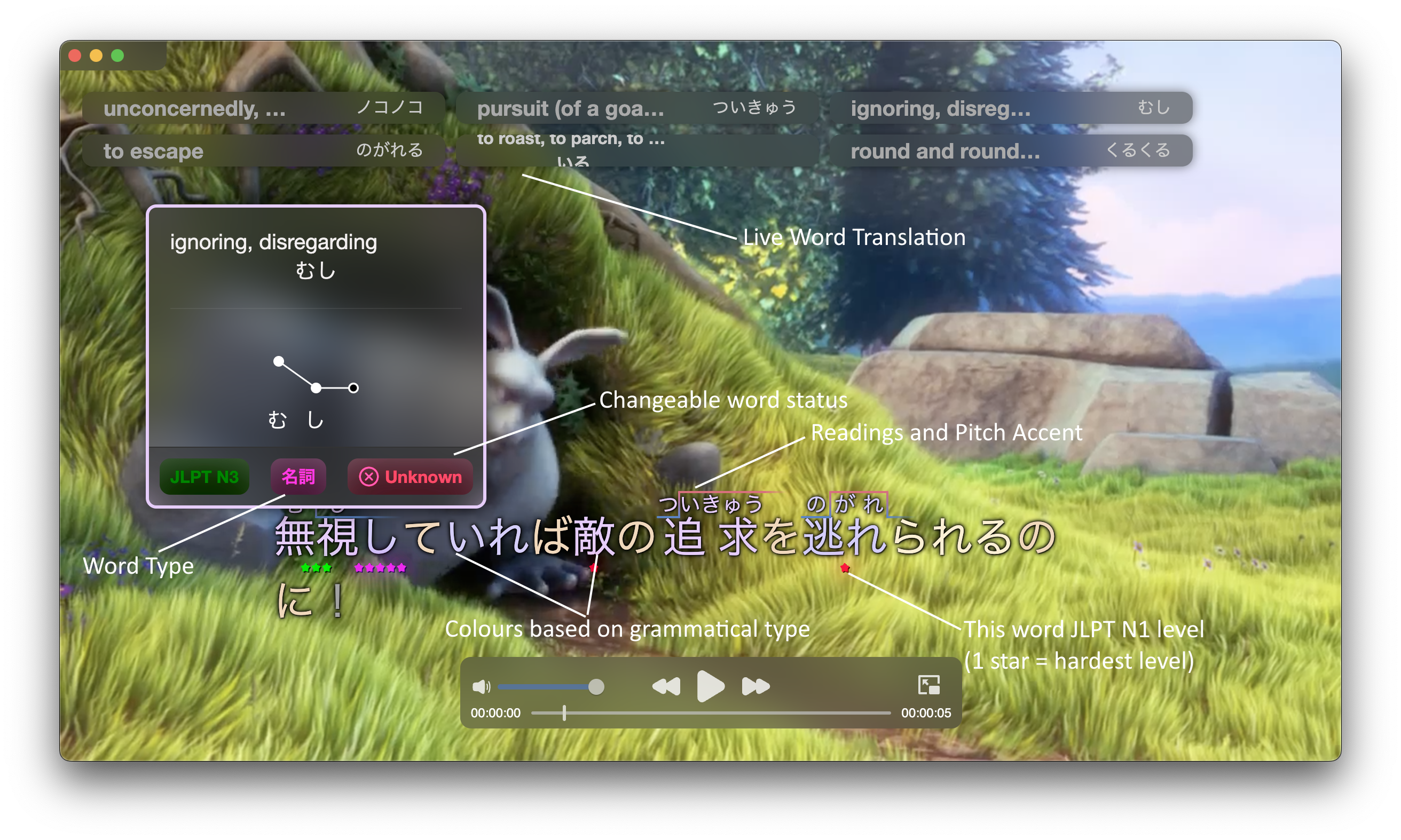
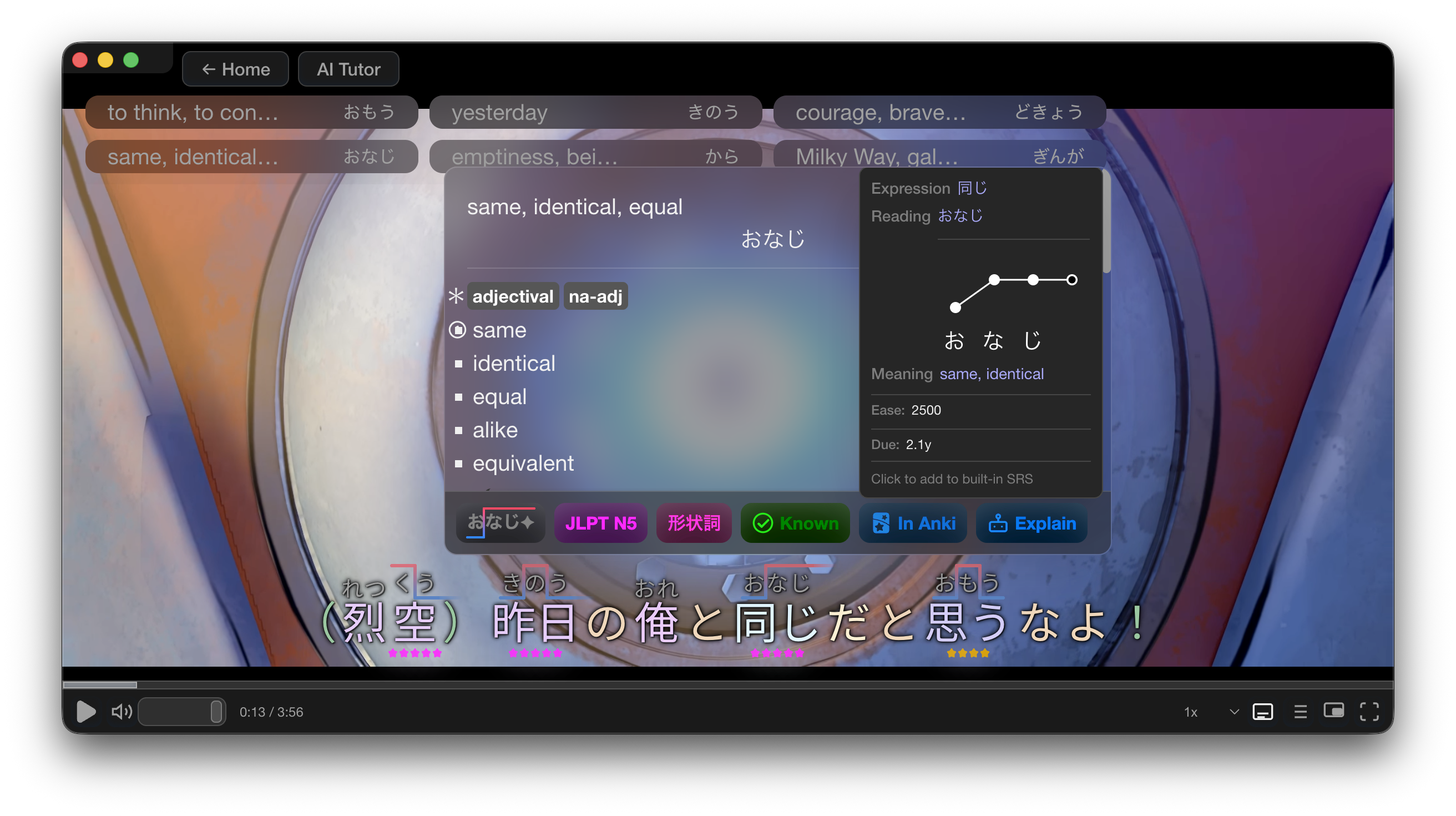
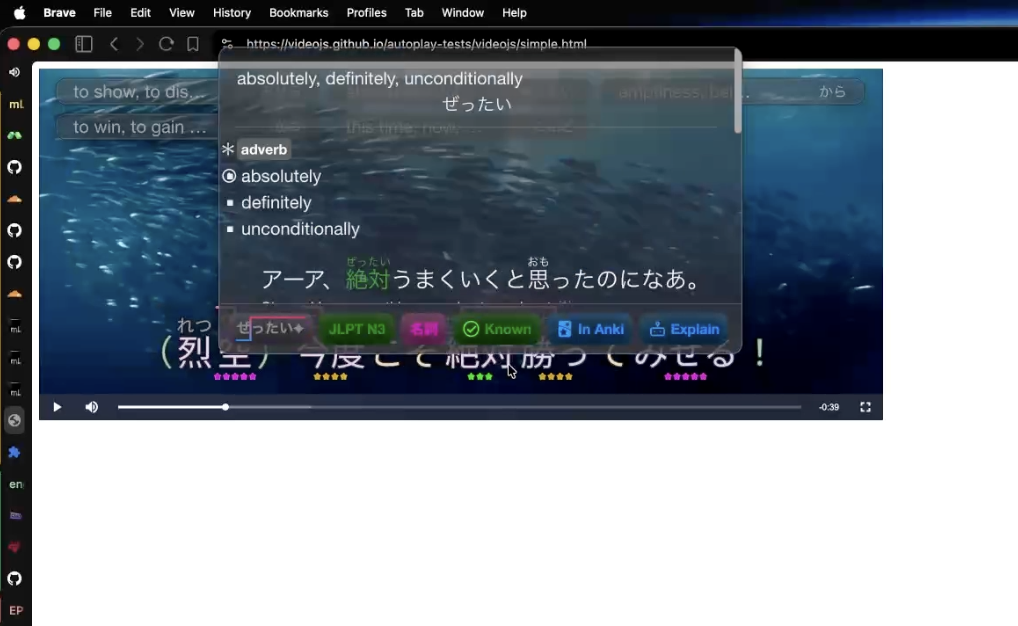
| Video Immersion | Drag & drop videos or stream URLs (.m3u8, .mp4). Color-coded subtitle overlay with instant word lookup. One-click flashcard creation with video screenshots. |
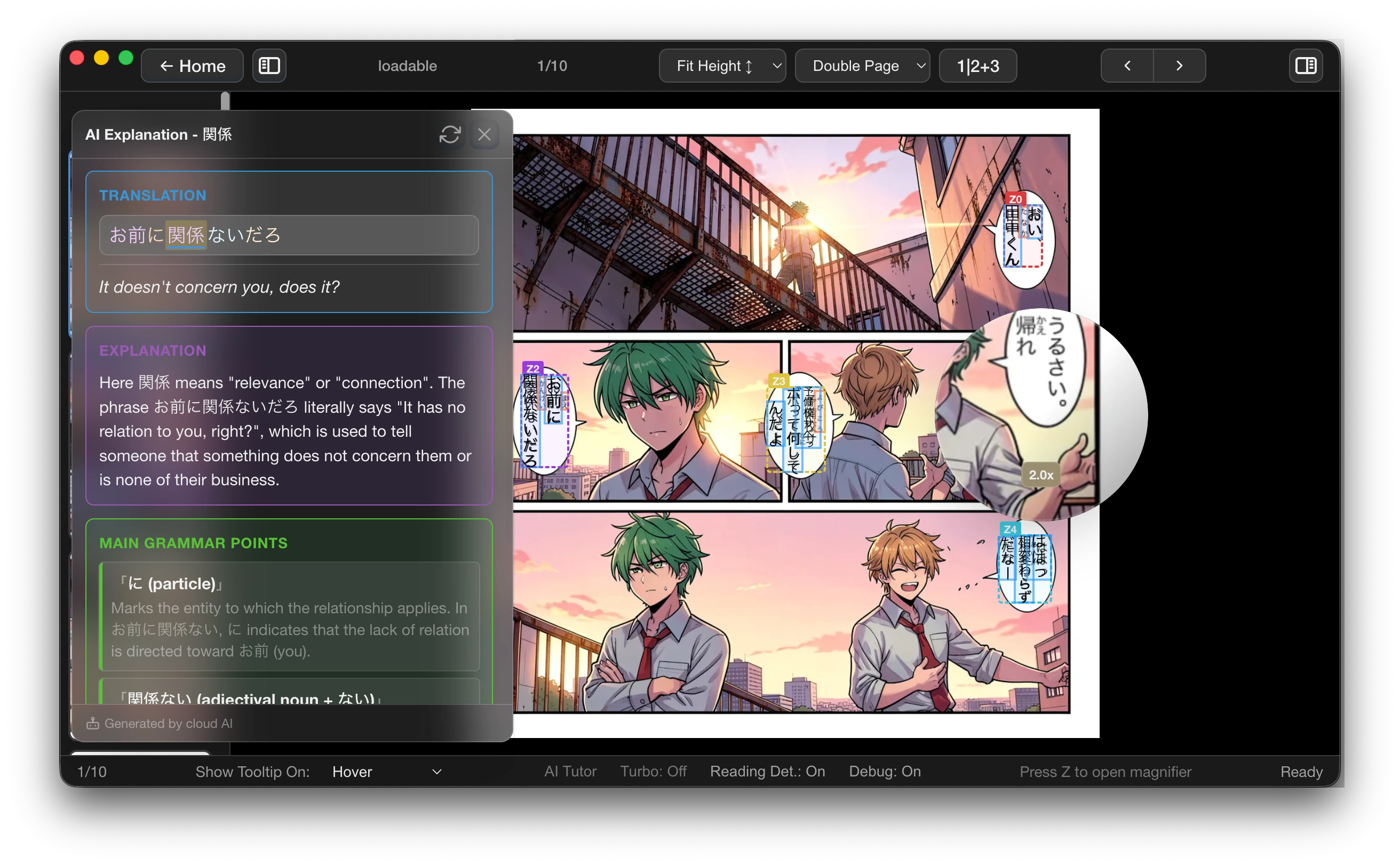
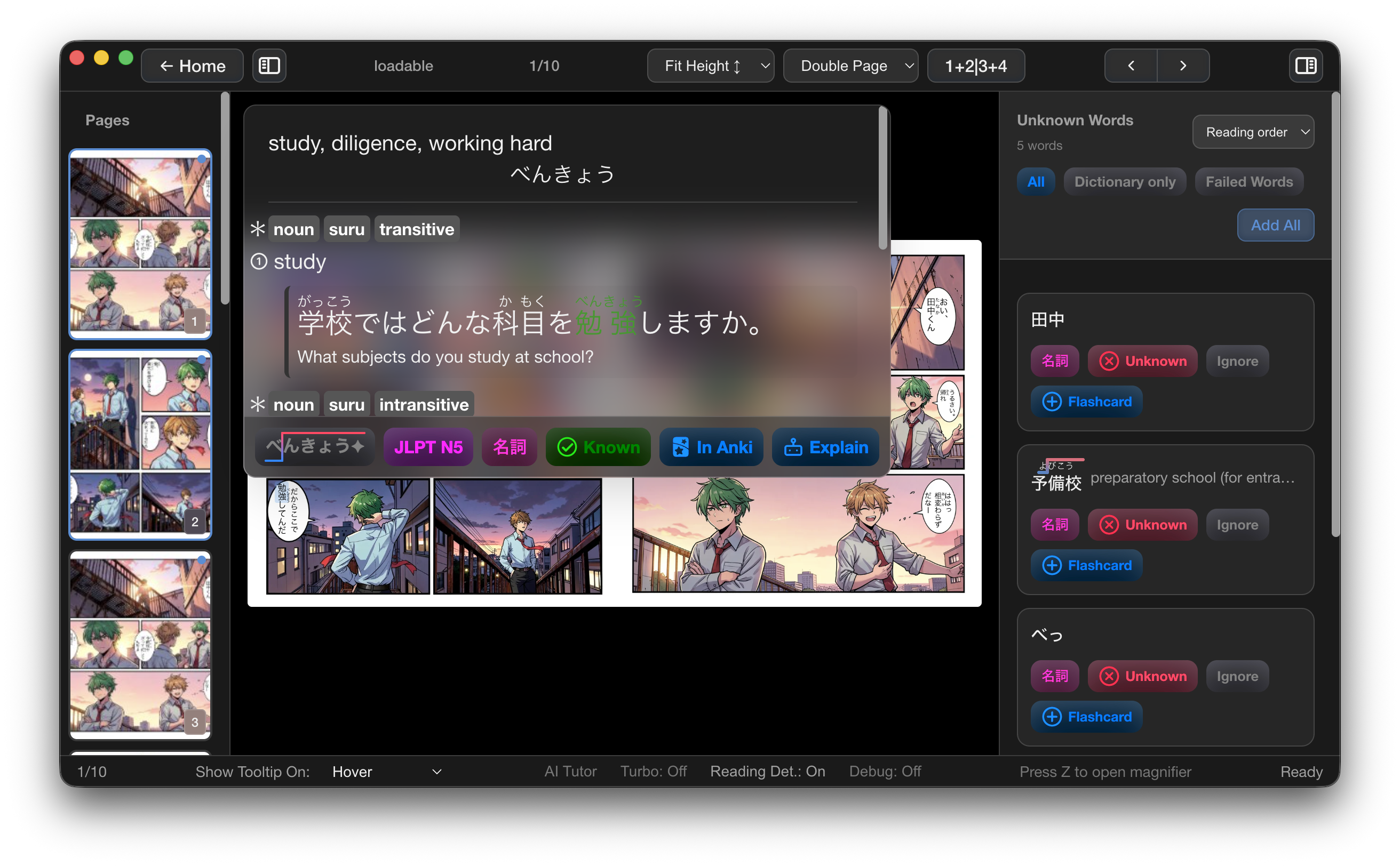
| Reader / OCR | Open image folders or PDFs with real-time OCR (RapidOCR, PaddleOCR, MangaOCR). Click any text for instant lookup. Double-page spread mode, furigana toggle, magnifying glass. |
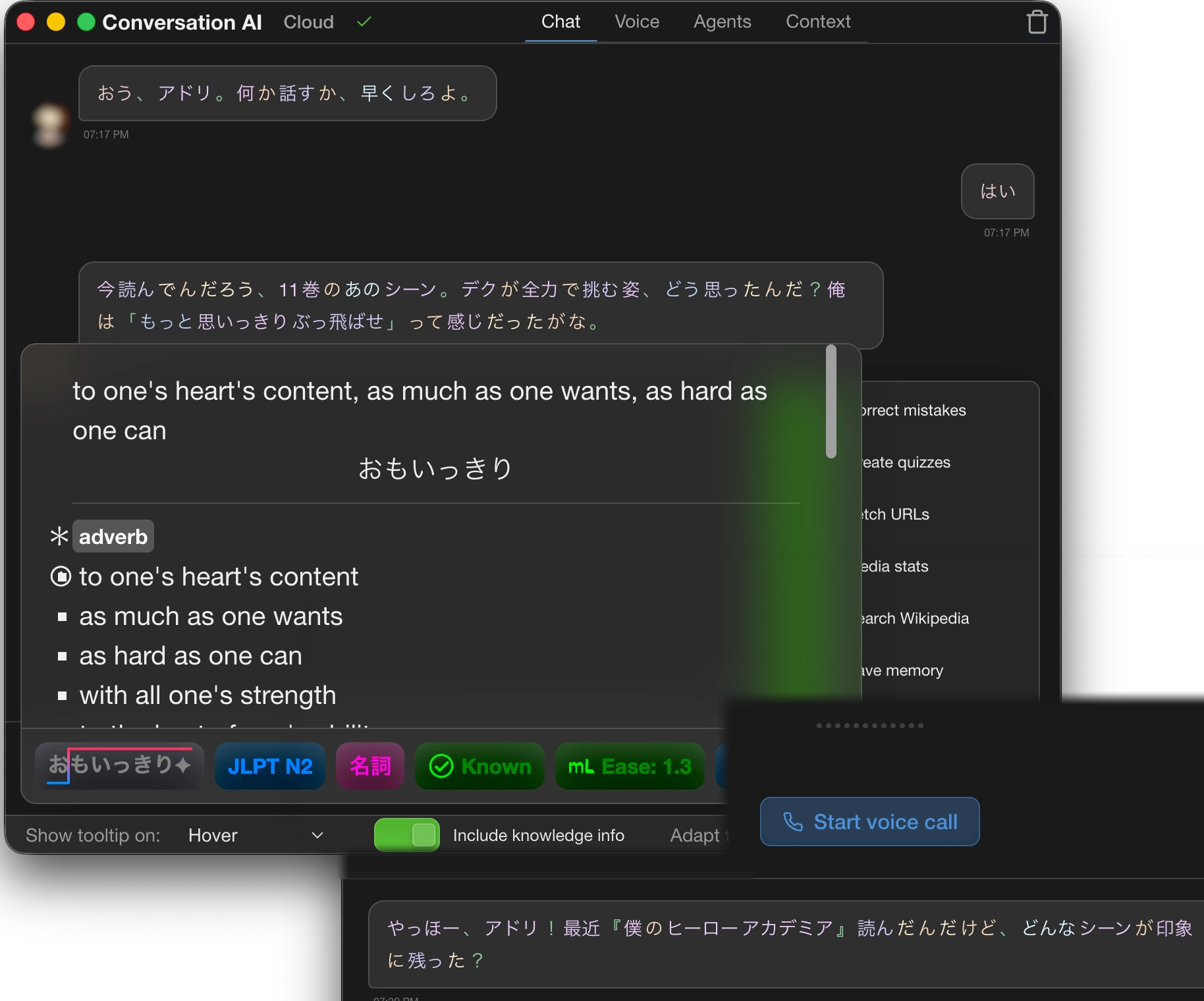
| AI Conversation Agent | Full AI tutor with voice chat. Built-in Qwen3-4B (runs offline), Ollama, or Cloud LLM. Corrects mistakes, creates quizzes, adapts to your level. |
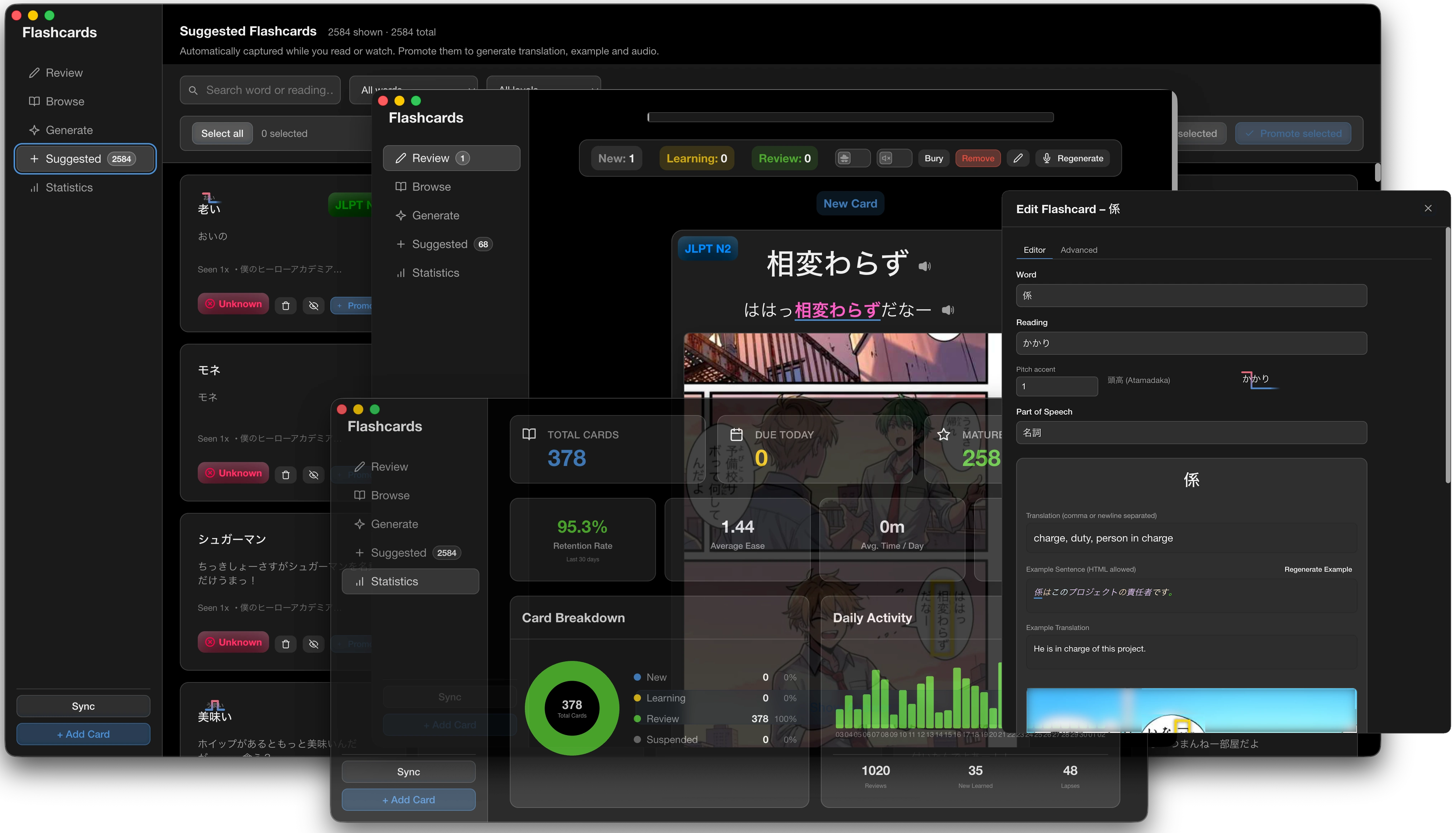
| SRS Flashcards | Anki-like spaced repetition with 5 tabs: Review, Browse, Generate, Suggested, Statistics. Bulk TTS generation, LLM example sentences, pitch accent display. |
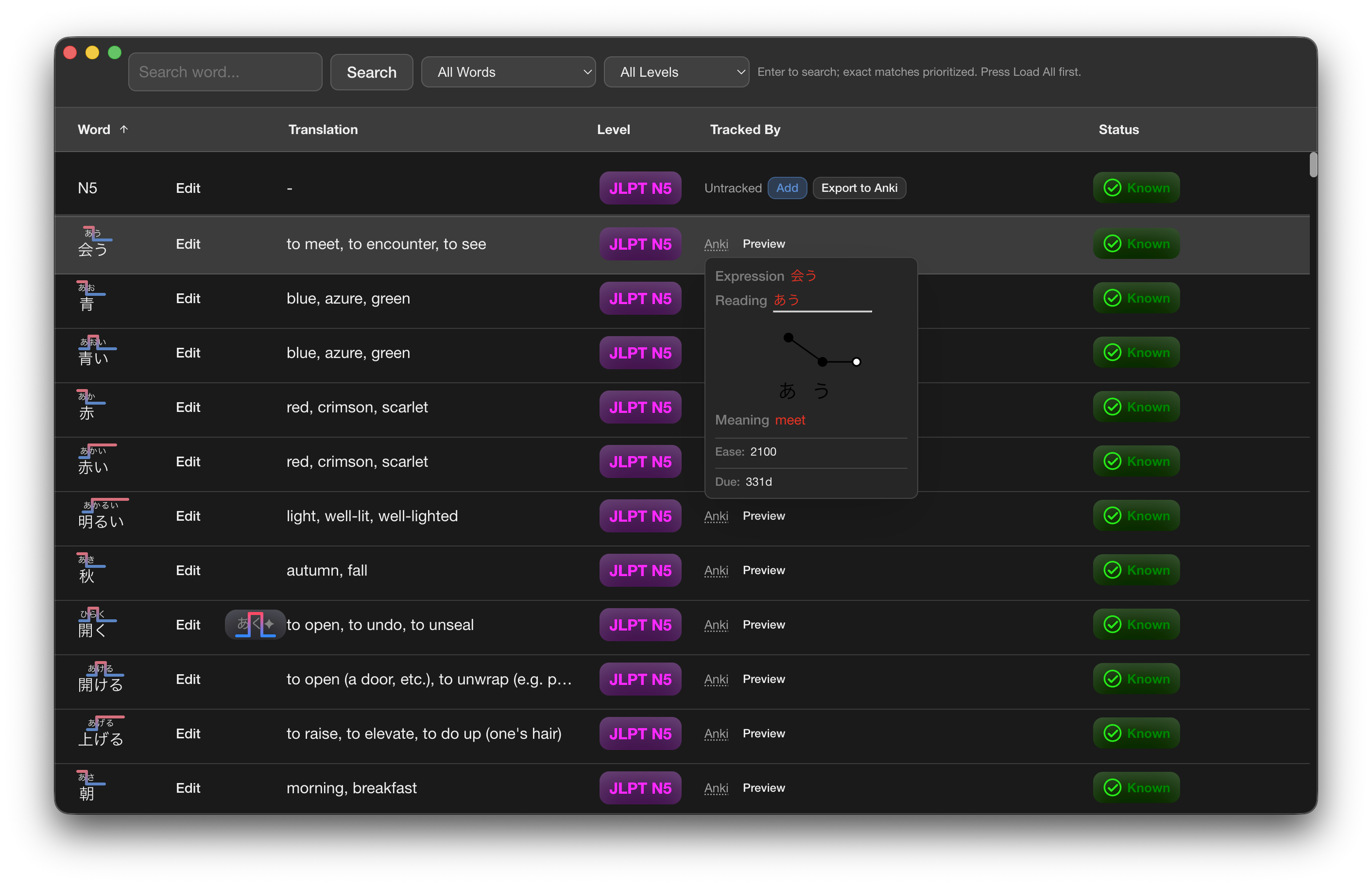
| Word Passive Tracking | Auto-tracks every word you see/hover across all media. Failed words feed into your SRS queue automatically. |
| Word Sync | Intelligent vocabulary assessment with kanji-boosted weighted sampling. Efficiently tests what you actually don't know. |
| Feature | Description |
|---|---|
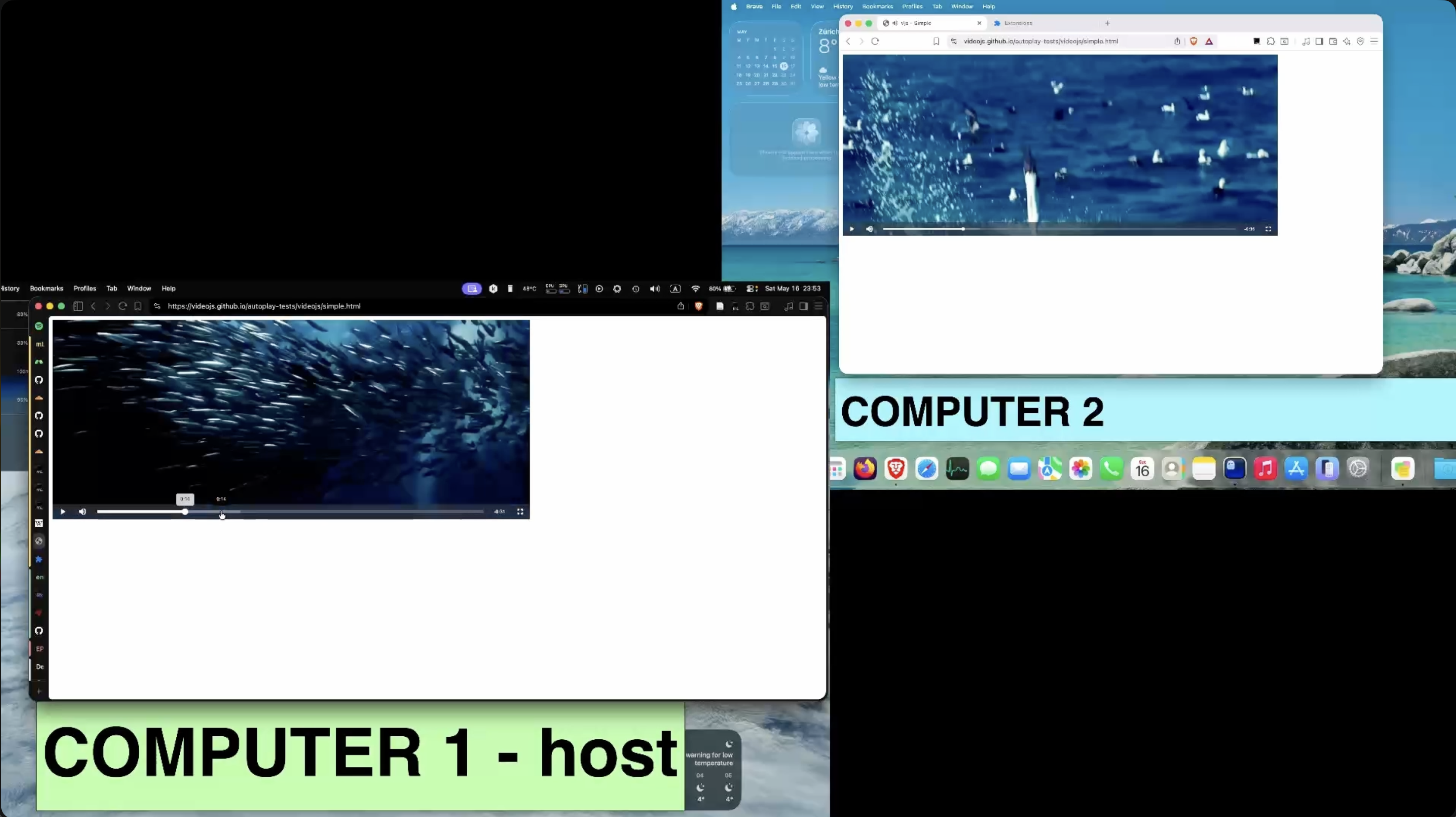
| Watch Together | Sync video playback across devices. Local network or cloud rooms with cloud-synced playback. |
| Between-Devices Sync | Desktop ↔ Mobile sync via tethered mode (local network) or cloud. Bidirectional settings + flashcard sync. |
| Cloud Flashcard Sync | Share flashcards instantly via QR code through the cloud. |
| Feature | Description |
|---|---|
| Text-to-Speech | Kokoro (82M), Qwen3-TTS (1.7B), System TTS, or remote. Voice cloning with custom samples. |
| Speech-to-Text | Whisper-small via faster-whisper with Silero VAD. Voice activity detection or push-to-talk modes. |
| LLM Word Explainer | Instant AI explanations for any word with 500-entry cache. |
| Bulk AI Generation | Generate example sentences and audio for hundreds of cards at once. |
| Feature | Description |
|---|---|
| Video Overlay | Transparent always-on-top subtitle window for any video player. Syncs with the browser extension for streaming sites. Auto-positioning, geometry locking, drag & drop subtitles. |
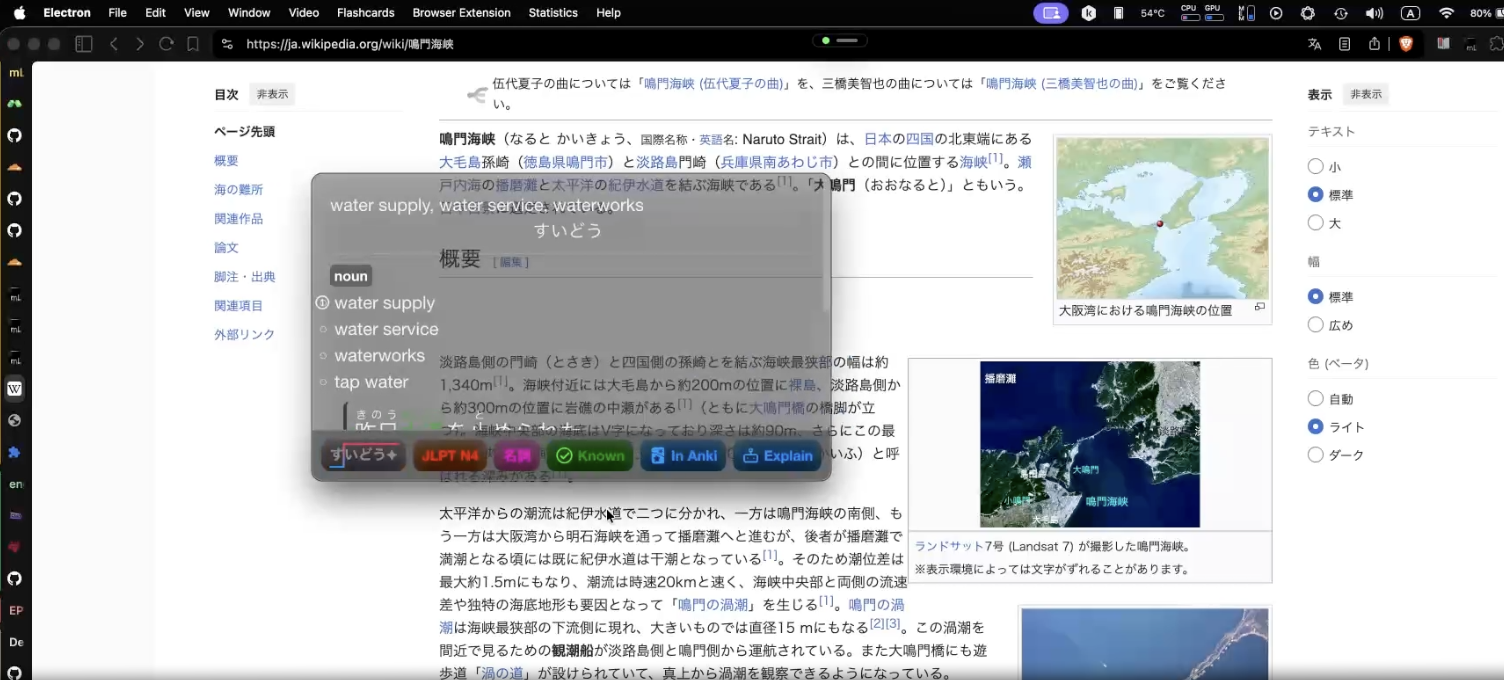
| Text Overlay | Full-screen overlay for web browsing. Click any text on a webpage to look up words instantly without leaving the page. |
| Browser Extension | Chrome/Firefox extension that brings mLearn's subtitle overlay to any streaming website. |
| Statistics Dashboard | Heatmaps, streaks, immersion tracking, review activity, level breakdowns, word acquisition analytics. |
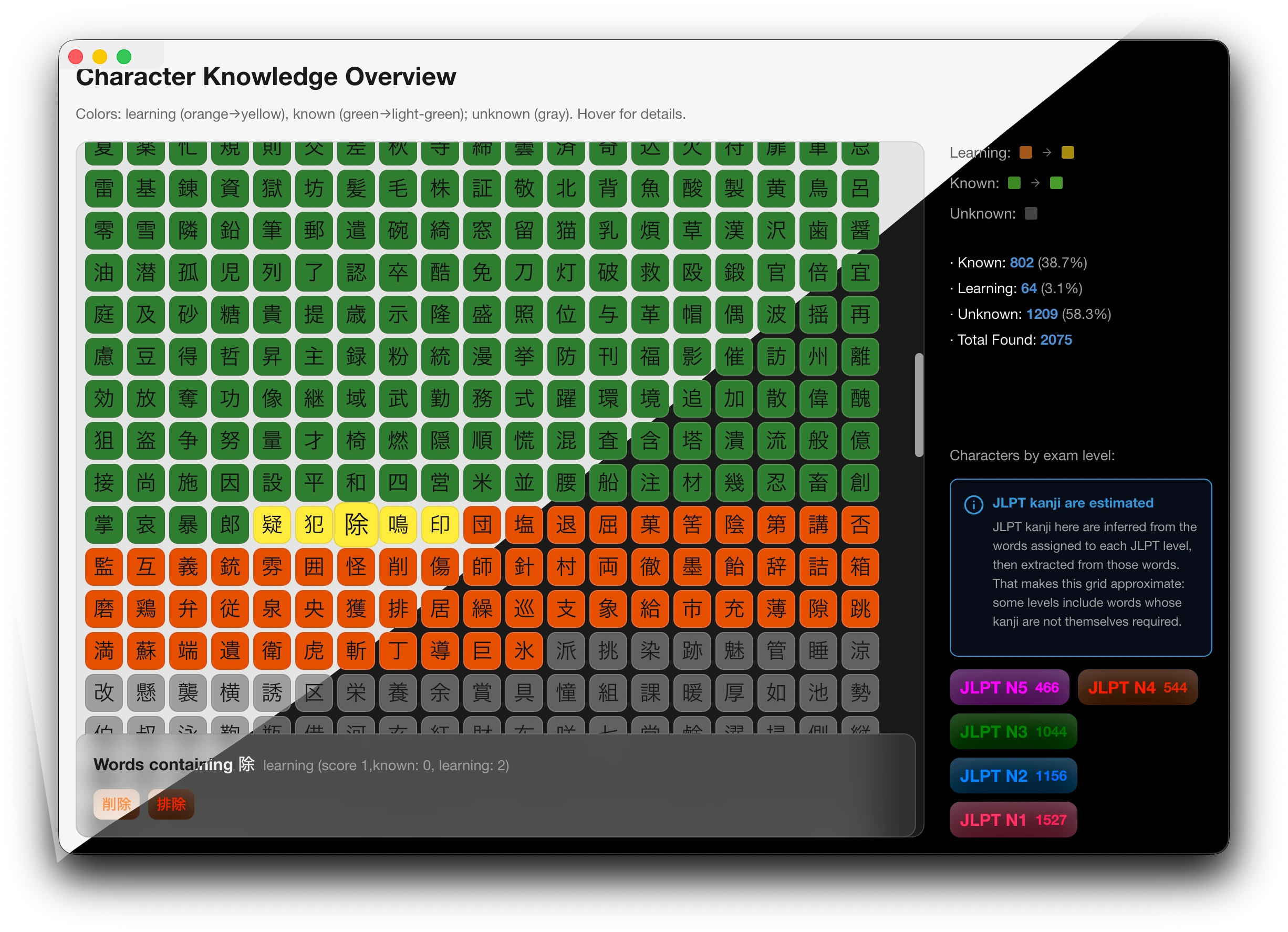
| Kanji Grid | Visual knowledge map of all kanji colored by status with level filtering. |
| 7 Themes | Light, Dark, Darker, Light High Contrast, Dark High Contrast, Glass Light, Glass Dark. |
| Plugin System | Extensible plugin architecture for custom learning tools. |
| Feature | Description |
|---|---|
| iOS & Android | 🚧 Coming Soon. Full mobile app via Capacitor. Reuses desktop routes with mobile-optimized layout. Tethered mode connects to desktop backend. |
| Flashcards PWA | ✅ mlearn-app.kikan.net — Progressive Web App for flashcard review. Syncs with desktop via cloud or tethered mode. Use it on any device with a browser while waiting for native apps. Source |
v2.0 is a complete rewrite in TypeScript + SolidJS with major new capabilities:
- AI Conversation Agent — Full AI tutor with voice chat, tool calling, and memory
- OCR Reader — Manga/comic/PDF reader with 3 OCR engines
- Statistics Dashboard — Comprehensive analytics with heatmaps and immersion tracking
- Watch Together — Synced video watching with cloud playback sync
- TTS / Voice — Kokoro, Qwen3-TTS, voice cloning
- STT / Speech Recognition — Whisper-based voice input
- Browser Extension — Chrome/Firefox extension for streaming sites
- Video Overlay — Always-on-top synced subtitles for any video player
- Text Overlay — Click-to-lookup word overlay for web browsing
- Between-Devices Sync — Mobile ↔ Desktop sync
- Cloud Backend — Remote server support in addition to local/tethered
- Word Passive Tracking — Auto-tracks word encounters across all media
- Word Sync — Smart vocabulary assessment with kanji-boosted sampling
- Flashcards PWA — mlearn-app.kikan.net for flashcard review on any device with sync (source)
- Mobile App — iOS/Android via Capacitor (coming soon)
- Plugin System — Extensible plugin host architecture
- Kanji Grid — Visual kanji knowledge map
- 7 Themes — Including glass themes
- Bulk AI Generation — Bulk TTS + example generation
- Video Clipping — Auto-clip video segments for flashcards
| Platform | Status |
|---|---|
| macOS (Apple Silicon) | ✅ Fully supported |
| macOS (Intel) | ✅ Fully supported |
| Linux (x86_64) | ✅ Fully supported |
| Windows (x86_64) | ✅ Fully supported |
| iOS | 🚧 Coming Soon — Get notified |
| Android | 🚧 Coming Soon — Get notified |
| Web (Flashcards PWA) | ✅ mlearn-app.kikan.net — sync your flashcards and review on any device (source) |
| Browser Extension | ✅ Chrome / Firefox |
| Layer | Technology |
|---|---|
| Frontend | SolidJS (signals-based reactivity), TypeScript |
| Desktop | Electron 41, multi-window architecture |
| Mobile | Capacitor 8 (iOS/Android) |
| Backend | Python FastAPI (port 7752) |
| Build | Vite 6 with custom multi-page config |
| Testing | Vitest with coverage |
| Styling | CSS per component, 7-theme system |
Get the latest release from the Releases page.
# Clone the repository
git clone https://github.com/adrianvla/mLearn.git
cd mLearn

# Install dependencies
npm install

# Language data and dictionaries are downloaded on demand from the configured catalog.
# See "How to Add Your Own Language" for the catalog contract.

# Development mode (Vite + Electron)
npm run dev

# Or start the mobile dev server
npm run dev:mobile# macOS
npm run dist:mac
# Windows
npm run dist:win
# Linux
npm run dist:linux
# All platforms
npm run distRenderer (SolidJS) → getBridge() → Electron IPC | Capacitor local storage
→ getBackend() → Python Backend (port 7752, HTTP)
Electron Main → Web Server (port 7753, tethered mode)
The app uses platform abstraction layers so the same renderer code works across Electron, Capacitor, and web:
getBridge()— PlatformBridge for IPC/storage (16 sub-interfaces)getBackend()— BackendAdapter for Python API calls (local / tethered / cloud modes)getPlatform()—'electron' | 'capacitor' | 'web'
15 Desktop Windows (each a separate Vite entry): Main, Welcome, Video, Reader, Flashcards, Conversation Agent, Statistics, Settings, Kanji Grid, Word Definition, Word DB Editor, Word Sync, Connect QR, Plugin Host, Licenses, Overlay
Mobile (in development): Single mobile.html with HashRouter, reuses desktop routes wrapped in MobileLayout + BottomTabBar.
Languages are installed at runtime from a language catalog. The app does not require language modules, dictionaries, or frequency files to be bundled in this repository.
The default catalog URL is:
https://mlearn.kikan.net/language-catalog.json
Users and developers can point the app at a different compatible catalog in Settings → Connection → Language Catalog URL. Internally this is the languageCatalogUrl setting.
A catalog is only an index. It tells the app which language archives and dictionary archives are available, where to download them, and which checksums to verify. Runtime behavior comes from the files installed from those archives into the user's language-data/ directory.
The catalog is a JSON file with a top-level languages object. Each language has a core language package plus optional dictionary packs keyed by definition language:
{
  "schemaVersion": 1,
  "generatedAt": "2026-07-06T00:00:00.000Z",
  "languages": {
    "example": {
      "name": "Example Language",
      "nameTranslated": "Example",
      "version": "example-package-2026.07.06",
      "minimumAppVersion": "2.7.0",
      "bundle": {
        "url": "https://example.com/language-data/v1/example/language-package-2026.07.06.tar.gz",
        "sizeBytes": 123456,
        "sha256": "..."
      },
      "files": [
        {
          "id": "language-metadata",
          "path": "languages/example.json",
          "required": true
        }
      ],
      "dictionaryPacks": {
        "en": {
          "targetLanguage": "en",
          "name": "English",
          "version": "example-en-dictionary-2026.07.06",
          "bundle": {
            "url": "https://example.com/language-data/v1/example-en/dictionary-2026.07.06.tar.gz",
            "sizeBytes": 123456,
            "sha256": "..."
          },
          "assets": [
            {
              "id": "dictionary-en",
              "path": "dictionaries/example/en/dictionary.db",
              "required": true
            }
          ]
        }
      }
    }
  }
}
bundle.url may also be written as a relative href; relative links are resolved against the catalog URL. Archive paths must be safe relative paths, and archive contents are extracted under files/.
minimumAppVersion is optional. When present, it must be a semantic major.minor.patch version. Clients compare it numerically, including normal prerelease ordering, and keep incompatible language packages visible but unavailable for installation. Catalog entries without it remain compatible with older clients.
Core language packages and dictionary packs should install into stable, language-grouped paths:
languages/<code>.json
languages/<code>.freq.json
dictionaries/<code>/<target>/dictionary.db
dictionaries/<code>/<target>/metadata.json
models/<code>/...
adapters/<code>_adapter.py
Dictionary packs are separate from the core language package so users can install only the definition languages they need. A user can install multiple dictionary packs for the same learning language, such as ja -> en, ja -> fr, and ja -> de.
The installed languages/<code>.json file is the language contract. It tells the app how to tokenize, normalize, display, OCR, look up, and study the language. Prefer metadata-driven building blocks over hardcoded app behavior.
{
  "name": "Example Language",
  "name_translated": "Example",
  "colour_codes": {
    "NOUN": "#ebccfd",
    "VERB": "#ffefd1"
  },
  "translatable": ["NOUN", "VERB"],
  "frequencyLevels": {
    "names": { "1": "A1", "2": "A2" },
    "displayOrder": "ascending",
    "difficulty": "higher-is-harder"
  },
  "textProcessing": {
    "scriptProfile": {
      "acceptedScripts": ["Latn"],
      "wordScriptValidation": "contains-required"
    },
    "lexemeNormalization": {
      "surface": [{ "type": "case-fold" }]
    },
    "readingAnnotation": {
      "enabled": false
    },
    "partOfSpeech": {
      "translatable": ["NOUN", "VERB"],
      "colors": {
        "NOUN": "#ebccfd",
        "VERB": "#ffefd1"
      }
    },
    "tokenJoinSeparator": " "
  },
  "runtime": {
    "nlp": {
      "tokenizer": {
        "type": "unicode-word",
        "capabilities": ["segments"],
        "fallback": "unicode-word"
      },
      "dictionary": {
        "type": "sqlite-zlib-json",
        "schema": "simple-headword-zlib-json",
        "targetPathTemplate": "dictionaries/{language}/{target}/dictionary.db",
        "metadataPath": "dictionaries/example/en/metadata.json",
        "renderer": "simple-glosses"
      }
    }
  },
  "languageData": {
    "version": "example-package-2026.07.06",
    "assets": [
      {
        "id": "language-metadata",
        "path": "languages/example.json",
        "required": true
      },
      {
        "id": "frequency",
        "path": "languages/example.freq.json",
        "required": true
      }
    ],
    "dictionaryPacks": {
      "en": {
        "targetLanguage": "en",
        "name": "English",
        "version": "example-en-dictionary-2026.07.06",
        "assets": [
          {
            "id": "dictionary-en",
            "path": "dictionaries/example/en/dictionary.db",
            "required": true
          },
          {
            "id": "metadata-en",
            "path": "dictionaries/example/en/metadata.json",
            "required": true
          }
        ]
      }
    }
  }
}
The most important metadata areas are:
runtime.nlp.tokenizer— declares how trusted tokenization works. Use a generic tokenizer when possible; only add a Python adapter when metadata cannot express the behavior.runtime.nlp.dictionary— declares the installed dictionary DB schema and lookup paths.textProcessing.scriptProfile— tells the app what scripts count as words for Reader, OCR, subtitles, STT, and filtering.textProcessing.lexemeNormalization— maps inflected/variant forms to dictionary lookup candidates.textProcessing.readingAnnotation— enables ruby/furigana-style readings only for languages that actually need them.textProcessing.partOfSpeechandcolour_codes— define POS aliases, translatable tags, and display colors.frequencyLevelsandgrammarLevels— define labels and ordering. The UI derivesvisualLevelfrom this metadata instead of assuming JLPT.prosody— optional. Use this only when the language has accent/stress/tone data that should be rendered in word/flashcard surfaces.languageData.dictionaryPacks— one dictionary package per definition language, e.g.ja -> en,ja -> fr,de -> en.
Most languages should use src/root-of-app/generic_language.py through metadata. If a language needs behavior that cannot be described with metadata, include an adapter in the package and opt in explicitly:
{
  "runtime": {
    "nlp": {
      "adapter": {
        "type": "python-module",
        "path": "adapters/example_adapter.py"
      }
    }
  }
}
Do not publish languages/<code>.py as a convention or fallback. Undeclared adapter files are ignored.
Any static host, CDN, or API can serve a compatible catalog and archives. The first-party mLearn deployment uses the separate mlearn-website repository to build dictionaries, package archives, upload assets, and deploy the catalog:
npm run build:dictionaries
npm run package:language-data
npm run test:language-data
npm run deploy:language-data
Those commands are implementation details of the first-party catalog, not requirements for third-party catalogs. A third-party catalog only needs to publish the JSON shape above and serve the referenced archives.
After publishing a catalog or running one locally:
- Open Settings or the welcome window.
- Set Language Catalog URL to the catalog JSON URL.
- Select the learning language.
- Select the dictionary definition language.
- Install language data.
- Smoke-test tokenization, dictionary lookup, Reader/OCR, subtitles, flashcards, Word Sync, and Level Study.
If the app needs a new generic capability for a language, add it to the shared language metadata schema and consume it through src/shared/languageFeatures.ts; do not hardcode a language branch in renderer or Electron code.
mLearn currently publishes Japanese and German packages in the default catalog. More languages can be added by publishing package metadata and assets to a compatible catalog.
Yes. Installed language packages and dictionary packs work offline after download. Features that depend on cloud AI, online video sources, or an unavailable runtime component still need the relevant service/component.
Yes. Flashcards are built into mLearn.
mLearn is free to use and source-available. It is licensed under the Sustainable Use License v1.0.
Why source-available? This project represents thousands of hours of work (around ~1.5 years of development at the time of writing this) across NLP pipelines, OCR engines, AI tutoring systems, and multi-platform architecture. The Sustainable Use License keeps the code transparent and accessible for personal use and non-commercial sharing, while protecting against resale or exploitation — so the app can remain free for learners without being stripped for parts.
Paste a link to a streaming playlist (e.g., ending in .m3u8 or .mp4) into the video player, or drag & drop a local video file.
Drag & drop subtitle files (.srt, .vtt, .ass) onto the video player or overlay window.
Video Overlay — Open it from the video player's context menu or via the browser extension. It's a transparent, always-on-top window that syncs with the video and lets you look up words without leaving your content.
Text Overlay — Activate text mode from the browser extension or overlay controls. The window becomes fullscreen and click-through: click any text on a webpage to get an instant word lookup popup.
Downloaded language data is stored in the user's application data directory under language-data/. Replacing the app binary does not remove installed language packages or dictionaries.
Build it with npm run build:extension, then load the extension/dist/ folder as an unpacked extension in Chrome/Edge/Firefox. It will communicate with the running mLearn desktop app.
Please open a GitHub issue.
npm run dev           # Vite (3000) + Electron concurrent
npm run typecheck     # CRITICAL: both tsconfigs before commit
npm run build         # Production build
npm run test          # Vitest (all 3 projects)
npm run test:coverage # Vitest with coverage
npm run dev:mobile    # Capacitor watch mode
npm run build:mobile  # Capacitor build → dist-mobile/
npm run build:extension # Build browser extensionsrc/
├── electron/ # Main process (CommonJS). IPC, window management, services
├── renderer/ # SolidJS UI. Components, windows, hooks, contexts
├── shared/ # Types, constants, platform bridges/backends
├── root-of-app/ # Python FastAPI backend. NLP, translation, OCR, TTS
└── html/ # Electron window entries + mobile.html
extension/ # Chrome/Firefox browser extension
android/, ios/ # Capacitor native projects
examples/plugins/ # Plugin templates
npm run typecheck— validates both tsconfigs- New IPC → add to
IPC_CHANNELS, implement in both bridges - Settings changes → update
Settingsinterface +DEFAULT_SETTINGS - New renderer code → use
getBridge()/getBackend(), never direct IPC
- End User License Agreement: EULA.md
- Terms of Service: TERMS_OF_SERVICE.md
- Privacy Policy: PRIVACY_POLICY.md
- School Deployment Guide: SCHOOL_DEPLOYMENT.md
Web versions of these documents are available at mlearn.kikan.net.
This software is licensed under the Sustainable Use License v1.0. See the LICENSE file for the full text.
Copyright (C) 2024-2026 Adrian Vlasov

Sustainable Use License — Version 1.0

By using the software, you agree to all of the terms and conditions below.

The licensor grants you a non-exclusive, royalty-free, worldwide,
non-sublicensable, non-transferable license to use, copy,
distribute, make available, and prepare derivative works of
the software, in each case subject to the limitations below.

You may use or modify the software only for your own internal
business purposes or for non-commercial or personal use. You
may distribute the software or provide it to others only if
you do so free of charge for non-commercial purposes.
Additional licenses for third-party libraries may be found in the Settings → About section of the app.
Made with ❤