


cip30-test-wallet reproduces real Cardano wallet failures in automated browser tests, with no node, faucet, extension, or shared chain state.
It injects a CIP-30 test wallet into the page under test. The wallet holds real keys, returns real UTxO CBOR, signs real transaction CBOR with a real Ed25519 signature, and records every call in a journal your test can read. A catalogue of quirks reproduces the failures that only show up on a user's machine: a wallet on the wrong network, a wallet that injects late, a user who declines or never answers.
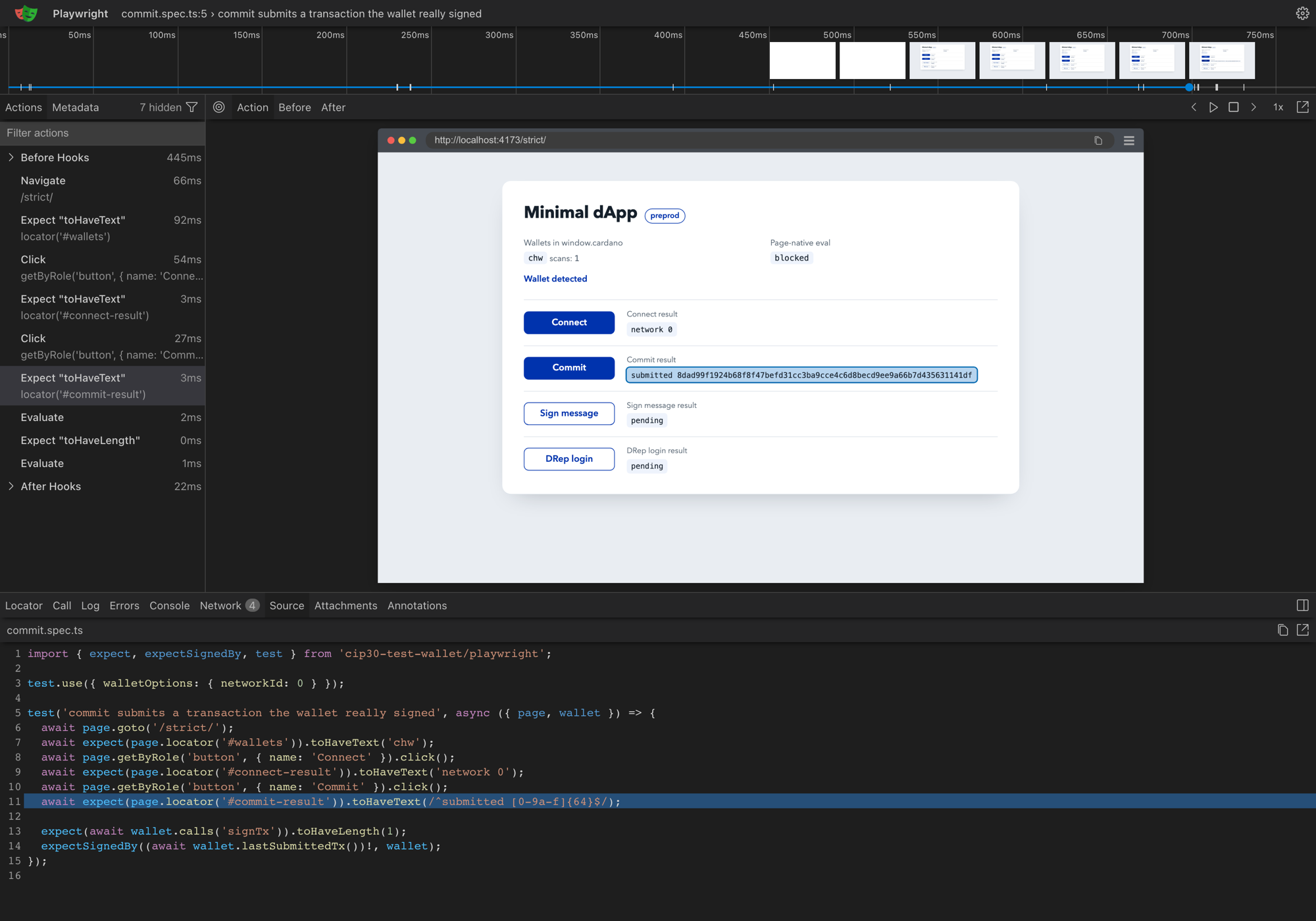
A Playwright test in the trace viewer. The wallet is detected, connects on preprod and signs the commit transaction without a popup, and expectSignedBy proves the submitted transaction carries its signature.
Status: 0.x. The signing core, the Playwright fixture and the doctor command are covered by unit tests and by browser tests in Chromium, Firefox and WebKit, and they run in the end-to-end suites of real dApps. Until 1.0 a minor release can still change the API, the notes of each GitHub release say what changed.
Coding agents start with AGENTS.md.
- A CIP-30 provider for the page:
apiVersion,name,icon,supportedExtensions,enable,isEnabled, and the api methodsgetNetworkId,getUtxos(withamountandpaginate),getBalance(with native assets),getCollateral,experimental.getCollateral,getUsedAddresses,getUnusedAddresses,getChangeAddress,getRewardAddresses,getExtensions,signTx,submitTx,signData. - The
cip95namespace:getPubDRepKey,getRegisteredPubStakeKeys,getUnregisteredPubStakeKeys,signData. - A Playwright fixture:
test.use({ walletOptions })configures the wallet,walletin the test reads the journal and flips quirks at runtime. expectSignedBy(txHex, wallet, { roles? }): proves the transaction your dApp submitted really carries the wallet's signature (payment by default, optionally stake and DRep) over its body hash. RecordingsubmitTxalone proves nothing.expectSignedData(result, expected): proves asignDataorcip95.signDataresult the way a careful verifier does, checking the COSE signature, key and address.- The quirk catalogue in
quirks/, a provenance note for every switch. doctor: a command line check of a deployed dApp for the secure-context and content-security-policy traps, with a browser mode that measures wallet detection.
signData follows CIP-30 and CIP-8 byte for byte with Emurgo's message-signing library: payment key for base, pointer and enterprise addresses, stake key for reward addresses. CIP-95 is announced by default: getPubDRepKey, the registered and unregistered stake keys, and cip95.signData with the bare DRep ID or a type 6 address. signTx signs Conway governance transactions: stake and vote delegation certificates with the stake key, DRep registration, update and retirement and DRep votes with the DRep key. Pool and committee certificates are never witnessed by the wallet, as CIP-95 requires. Pre-Conway certificates are refused with TxSignError DeprecatedCertificate (3).
This release is a CIP-30 subset for transaction tests plus CIP-95, including governance and script transactions. Every transaction form outside the supported set below is missing on purpose and may come in a later release. submitTx is simulated: it records the transaction, applies it to the wallet's UTxOs and stake registration, and returns its id. It never talks to a node. Fees, balance, witnesses and certificates are checked only with walletOptions.ledger: { checks: true }, see Ledger checks. Plutus scripts are never run.
You have a dApp with a wallet connect and want its wallet flows under test. Each step below stands on its own, stop wherever the coverage is enough.
npm install --save-dev cip30-test-wallet @playwright/test
npx playwright install chromium
// playwright.config.ts
import { defineConfig } from '@playwright/test';
export default defineConfig({
testDir: 'tests',
use: { baseURL: 'http://localhost:5173' },
webServer: { command: 'npm run dev', url: 'http://localhost:5173', reuseExistingServer: !process.env.CI },
});Use your dev server's command and port. A deployed URL works as baseURL too, without webServer.
// tests/connect.spec.ts
import { test, expect } from 'cip30-test-wallet/playwright';

test.use({ walletOptions: { name: 'eternl', networkId: 0 } });

test('connects to the wallet', async ({ page, wallet }) => {
  await page.goto('/');
  await page.getByRole('button', { name: 'Connect' }).click();
  await expect(page.getByText('Connected')).toBeVisible(); // whatever your app shows after a connect

  expect(await wallet.calls('enable')).toHaveLength(1);
});
Import test and expect from cip30-test-wallet/playwright, not from @playwright/test. name is the key under window.cardano. Use one your dApp lists, many dApps only offer wallets they know. networkId is 0 for a testnet dApp and 1 for mainnet. This test needs no chain, no funds and no transaction builder.
The failures users report and nobody can reproduce on a developer machine. Each is one line of walletOptions:
test.use({ walletOptions: { networkId: 1 } });                        // wallet on mainnet, your dApp expects preprod
test.use({ walletOptions: { quirks: { enableRejected: true } } });    // the user declines the connection
test.use({ walletOptions: { quirks: { lateInjection: 1500 } } });     // the wallet appears after 1.5 seconds
test.use({ walletOptions: { quirks: { signRejected: true } } });      // the user declines the signature
test.use({ walletOptions: { quirks: { submitFails: true } } });       // the node refuses the transaction
A user who never answers the signing prompt, answered by the test when your assertion is done:
test.use({ walletOptions: { quirks: { signHangs: true } } });
await page.getByRole('button', { name: 'Commit' }).click();
await expect(page.getByText('Waiting for your wallet')).toBeVisible();
await wallet.release('signTx');
Wallet errors are plain { code, info } objects as CIP-30 requires, so a dApp that shows err.message shows nothing. That is the most common bug these tests find. The full list is in User-side failures and the quirk catalogue.
Two questions decide how a transaction test is wired, answer them for your dApp first:
- Where does the builder get its inputs? The wallet's UTxOs exist only in the wallet. A builder connected to the CIP-30 api reads them through
getUtxos()and works. One that looks the address up at an indexer finds nothing. - Who submits? The wallet's
submitTxrecords the transaction, applies it to the wallet's UTxOs and never reaches a chain. A library or backend that submits on its own has to be intercepted withpage.route.
The details and a recipe per library follow in Building and submitting transactions. A test then proves the signature instead of counting calls:
// tests/commit.spec.ts
import { test, expect, expectSignedBy } from 'cip30-test-wallet/playwright';

test.use({ walletOptions: { name: 'eternl', networkId: 0, utxos: [{ lovelace: 10_000_000 }] } });

test('commit writes the expected metadata', async ({ page, wallet }) => {
  await page.goto('/commit');
  await page.getByRole('button', { name: 'Connect' }).click();
  await page.getByRole('button', { name: 'Commit' }).click();
  await expect(page.getByText('Commit submitted')).toBeVisible(); // the click does not wait for signing

  expect(await wallet.calls('signTx')).toHaveLength(1);
  const tx = await wallet.lastSubmittedTx();
  expectSignedBy(tx!, wallet);
});- A dApp that logs in with a signed message becomes testable behind the login, see Pages behind a wallet login.
npx cip30-test-wallet doctor <url>checks the deployed site for the content security policy and detection problems that break wallets in mobile in-app browsers, see doctor.- Let a coding agent run and extend these tests on its own, see CI and coding agents.
The full option and handle reference is in docs/fixture-api.md.
The wallet's UTxOs are synthetic, they exist inside the wallet and on no chain. Three things follow for a dApp under test:
- Build from the wallet's
getUtxos(). Evolution SDK, Mesh and Lucid Evolution do that when they are connected to the CIP-30 api. A builder that looks the address up at a chain indexer finds nothing. - Protocol parameters still come from the network. Serve a recorded answer with
page.routeand the test runs offline. - Nothing reaches a chain.
submitTxonly records the transaction and applies it to the wallet's UTxOs. A library or backend that submits on its own has to be intercepted withpage.route, thenexpectSignedByproves the transaction it would have sent.
Tested, complete recipes in docs/recipes.md:
- By library: Evolution SDK, Mesh, Lucid Evolution, and how to bundle them for a test page
- A backend or provider that submits
- Protocol parameters offline
- User-side failures: declined, hanging, wrong network, late injection
- Reading the journal and signing in with a message
- Testing a wallet module directly on a dev server
- Running inside an agent sandbox: browsers cannot start inside it on macOS
An extension wallet asks for approval in its own popup, usually behind a password, so every connect and every signature needs a human. This wallet answers inside the page. A CI job or a coding agent that drives a browser can connect, sign and submit in one unattended run, with no seed to guard and no funds to lose. The default mnemonic is a public test vector.
Everything the run produces is readable by a program:
- The journal (
wallet.calls()) lists every CIP-30 call with its arguments, result or error. expectSignedByandexpectSignedDatafail with a concrete reason when a signature does not verify.- Wallet errors are CIP-30
{ code, info }objects. Harness problems areChwErrors with a stable code such asCHW_UNSUPPORTED_TX_FORM,CHW_UNRESOLVED_INPUTorCHW_UNRESOLVED_SCRIPTand a hint on what to change. doctor --jsonprints the full report, and the exit code (0 clean, 1 findings, 2 run failed) is enough to gate a pipeline.
So an agent that changes a wallet flow can check its own work: write or extend a Playwright test, run it, read the journal and the assertion output, fix, repeat. A few lines in your project's agent instructions are enough:
Wallet flows are tested with cip30-test-wallet (Playwright fixture, import from `cip30-test-wallet/playwright`).
After changing connect, signing or submit code, run the wallet tests and check `wallet.calls()` and `expectSignedBy`.
Reproduce user-side failures with `walletOptions.quirks` (see node_modules/cip30-test-wallet/quirks/README.md), never with a real wallet.
Before writing a transaction test, read node_modules/cip30-test-wallet/AGENTS.md and node_modules/cip30-test-wallet/docs/recipes.md: the wallet's UTxOs exist only in the wallet, and anything that submits outside the wallet must be intercepted.
Before deploying, run `npx cip30-test-wallet doctor <url> --json` and treat exit code 1 as a failed check.
On macOS, run the browser tests and `doctor --deep` outside the agent sandbox or with escalation, browsers crash at launch inside it.
On macOS, Playwright browsers cannot start inside an agent sandbox such as Codex --sandbox workspace-write. Chromium, Firefox and WebKit all abort at launch because the sandbox blocks the window server, Playwright reports only a closed browser, and every abort opens a crash dialog. The agent has to run browser tests and doctor --deep outside the sandbox or with its escalation. doctor --deep detects the Codex sandbox and stops with that hint instead of launching, see Running inside an agent sandbox.
An agent that browses through Playwright MCP, or any driver that loads a script before the page's own scripts, gets the wallet from a file:
npx cip30-test-wallet init-script --network 0 --out wallet.js{
"mcpServers": {
"playwright": {
"command": "npx",
"args": ["@playwright/mcp@latest", "--isolated", "--init-script", "/absolute/path/to/wallet.js"]
}
}
}Every page the agent opens then has the wallet in window.cardano. The agent reads the journal and controls the wallet with its evaluate tool through window.__chw: journal, setQuirk(name, value), release('signTx') and reject('signTx'). Quirks, UTxOs and a mnemonic from an environment variable go in through --options and --mnemonic-env. Tested with Playwright MCP against the demo dApp under a strict content security policy. Details in docs/init-script.md.
Inside your own Playwright code, without the test runner, attachWallet(page, options) installs the same wallet and returns the wallet handle. It keeps the ledger in Node, like the fixture. Call it before the first navigation, once per page, and never on a page the test fixture already set up:
import { attachWallet } from 'cip30-test-wallet/playwright';

const wallet = await attachWallet(page, { networkId: 0 });
For other drivers, page.addInitScript takes the script directly. The ledger then lives in the page and a reload resets it to the configured UTxOs:
import { initScript, prepareWallet } from 'cip30-test-wallet';

await page.addInitScript({ content: initScript(prepareWallet({ networkId: 0 }).config) });Many dApps log in with a signed message (CIP-8 signData). The test wallet signs that message like a real wallet, so the dApp issues a real session, and every page behind the login becomes testable. Sign in once per role in a setup step, save the session with Playwright's storageState, and reuse it in the tests. That keeps the number of logins low, which matters because login endpoints are usually rate limited.
// tests/drep.setup.ts
import { test as setup } from 'cip30-test-wallet/playwright';

const mnemonic = process.env.E2E_DREP_MNEMONIC;
setup.skip(!mnemonic, 'needs E2E_DREP_MNEMONIC, a testnet wallet registered as DRep');
setup.use({ walletOptions: mnemonic ? { mnemonic } : {} });

setup('sign in as DRep', async ({ page }) => {
  await page.goto('/login?role=drep');
  await page.getByRole('button', { name: 'Sign in with wallet' }).click();
  await page.waitForURL('**/home/');
  await page.context().storageState({ path: 'playwright/.auth/drep.json' });
});
Tests that depend on this setup project start with test.use({ storageState: 'playwright/.auth/drep.json' }). Keep the auth folder out of version control.
What decides whether a login works:
- Roles without chain state work with any mnemonic, the default one included, for example a plain account login with the reward address.
- Roles the dApp checks on chain need a wallet that really has that role on the dApp's network, for example a DRep registered on preprod. Pass its mnemonic through an environment variable, never commit it. Its keys end up in traces like any other, so use a testnet wallet only.
- Governance actions are signed. Votes, vote delegation and DRep updates are signed with the right keys.
submitTxnever reaches a chain, so a vote is never cast from a test. - Token-gated pages that check ownership on chain, through an indexer or their backend, do not see the synthetic UTxOs, the address itself has to hold the tokens. Pages that read
getBalanceorgetUtxosin the browser do see them.
The fixture injects into any URL, so this also works against a deployed site, not only a local dev server. The wallet's network has to match the site's. Against a mainnet site only flows that cost nothing make sense, such as a message-signing login, and only with a mnemonic that holds nothing. Remember that a production login creates real accounts and sessions on that site.
The wallet's extended private keys are serialised into the page's init script by design, that is how an injected CIP-30 provider signs without a node process to call back into. So they appear in Playwright traces, HAR files and any dump of the page. The same holds for the file init-script writes, keep it out of version control. Use only throwaway mnemonics for tests, never one that holds real funds. The default mnemonic is the public CSL test vector and holds no funds.
Errors are plain { code, info } objects, as CIP-30 requires, never Error instances. Code that reads err.message shows up immediately. getUtxos() returns [] for an empty wallet and null when the requested amount cannot be reached. Addresses are hex CBOR bytes. A test that is green with the defaults already tells you something.
One compatibility exception: getCollateral() without an argument means 5 ADA. CIP-30 calls that form possible but not specified, Mesh calls it this way and Lace answers it this way. An amount of 0 or above 5 ADA is InvalidRequest. Collateral comes from pure ADA UTxOs without datum or reference script, at most three: first in configuration order, then the largest ones if that is not enough. null when even that does not cover the amount.
State after submit: a submitted transaction spends its inputs and creates its outputs, a phase 2 invalid one spends only its collateral. getUtxos, getBalance and getCollateral show the result, CIP-95 reflects stake registration and unregistration certificates. In the Playwright fixture this state lives in Node for the whole test and survives reloads, navigations and origin changes. wallet.utxos() reads it. The journal still starts fresh with every page load. walletOptions.ledger: { state: false } keeps the configured UTxOs and stake registration as before 0.8.0. A spent output stays known for signTx. Without the ledger checks the wallet also accepts a second spend of it, which a node would refuse.
With walletOptions.ledger: { checks: true } the wallet's submitTx refuses a transaction a Conway node would refuse, before anything changes. The dApp receives TxSendError Failure, the plain object { code: 2, info }, and info names every failed rule the way a node reports it:
ConwayApplyTxError [ConwayUtxowFailure (UtxoFailure (FeeTooSmallUTxO (Mismatch (RelGTEQ) {supplied: Coin 150000, expected: Coin 170000})))]
Match on the rule name. Ogmios and Blockfrost wrap the same rules in formats of their own, so the whole string differs between providers. A refused transaction leaves the UTxOs, the stake registration and wallet.utxos() as they were, and lastSubmittedTx() skips it. signTx checks nothing, the checks run at submitTx.
| Check | Rule a node names |
|---|---|
| Inputs, collateral inputs and reference inputs exist and are unspent | BadInputsUTxO, or only ConwayMempoolFailure when every spend input is already spent |
| Inputs, withdrawals and refunds equal outputs, fee, deposits and donation, mint included | ValueNotConservedUTxO |
| Fee at least the minimum from size, declared ExUnits and reference scripts | FeeTooSmallUTxO |
| Size, ExUnits, output value size and minimum UTxO value | MaxTxSizeUTxO, ExUnitsTooBigUTxO, OutputTooBigUTxO, BabbageOutputTooSmallUTxO |
Validity interval, when currentSlot is set |
OutsideValidityIntervalUTxO |
| Network of outputs, withdrawals and the body | WrongNetwork, WrongNetworkWithdrawal, WrongNetworkInTxBody |
| Collateral | TooManyCollateralInputs, and with redeemers NoCollateralInputs, InsufficientCollateral, CollateralContainsNonADA, IncorrectTotalCollateralField, ScriptsNotPaidUTxO |
| Witnesses and scripts, native scripts evaluated | MissingVKeyWitnessesUTXOW, InvalidWitnessesUTXOW, MissingScriptWitnessesUTXOW, ExtraneousScriptWitnessesUTXOW, ScriptWitnessNotValidatingUTXOW |
| Metadata hash in the body against the auxiliary data | MissingTxBodyMetadataHash, MissingTxMetadata, ConflictingMetadataHash |
| Stake, pool and DRep certificates and their deposits | StakeKeyRegisteredDELEG, StakeKeyNotRegisteredDELEG, DepositIncorrectDELEG, RefundIncorrectDELEG, StakePoolNotRegisteredOnKeyPOOL, ConwayDRepAlreadyRegistered, ConwayDRepNotRegistered, ConwayDRepIncorrectDeposit, ConwayDRepIncorrectRefund |
| Proposal deposits, and the account a proposal returns its deposit to is registered and on the wallet's network | ProposalDepositIncorrect, ProposalReturnAccountDoesNotExist, ProposalProcedureNetworkIdMismatch |
| Reference scripts at most 200 KiB | ConwayTxRefScriptsSizeTooBig |
Left unchecked: pool parameters (cost, reward account network, VRF key, retirement epoch), network IDs inside governance actions, the accounts of a treasury withdrawal proposal (their network and whether they are registered), duplicate certificates or proposals, withdrawal amounts against reward balances and whether the reward account is registered, a reward balance left at unregistration, whether a delegation target (pool or DRep) is registered, whether voters and governance actions exist, committee certificates, the treasury value, a validity interval reaching past what a node can map to time (OutsideForecast, there is no slot calendar), Plutus scripts inside the auxiliary data, metadata strings or byte strings longer than 64 bytes, anchor URLs longer than 128 bytes, the content of governance actions beyond their deposit and return account, such as the previous action id and the guardrail script hash, and everything that runs Plutus: redeemers, datums, the script data hash and is_valid. The value balance still counts withdrawals.
The wallet's own stake key starts registered with the key deposit when stakeRegistered is true, its DRep key when ledger.drepRegistered is true. Every other credential and every pool starts unregistered, so a delegation of another wallet's stake key, the retirement of a pool the test did not register and a proposal that returns its deposit to another wallet's reward account are refused, even where a node would accept them because that account is registered on chain. The protocol parameters default to mainnet or preprod by networkId, recorded on 2026-09-30, the preprod values also hold for preview. ledger.protocolParams overrides single values, ledger.currentSlot sets the slot the validity interval is checked against. Every option is in docs/fixture-api.md:
test.use({ walletOptions: { ledger: { checks: true, currentSlot: 110_000_000, protocolParams: { keyDeposit: 3_000_000, priceMem: [577, 10_000] } } } });A form the checks cannot judge (Byron addresses, bootstrap witnesses, the deprecated certificates 5 and 6 and everything signTx reports as unsupported except unknown certificate numbers, which are APIError InvalidRequest) makes submitTx raise CHW_UNSUPPORTED_TX_FORM, a harness diagnosis. The checks run in Node, with the fixture and with attachWallet. init-script has no Node side and refuses checks.
The wallet decides what to sign for these body fields: inputs at key and script addresses, reference inputs, required_signers, withdrawals, certificates, mint, voting procedures, proposal procedures, treasury value and donation, collateral inputs, collateral return and total collateral, plus outputs, fee, ttl, validity start, auxiliary data hash, script data hash and network id. A requirement it does not own must already be covered by a valid witness in the transaction (multi-party flows), otherwise signTx refuses with TxSignError ProofGeneration.
Scripts come from the witness set and from the reference scripts of inputs and reference inputs, as on chain, never from collateral inputs. A native script is evaluated: the wallet signs with every key of its own the script names (never for a constitutional committee credential), and at partialSign: false the script must hold with those keys plus the valid witnesses already in the transaction, validity start and ttl included. A Plutus script needs no wallet witness and is never run. A script the transaction needs but does not provide raises CHW_UNRESOLVED_SCRIPT with a hint to attach it or to add the UTxO holding it as scriptRef to utxos or foreignUtxos.
Anything else (Byron inputs, the pre-Conway update field, unknown body keys, certificates or voters) raises a harness diagnosis ChwError with code CHW_UNSUPPORTED_TX_FORM at partialSign: false. A harness diagnosis is never disguised as a wallet error. An input or reference input the mock ledger does not know raises CHW_UNRESOLVED_INPUT with a hint to add it to utxos or foreignUtxos. CHW_UNRESOLVED_INPUT and CHW_UNRESOLVED_SCRIPT come at both partialSign values: without the input or the script the wallet cannot tell its own share.
Evolution SDK always calls signTx(cbor, true), so with Evolution the form check above never refuses: the wallet signs only its own share and logs a console.warn naming every skipped form instead. A missing input or script still raises CHW_UNRESOLVED_INPUT or CHW_UNRESOLVED_SCRIPT.
A consumer SDK expecting real-wallet behaviour can still misbehave against a spec-conformant wallet. See docs/known-consumer-issues.md, for example Evolution SDK's cip30Wallet(api).rewardAddress(), which rejects the hex-encoded reward address CIP-30 requires.
examples/minimal-dapp is a framework-free page served under a strict and a permissive Content Security Policy. It scans window.cardano, connects, checks the network, signs and submits a fixed transaction, casts a DRep vote, delegates its vote to its own DRep, signs a message with the stake key, and runs a DRep login that tries the bare DRep ID and the type 6 address in turn. npm run serve:demo starts it on port 4173, npm run test:browser runs the browser suite against it in Chromium, Firefox and WebKit. npm run doctor:demo runs doctor --deep against its strict, permissive and hashed variants in one go, arguments after -- go to every run, for example npm run doctor:demo -- --browser webkit.
npx cip30-test-wallet doctor https://your-dapp.example
npx cip30-test-wallet doctor https://your-dapp.example --deep --browser webkit --click '#connect' --expect '#wallet-found' --settle 3000
Static: secure context, every content security policy in headers and meta tags, and whether the effective script policy blocks eval, which is how some mobile wallet in-app browsers inject, Eternl iOS among them. Deep: when the page reads window.cardano and whether it retries, whether the policy really blocks eval inside a first-party script, and whether an injected wallet, optionally a late one, is detected. Exit 0 clean, 1 findings, 2 run failed. Details in docs/doctor.md.
A deep run against the strict variant of the demo dApp (npm run serve:demo), with a wallet that arrives after the page's only scan. Long explanations are shortened here:
$ npx cip30-test-wallet doctor http://127.0.0.1:4173/strict/ --deep --inject-after 1000 --expect '#wallet-found'
cip30-test-wallet doctor  http://127.0.0.1:4173/strict/

Page
  status          200
  content type    text/html; charset=utf-8
  secure context  yes

Content security policy
  header  default-src 'none'
          script-src 'self'
          style-src 'self' 'unsafe-inline'
          connect-src 'self'
          base-uri 'none'
          form-action 'none'
  eval    blocked by policy

Deep run (chromium)
  window.cardano  accessed once, after 108 ms
  violations      script-src:eval:http://127.0.0.1:4173/strict/app.js:7
  eval probe      blocked
  injection       wallet injected at 1024 ms, present in window.cardano, 0 page reads
                    after that
  expect          #wallet-found not visible within 1500 ms

Findings (3 warnings)
  [warning] eval-blocked: eval is blocked by script-src from the header policy
    The effective script policy has no 'unsafe-eval'. Some mobile wallet in-app browsers
    inject their CIP-30 provider through eval, confirmed for Eternl iOS, [...]

  [warning] single-scan: window.cardano was read once, 108 ms after load
    One read and no retry within the observation window. [...]

  [warning] wallet-not-detected: the wallet was injected at 1024 ms but #wallet-found
            was not visible within 1500 ms
    The page read window.cardano 0 times after the injection. [...]

Result: findings above info, exit 1
The sections always come in this order: the page as fetched, its policies one directive per line, the browser measurements when --deep ran, the findings from error to info, and a result line with the exit code.
Installed with the package:
@noble/curves,@noble/hashesand@scure/base: Ed25519, Blake2b and bech32, pure TypeScript without WASM. Together with the package's own CBOR and signing code they are the whole page bundle. It contains no WASM and noeval, because both can fail under the same content security policydoctordiagnoses.@scure/bip39: checks the mnemonic and turns it into entropy. The package's own BIP32-Ed25519 code derives the CIP-1852 keys from it with the two@noblelibraries, in Node only. None of this reaches the page.@playwright/test: optional peer, needed for the fixture anddoctor --deep, not for the staticdoctor.
Used by the test suite only:
- Evolution SDK,
@emurgo/cardano-serialization-lib-nodejs(CSL) and@emurgo/cardano-message-signing-nodejsare the reference implementations. Derived keys must match CSL byte for byte at every step of a few hundred seeded derivations, and match what Evolution derives. Addresses and signatures must match CSL byte for byte, and CSL must parse the UTxOs and witness sets the wallet returns. Body hashes and transaction ids must match Evolution, and Evolution must merge the witness sets without losing foreign witnesses. The COSE_Sign1 and COSE_Key thatsignDatareturns must match the message-signing library byte for byte. Both Emurgo libraries are Rust compiled to WASM, an independent codebase, so agreement with them is not agreement with ourselves. They are dev dependencies and are never installed by users.
The spike results the signing core was accepted on are in docs/verification.md.
npm install
npx playwright install chromium firefox webkit
npm test              # core and page tests in Node
npm run typecheck
npm run build         # dist/node and dist/page.js
npm run test:browser  # builds first, then Playwright in three engines
npm run bundle:check # the page bundle must stand alone: no Node, no WASM, no externalsReleases are published to npm by the release workflow, never from a local machine.
- Bump the version on a branch with
npm version minor --no-git-tag-version(orpatch, orprerelease --preid beta), open a PR and squash merge it. - Tag the merge commit on
mainand push the tag:git tag -a v0.4.0 -m v0.4.0 && git push origin v0.4.0. - Approve the staged version on npmjs.com under Staged Packages (asks for 2FA). Only then is it installable.
The workflow checks that the tag matches package.json and sits on main, runs typecheck, unit tests, build and the bundle check, stages the version on npm with provenance and creates the GitHub release. A prerelease tag such as v0.5.0-beta.1 goes to the npm dist-tag named after its identifier, beta here, and becomes a GitHub prerelease, a stable tag goes to latest. If the workflow fails after staging, approve the staged version first and then rerun it, it skips npm when that version already came from the same commit.
Related work: cardano-test-wallet (MIT) is the conceptual predecessor, a simulated wallet built for GovTool. Sorbet and Cardano Dev Wallet are browser extensions for manual testing, with a human at the popup. This project is built for runs without one: CI pipelines and coding agents that drive a browser.