
Folded into physica. Version 0.6.0 is the final release: every item is deprecated with a note naming its new home, and nothing else changed. The same formulas, tested against the same published values and more, now live in
| geo5d | physica |
|---|---|
NormalGravity, GRS80 and WGS84 constants |
geopotential::normal |
GeopotentialNumber (heights) |
geopotential::normal::NormalGravity::{dynamic_height, normal_height} |
SphericalHarmonicModel (gravity, geoid, deflections, gradients) |
geopotential::Coefficients, Partials, normal::bruns |
relativity (clocks) and transfer |
gravimetry::clocks |
relativity (periapsis, de Sitter) |
gravitational::energy |
relativity (frame dragging) |
gravitics::gem |
constants |
metrology |
cargo add geopotential gravimetryThe original description follows.
Gravity and relativity for geodesy. It covers normal gravity, heights from the geopotential,
gravity from spherical-harmonic models, and the link between clocks and heights: a clock runs
faster the higher it is. Pure Rust, f64, no unsafe code.
Part of a family:
geo3dsays where (positions on the ellipsoid);geo4dsays when (precise time);geo5dadds gravity and relativity, and re-exports both.
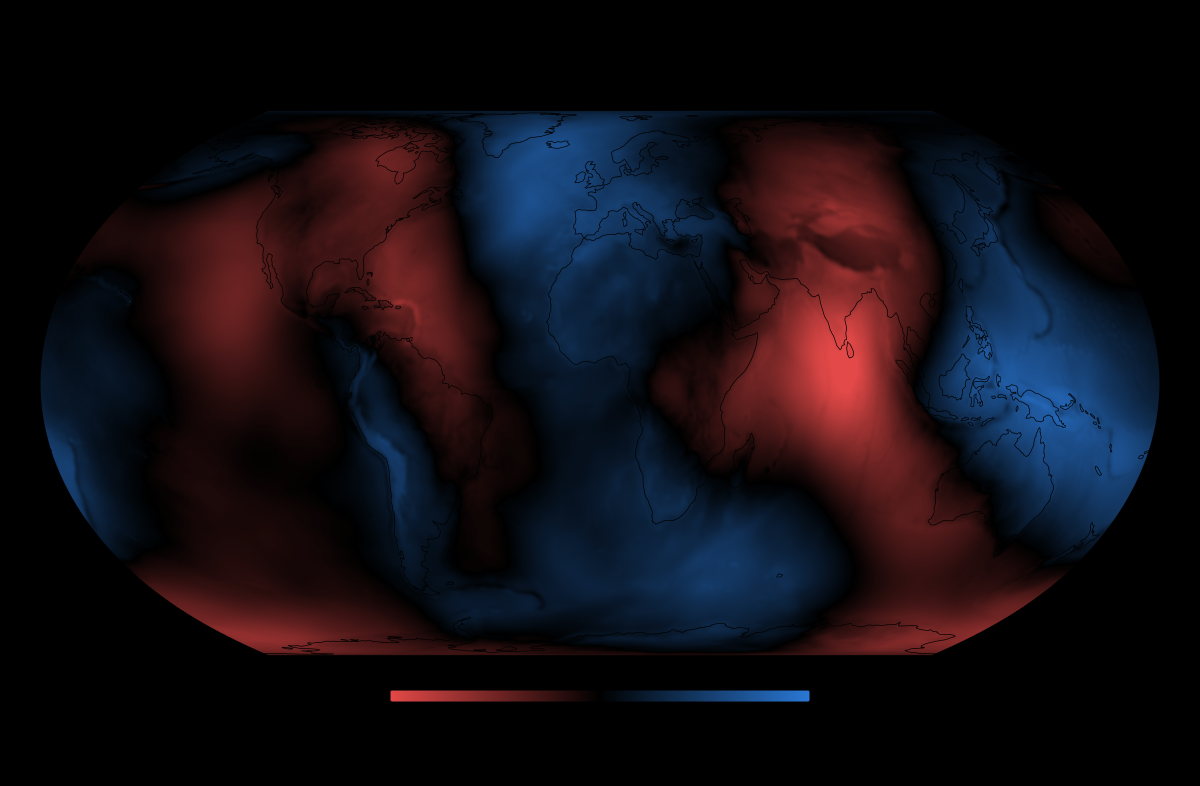
The geoid from the GOCO06s model, computed with
geopotential, the engine geo5d uses for gravity.
cargo add geo5duse geo5d::{relativity, GeopotentialNumber, NormalGravity};
// Two optical clocks, compared over a fibre, differ in frequency by 3.2 parts in 10¹⁷.
let g = NormalGravity::GRS80.at_latitude(47.0);
let height = relativity::height_difference(3.2e-17, g);
assert!((0.29..0.30).contains(&height)); // 29 cm: the faster clock is higher
// A surveyed geopotential number, as a height in metres.
let h = GeopotentialNumber::new(9_806.2).dynamic_height(NormalGravity::GRS80.gamma_45());
assert!((h - 1000.0).abs() < 0.1);| Item | What it does |
|---|---|
NormalGravity |
Gravity of the reference ellipsoid (GRS80, WGS84) on and above it (Moritz 2000) |
GeopotentialNumber |
Heights from the geopotential: dynamic, normal and orthometric |
SphericalHarmonicModel |
Gravity, geoid, gravity anomalies, deflections and the gradient tensor from a model such as an ICGEM .gfc file, through geopotential |
relativity |
Clocks as height meters (chronometric levelling), clock rates in TT and TCG (IERS Conventions 2010), frame dragging: the Lense–Thirring drag of satellite orbits and the gyroscope precessions Gravity Probe B measured (Everitt et al. 2011), and the relativistic advance of a periapsis (Will 2014) |
transfer |
Relativistic corrections for GNSS and time transfer (Sagnac, Shapiro), and proper time along a trajectory |
constants |
The defining constants, including both conventional values of W₀ |
geoid_undulation returns the height anomaly (the quasigeoid). Over high mountains the classical
geoid differs from it by up to about 1 m, because that needs an assumed crustal density.
A spinning Earth drags space around with it. The orbit of the LAGEOS satellite turns by about 31 milliarcseconds a year because of it, which LAGEOS and LARES-2 measure to about 0.1%.
use geo5d::constants::EARTH_ANGULAR_MOMENTUM;
use geo5d::relativity::{MAS_PER_YEAR, lense_thirring_node_rate};

let drag = lense_thirring_node_rate(EARTH_ANGULAR_MOMENTUM, 12_270e3, 0.0045);
println!("{:.2} mas/yr", drag * MAS_PER_YEAR); // 30.67- Relativity: the clock signs and sizes match the Tokyo Skytree experiment: 452.6 m of height gives 21.2 Hz on a strontium clock (Takamoto et al. 2020).
- Gravity: on the EGM96 model, it matches pyshtools to 0.05 µGal.
- Geoid: it matches GeographicLib to a constant offset of about 9 cm, which comes from convention.
- GOCO06s: on the degree-300 model, its synthesis matches
geopotentialto about 1e-15. - Frame dragging: LAGEOS's node drag (30.67 mas/yr) and Gravity Probe B's predicted drifts, 6,606 mas/yr geodetic and 39.2 mas/yr frame dragging projected on its guide star.
- Clocks across a sample: the redshift gradients JILA and Wisconsin measured, 1.09×10⁻¹⁹ per mm (Bothwell et al. 2022) and 10.9×10⁻¹⁹ per cm (Zheng et al. 2023); the Sun's redshift seen from the Earth, 633.10 m/s (González Hernández et al. 2020).
- Orbits and light: Mercury's 42.98″ per century and the Moon's de Sitter precession of about 2″ per century (Will 2014); S2's 12.1′ per orbit round Sgr A* (GRAVITY 2020); Cassini's 262.4 µs round-trip Shapiro delay.
Not included yet:
- a classical-geoid option from topographic heights;
- the periodic TDB − TT series.