The Python Port Scanner project was developed to explore network security by identifying open ports and running services on a target system. The goal was to understand network reconnaissance, learn how services can be discovered, and gain hands-on experience with Python scripting, multithreading, and cybersecurity fundamentals in a controlled Kali Linux environment.
- Practical experience with network scanning and port enumeration
- Understanding of common services and protocols running on open ports
- Experience in multithreading for efficient scanning
- Python scripting for developing security tools
- Understanding the role of reconnaissance in penetration testing workflows
- socket – for network communication and port checking
- threading – for concurrent scanning to improve speed
- sys – for command-line argument handling
- time – for scan timing and delays
Below are the key steps taken in using the Python Port Scanner:
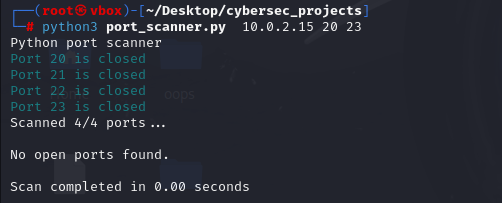
Ref 1: Target Selection
This screenshot shows the target system prepared for scanning.
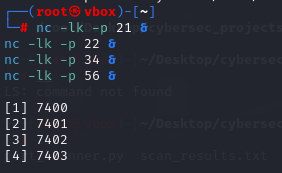
Ref 2: Netcat Listener Test
This screenshot demonstrates opening ports using Netcat (nc -lk -p <port>) to test the scanner against a live listener.
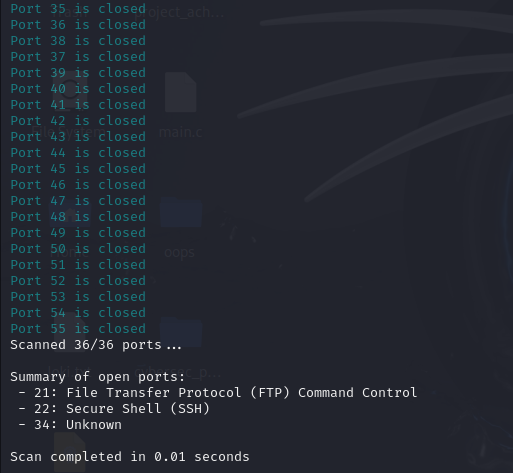
Ref 3: Scanning in Progress
Shows the scanner actively scanning ports with color-coded output.

Ref 4: Open Ports Detected
Shows detected open ports and their respective services.
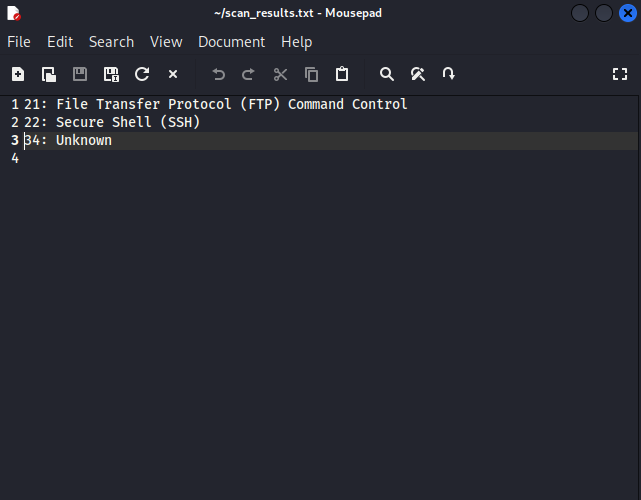
Ref 5: Scan Results Exported
Shows the scan_results.txt file with the summary of open ports.