Repository navigation
[TileRT] DeepSeek-V4.1-Flash FP4 GB300 AgentX: vLLM prefill + TileRT DEP32 decode at 4, 8 and 16 sequences per GPU / [TileRT] DeepSeek-V4.1-Flash FP4 GB300 AgentX:vLLM prefill + TileRT DEP32 decode,每卡 4 / 8 / 16 条序列 - #5093
CrimsonDump wants to merge 13 commits into
Conversation


…refill worker in TILERT_ROUTER_P_URLS

903 adds frontend.args.rust-front: the router runs under the release's Rust
front supervisor. 904 sets TILERT_ROUTER_P_URLS (the --vllm-url list) on the
router command; TileRT 0.2.0's router requires it and sends each prefill
straight to one of those workers. Earlier tilert releases do not read it.
… GPU (tilert 0.2.0)

Six vLLM prefill workers (DP2 + EP, official vLLM image by digest, unmodified;
TileRT only as a KV connector, plus vLLM's SimpleCPUOffloadConnector) feed one
TileRT DEP32 decode over NVLink; the router has its own tray. Concurrency 1200,
2000 and 3200. Every role installs tilert 0.2.0 from PyPI and checks its sha256.
DSpark with five drafts at the simulated golden acceptance 3.51.


|
Thanks for the contribution!
中文感谢你的贡献!
|


|
Preview while the sweep is pending: where this PR's three points should land on the current GB300 DeepSeek-V4.1-Flash agentic board.
|
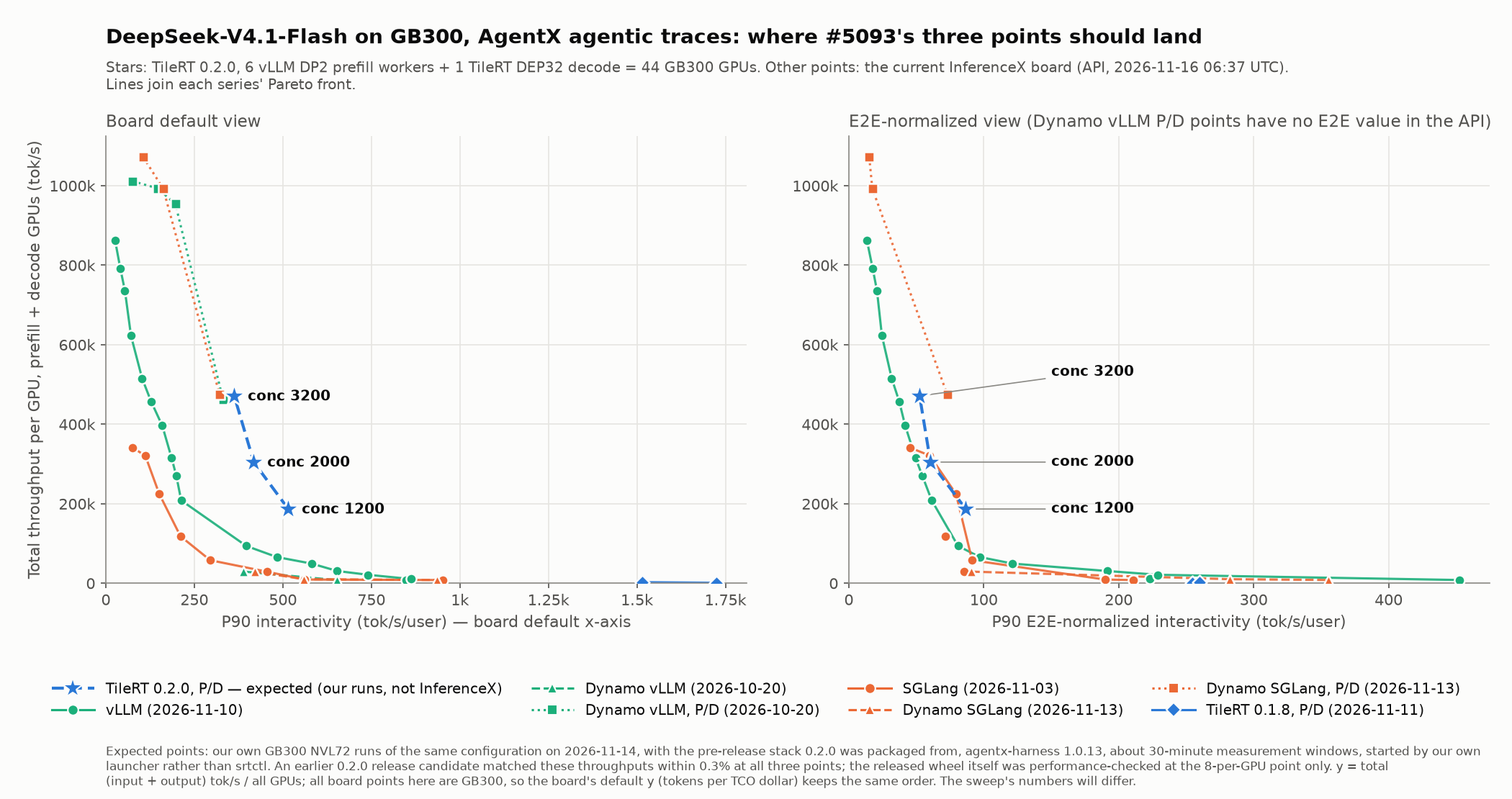
|
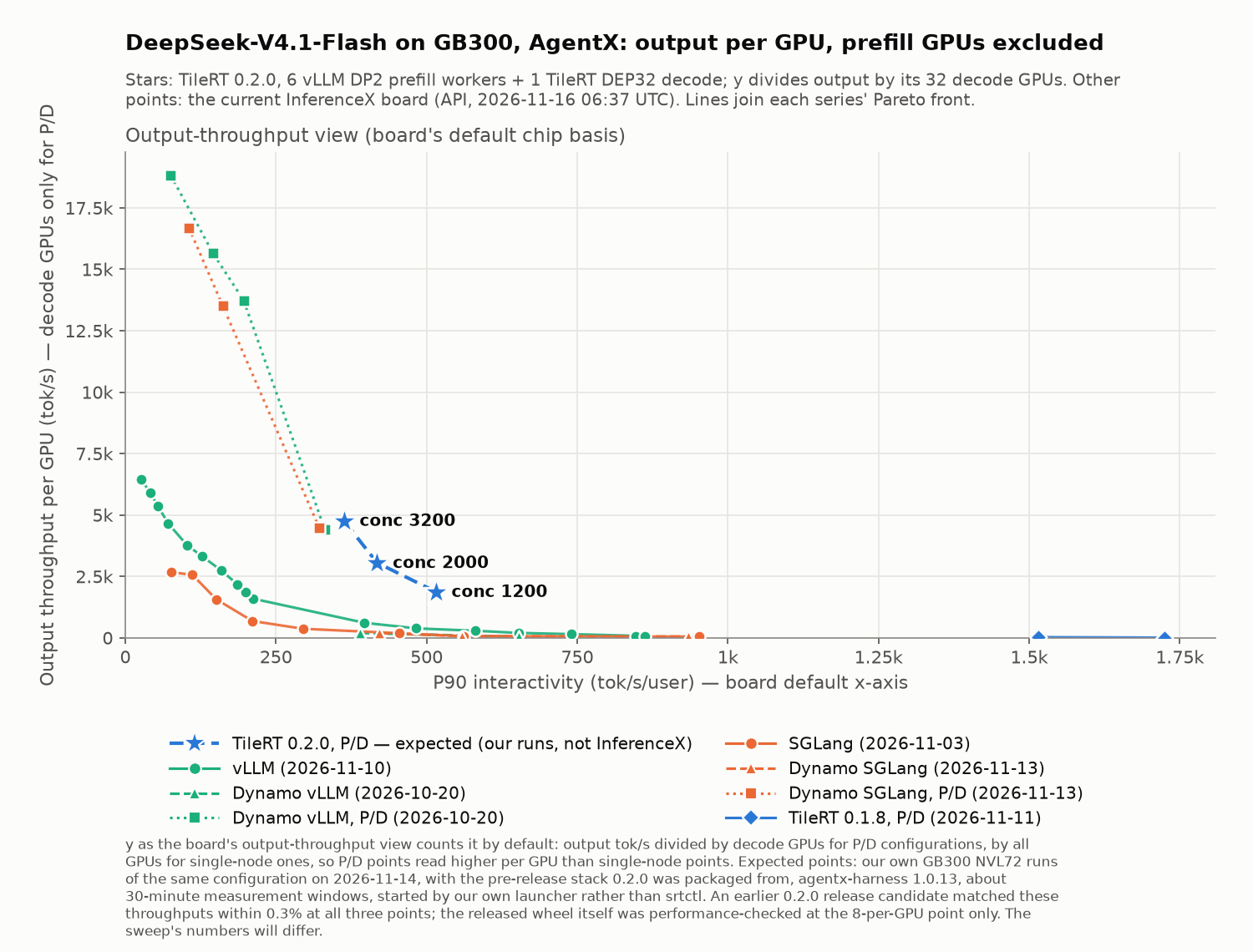
A third view, without the prefill GPUs: output throughput per GPU against P90 interactivity, counted the way the board's output-throughput view does by default (decode GPUs only for P/D configurations, all GPUs for single-node ones, so P/D points read higher per GPU than single-node points).
Same runs and caveats as the comment above. The per-decode-GPU numbers in the PR description (1,880 / 3,057 / 4,755) come from the earlier 0.2.0 release candidate and agree with these within 0.3%. |
|
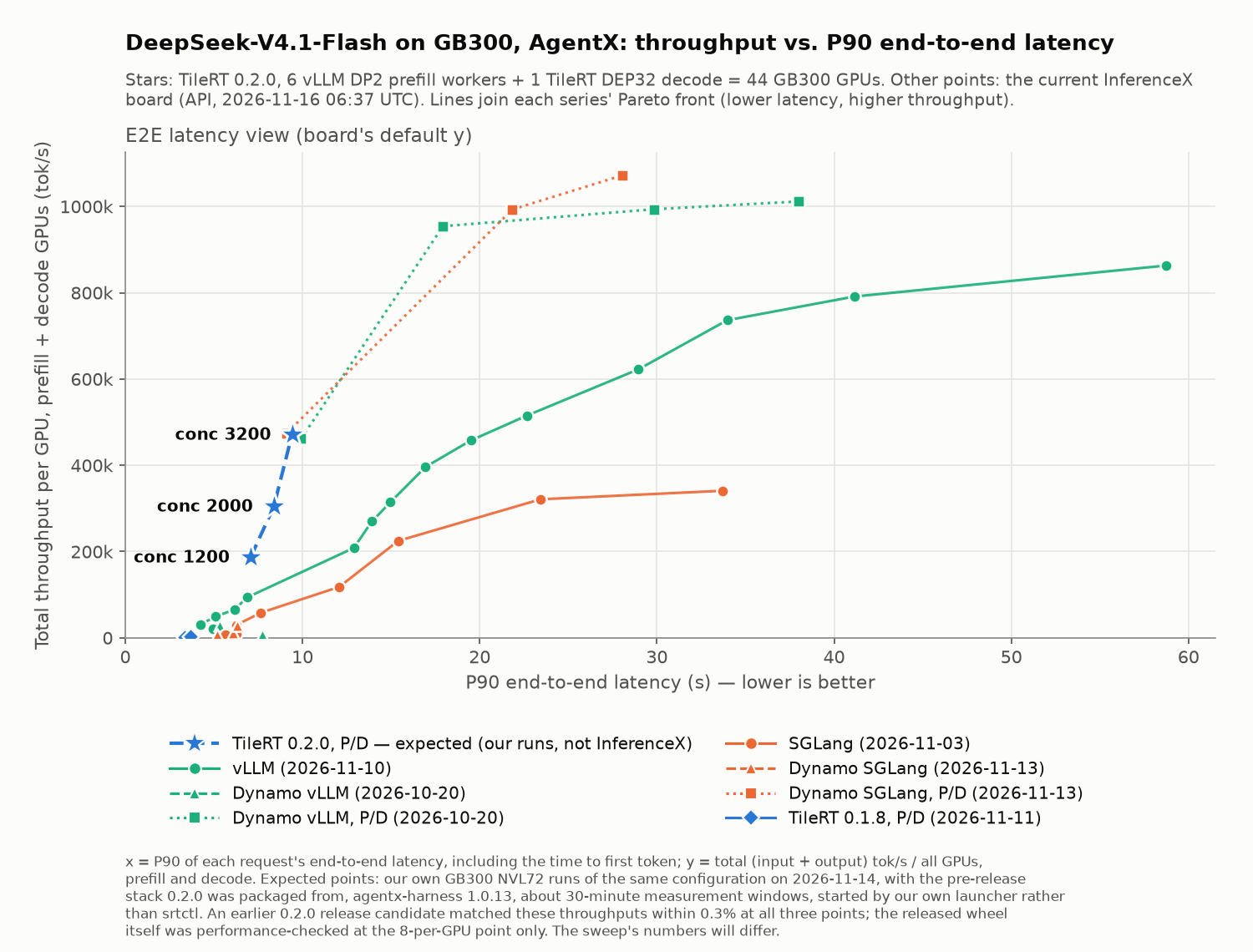
And with P90 end-to-end latency on the x-axis (the board's E2E Latency view, lower is better), with the same y as the first chart: total (input + output) tok/s divided by all GPUs, prefill and decode.
The latency is the P90 of aiperf's |

…RT DEP decode; declare the prefill DRAM KV tier; point the changelog at SemiAnalysisAI#5094

The tilert 0.2.0 wide-EP decode reads the model shape from inference/config.json and
falls back to the multimodal top-level config.json, which it rejects; the cluster's
HF cache snapshot lacks that file. The setup script now places the release's packaged
copy (identical to the Hub file at revision 314113f8) when it is missing.

Declare kv-offloading dram / vllm-simple with dram-utilization 0.304762 (4 prefill DP
ranks x 64 GiB per 840 GiB tray), and set the changelog pr-link to this PR.
The router role's setup script writes infx_rs_front_strict, which runs the release's
rs_front_sup with Sup.fallback replaced by a logged exit 1, and patch 903 starts the
supervisor through it. A run whose pd_stream front never comes up or dies mid-run now
fails instead of publishing Python-router numbers under the Rust-front config.
…_spec

tilert 0.2.0's router builds the Rust front's parser spec from
ParserEngineConfig.tool_call_body_array, which the vLLM nightly a2bcb565 image does
not have, so /rs_spec raised AttributeError, pd_stream never came up and the strict
supervisor failed the run (run 43850071147). The router setup now reads those fields
with a False default and fails if the release's rs_spec no longer matches.
…4 per GPU

- Router / tilert version 0.2.1 in the master entry; the setup script has a
  TODO for the 0.2.1 wheel sha256 (filled in once the wheel is published).
- The point at 4 sequences per decode GPU (concurrency 1200) runs four DEP2
  prefill workers on two trays (40 GPUs with the DEP32 decode); 8 and 16 per
  GPU keep six (44 GPUs). The override and the search-space entry are renamed
  to 4p1d to match.
- perf-changelog entry updated to match.
# Conflicts:
#	inferencex-e2e/configs/nvidia-master.yaml
…he rs_spec shim skips a field 0.2.1 already reads with a default

0.2.1 is on PyPI (tilert-0.2.1-cp312-cp312-manylinux_2_34_aarch64.whl, sha256
afefcca46370eb98fddbebd5b12d8fa538dda074a2c4afdb7cbd7c2e9dfd443c). Its rs_spec reads
tool_call_body_array through getattr already, so the shim from 835c648 would stop
the setup on that field; it now patches tool_args_json and skip_in_token_id_mode and
leaves a field already read with the default as it is.
perf-changelog.yaml: upstream appended entries; the TileRT entry stays at the physical end.
|
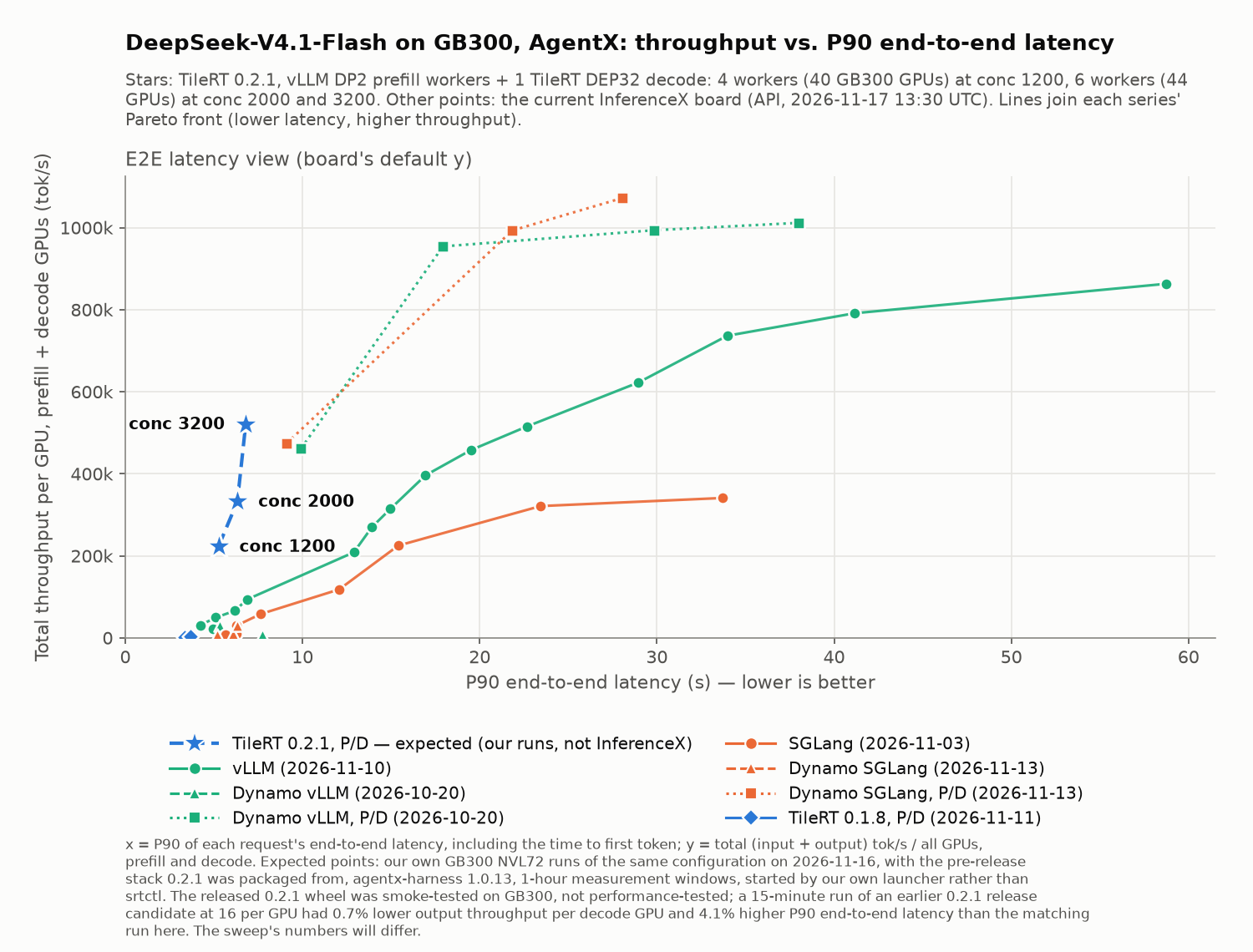
This PR now pins tilert 0.2.1 (on PyPI since 2026-11-17 13:02 UTC), and the conc 1200 point uses four prefill workers (40 GPUs) instead of six. The branch also carries your commits from #5094 and is merged with main, so the replica can fast-forward to 852f82a. Updated preview, with P90 end-to-end latency on the x-axis (the board's E2E Latency view, lower is better) and total (input + output) tok/s divided by all GPUs, prefill and decode, on the y-axis. It replaces the 0.2.0 previews above.
|
…s; drop the rs_spec shim

An AgentX curve publishes the points of a single run, so the DEP-only sweep would
replace the published concurrency-1 TP8 / TP24 points instead of extending the
curve. List dsv41flash-fp4-gb300-tilert-agentic-dspark-tp in the same changelog
entry so the sweep reruns those two points, recipes unchanged, next to the three
DEP points.

Drop the rs_spec shim: tilert 0.2.1 already reads tool_call_body_array with a
default, and the two fields it still rewrote exist in the pinned vLLM nightly,
so it no longer changed behaviour; tilert 0.1.8 ships no rs_spec.py, so the shim
failed the router setup of the TP points. Drop the unused 0.2.0 sha256 pin.
…s for the prefill

A cold FlashInfer autotune raises the prefill's warm-up memory peak, so its
KV cache ends at about 60 GiB per GPU instead of about 88 GiB when tuned
results are loaded. Ship the results vLLM itself saved for this exact
prefill (same image, same flags, GB300), in vLLM's own layout under its
config hash, and have the setup script copy them into
VLLM_FLASHINFER_AUTOTUNE_CACHE_DIR so a cold start loads them instead of
re-tuning.

vLLM reads them only under the same config hash and FlashInfer only with
the same library versions and GPU; anywhere else the prefill tunes as
before. Only the DEP recipe sets AUTOTUNE_CACHE_SEED; the TP recipe and
its points are unchanged.
|
Superseded by #5094 (merged). |


Summary
Adds TileRT wide-EP decode to the GB300 NVL72 AgentX board for DeepSeek-V4.1-Flash FP4. vLLM prefill workers hand the prompt KV over NVLink to one TileRT DEP32 decode (eight trays), at three points: 4, 8 and 16 sequences per decode GPU (concurrency 1200, 2000 and 3200), with four, six and six prefill workers (40, 44 and 44 GPUs). Every role uses the public
tilert==0.2.1aarch64 wheel from PyPI and checks its sha256 (afefcca4…) before using it.The same sweep also reruns the two existing concurrency-1 points of
dsv41flash-fp4-gb300-tilert-agentic-dspark-tp(TP8 and TP24 on tilert 0.1.8, recipes unchanged), so all five GB300 TileRT points publish together as one curve: an AgentX curve takes its points from a single run.What runs
dsv41flash-fp4-gb300-tilert-agentic-dspark-dep, three points:override_4p1d_dep2_dep32_eb4_c1200,override_6p1d_dep2_dep32_eb8_c2000,override_6p1d_dep2_dep32_eb16_c3200. The points differ in sequences per decode GPU (TILERT_EP_BATCH4 / 8 / 16), the number of prefill workers (four on two trays at 4 per GPU, six on three trays otherwise), the decode's extra CUDA graph sizes (TILERT_WEP_GRAPH_LANES) and the router's--decode-capacity(32 × sequences per GPU).vllm/vllm-openai:cu134-nightly-a2bcb5657a88…image by digest, unmodified. Two workers per tray, each DP2 + expert parallel on 2 GPUs. TileRT enters only as a KV connector (tilert.pd_vllm.official_connector, withtilert/pd_vllmfrom the wheel on the path). vLLM's ownSimpleCPUOffloadConnectorkeeps a lazy CPU DRAM KV tier of 64 GiB per DP rank (128 GiB per worker, 256 GiB per tray), within the proportional CPU DRAM rule. No tool-call parser.configs/dsv41flash-tilert-gb300-flashinfer-autotune/): the files vLLM itself wrote for this exact prefill, from a cold start of these prefill flags in the same image on GB300 with the model given by its Hub name, as the sweep gives it. They are kept as written, not renamed or edited, under vLLM's config hash28b1fd16…, the hash in the previous sweep's prefill logs. The setup script copies them intoVLLM_FLASHINFER_AUTOTUNE_CACHE_DIR=/tmp/flashinfer-autotune, so each cold start loads them instead of re-tuning, as a warm deployment does. A cold tune's temporary buffers otherwise leave each prefill GPU a KV cache of about 60 GiB instead of about 88 GiB (the previous sweep had about 60 GiB at all three points), which costs prefix-cache hits at 16 sequences per GPU. vLLM reads the files only under the same config hash, and FlashInfer loads them only when the recorded FlashInfer, CUDA, cuBLAS and cuDNN versions and the GPU match; anywhere else the prefill tunes as before. Only the DEP recipe sets this. If you would rather not ship tuned results, reverting5124b6aerestores the cold tune.nvidia/cuda:13.2.0-runtime-ubuntu24.04by digest; the setup script installs Torch 2.13.0+cu132, the pinned serving stack and the wheel, as for the existing TP entry. Besides the per-point values, the release reads only the simulated-acceptance pair InferenceX sets and the multi-node rendezvous from the environment.tilert-router) has a tray of its own, shared only with the benchmark client. It runs in the prefill image, tokenizes with the release's Rust port of vLLM's DeepSeek-V4.1 encoder, splits reasoning with vLLM's parser (no tool-call parsing), and serves the client port with the release's Rust front. It sends each prefill straight to one of the workers and one of its two DP ranks, keeping a conversation on one of them for its prefix cache.inference/config.json, the decode places the release's packaged copy; and the Rust front's supervisor runs in a strict mode where a fallback to the Python router fails the run instead of serving it. The router's parser-config shim is dropped again: tilert 0.2.1 already reads the one field the pinned vLLM nightly lacks with a default, so the shim changed nothing there, and the 0.1.8 wheel of the TP points has no such file, so the shim would fail their setup.2d9079c):903-tilert-router-rust-front.patchaddsfrontend.args.rust-front;904-tilert-router-prefill-urls.patchsetsTILERT_ROUTER_P_URLS(the--vllm-urllist) on the router command, which the router of tilert 0.2.0 and later requires. Earlier tilert releases do not read it, so the existing TP entry is unchanged apart from that variable appearing on its router command.TILERT_SIMULATE_ACC_LEN/TILERT_SIMULATE_ACC_METHODfromnum-mtp, as for the other DSv4.1 DSpark entries. 30-minute warm-up grace.Ran through srt-slurm once with 0.2.1: run 44104846387, all three DEP points. Since then this PR adds the TP rerun, drops the parser-config shim and ships the prefill autotune results, so the next sweep is the first run of this exact head.
What to check on the first run
P_DIRECT on: 4 P (...)at concurrency 1200 andP_DIRECT on: 6 P (...)at 2000 and 3200,dp_ranks 2, andpd_stream upfrom the Rust front supervisor (FALLBACK refusedmeans the Rust front did not come up or died, and the run fails by design).TileRTOfficialConnector 1: role=...line per engine.Using FlashInfer autotune cache file: /tmp/flashinfer-autotune/28b1fd16…/autotune_configs_dp0_rank0.json, no FlashInfer autotune dummy runs after it, and a KV cache of about 88 GiB per GPU rather than about 60 GiB. Otherwise the files were ignored and the prefill tuned cold, as in the previous sweep.Validation details
srtctllaunch plans for all three points render with patches 573, 900, 903 and 904 on2d9079c(37 srun steps at concurrency 1200: 4 prefill, 8 decode, router, services; 41 at 2000 and 3200 with 6 prefill), identically before and after merging main. The rendered prefill command matches the flags of our runs. The srt-slurmtests/test_tilert.pyand launch-snapshot tests pass with the patches.infx.workflows.validate_perf_changelogandinfx.matrix.planpass;infx.matrix.changedlists 3 added points.5124b6ae:validate_perf_changelogpasses andinfx.matrix.planlists five agentic points (the three DEP points and the two TP points) with their five evals; of these, only the three DEP points' recipe fingerprints differ from the previous head. The setup script's seeding step was run on its own for each case (prefill with and without the results, decode, router, no cache directory, an empty results directory). Theinfx/tests/srt_slurmandinfx/tests/matrixresults are the same as on the previous head.AI model disclosure
PR checklist and change type
Type of Change
Checklist
python -m infx.matrix.changed --base origin/mainlists affected config keys, I have appended one new entry covering them to the physical end ofinferencex-e2e/perf-changelog.yaml; if it lists none, I have added none. I have not edited historical entriesinferencex-e2e/perf-changelog.yamlentry, it carries exactly one primary sweep label (a maintainer applies it on fork PRs):full-sweep-fail-fast(recommended),full-sweep-enabled, ornon-canary-full-sweep-enabled. Optional modifiersall-evals,evals-only, andagentx-fastrequire a primary label; the last two block reuse while applied./use <run_id>(or the legacy/reuse-sweep-run) on this PR. Do this only once there is a final full sweep that is all green with evals passing, since after this comment the primary sweep label will no longer automatically kick off new sweeps. Remove and re-add the primary sweep label to force a new sweep.中文
在 GB300 NVL72 的 AgentX 榜上为 DeepSeek-V4.1-Flash FP4 加入 TileRT 宽 EP decode:vLLM prefill worker 通过 NVLink 把 prompt 的 KV 交给一个 TileRT DEP32 decode(八个托盘)。三个点:每张 decode GPU 4、8、16 条序列(并发 1200、2000、3200),prefill worker 分别是四、六、六个(共 40、44、44 张 GPU)。各角色都从 PyPI 装公开的
tilert==0.2.1aarch64 wheel,先核 sha256(afefcca4…)再用。同一次 sweep 还重跑
dsv41flash-fp4-gb300-tilert-agentic-dspark-tp已有的两个并发 1 点(TP8 和 TP24,tilert 0.1.8,recipe 不变),让 GB300 上 TileRT 的五个点一起发布成一条曲线:AgentX 的一条曲线只取一次运行的点。跑的是什么
dsv41flash-fp4-gb300-tilert-agentic-dspark-dep,三个点:override_4p1d_dep2_dep32_eb4_c1200、override_6p1d_dep2_dep32_eb8_c2000、override_6p1d_dep2_dep32_eb16_c3200。差别在每卡序列数(TILERT_EP_BATCH4 / 8 / 16)、prefill worker 数(每卡 4 条时四个、占两个托盘,其余六个、占三个托盘)、decode 额外的 CUDA graph 尺寸(TILERT_WEP_GRAPH_LANES)和 router 的--decode-capacity(32 × 每卡序列数)。cu134-nightly-a2bcb5657a88…镜像,按 digest 钉住,未做任何修改。每个托盘两个 worker,每个是 DP2 + 专家并行、占 2 张 GPU。TileRT 只以 KV connector 的形式进入(tilert.pd_vllm.official_connector)。vLLM 自带的SimpleCPUOffloadConnector提供 lazy 的 CPU 内存 KV 层,每个 DP rank 64 GiB(每个 worker 128 GiB,每个托盘 256 GiB),符合按 GPU 比例的 CPU 内存规则。不开 tool-call 解析。configs/dsv41flash-tilert-gb300-flashinfer-autotune/):vLLM 自己为这套 prefill 写下的文件,来自同一镜像、同样的 prefill 参数在 GB300 上的一次冷启动,模型按 Hub 名传入,和 sweep 一样。文件原样保留,没有改名或改内容,放在 vLLM 的 config 哈希28b1fd16…下,和上一次 sweep 的 prefill 日志里的哈希相同。setup script 把它们拷进VLLM_FLASHINFER_AUTOTUNE_CACHE_DIR=/tmp/flashinfer-autotune,每次冷启动直接加载,不再重新调,和热部署一样。否则冷调的临时缓冲会让每张 prefill GPU 的 KV 缓存只有约 60 GiB,而不是约 88 GiB(上一次 sweep 三个点都是约 60 GiB),每卡 16 条时会损失前缀缓存命中。vLLM 只在 config 哈希相同时读这些文件,FlashInfer 只在记录的 FlashInfer、CUDA、cuBLAS、cuDNN 版本和 GPU 都一致时加载;其他情况 prefill 照常调。只有 DEP 的 recipe 设了它。如果不希望附带调好的结果,回退5124b6ae即恢复冷调。tilert-router)单独占一个托盘,只和压测端共用。它跑在 prefill 镜像里,用发布版里 vLLM DeepSeek-V4.1 encoder 的 Rust 移植分词,用 vLLM 的 parser 拆 reasoning(不解析 tool call),客户端端口由发布版的 Rust 前端服务。每个 prefill 直接发给某个 worker 及其两个 DP rank 之一,同一个会话固定在同一处以复用前缀缓存。inference/config.json时,decode 放入发布版自带的那份;Rust 前端的 supervisor 以严格模式运行,回退到 Python router 时直接让这次运行失败,而不是继续服务。router 的 parser 配置补丁又去掉了:tilert 0.2.1 对固定的 vLLM nightly 缺少的那一个字段本来就取默认值,补丁在那里不起作用;TP 点用的 0.1.8 wheel 里没有那个文件,补丁会让它们的 setup 失败。2d9079c):903 加frontend.args.rust-front;904 在 router 命令上设TILERT_ROUTER_P_URLS(即--vllm-url那串地址),tilert 0.2.0 及之后的 router 必须有它。更早的 tilert 不读这个变量,已有的 TP 条目除了 router 命令上多出这个变量,其他不变。num-mtp设置TILERT_SIMULATE_ACC_LEN/TILERT_SIMULATE_ACC_METHOD,和其他 DSv4.1 DSpark 条目一样。预热宽限 30 分钟。0.2.1 在 srt-slurm 上跑过一次:run 44104846387,三个 DEP 点。之后本 PR 加了 TP 重跑、去掉了 parser 配置补丁、附带了 prefill 的 autotune 结果,所以下一次 sweep 是这个 head 的第一次运行。
第一次正式跑要看什么
P_DIRECT on: 4 P (...),2000 和 3200 时P_DIRECT on: 6 P (...);dp_ranks 2;Rust 前端 supervisor 的pd_stream up。出现FALLBACK refused表示 Rust 前端没起来或中途退出,这次运行会按设计失败。TileRTOfficialConnector 1: role=...。Using FlashInfer autotune cache file: /tmp/flashinfer-autotune/28b1fd16…/autotune_configs_dp0_rank0.json,之后没有 FlashInfer autotune 的 dummy run,每张 GPU 的 KV 缓存约 88 GiB 而不是约 60 GiB。不是这样就说明文件被忽略、prefill 照旧冷调,和上一次 sweep 一样。验证细节
2d9079c上打了补丁 573、900、903、904 后都能渲染(并发 1200 是 37 个 srun 步骤:4 个 prefill、8 个 decode、router 和服务;2000 和 3200 是 41 个,6 个 prefill),合并 main 前后渲染结果相同。渲染出的 prefill 命令和我们实际跑的参数一致。打补丁后 srt-slurm 的tests/test_tilert.py和启动快照测试都通过。infx.workflows.validate_perf_changelog和infx.matrix.plan都通过,infx.matrix.changed列出新增 3 个点。5124b6ae:validate_perf_changelog通过,infx.matrix.plan列出五个 agentic 点(三个 DEP 点和两个 TP 点)及五个 eval,其中只有三个 DEP 点的 recipe 指纹和上一个 head 不同。setup script 新加的拷贝步骤单独跑过每种情况(prefill 带和不带结果、decode、router、没设缓存目录、结果目录为空)。infx/tests/srt_slurm和infx/tests/matrix的结果和上一个 head 相同。