Leo Constantin, Sabine Kraml, Andre Lessa, Arpita Mondal, Timothée Pascal, Wolfgang Waltenberger
Previously involved in SModelS: Gaël Alguero, Mohammad Mahdi Altakach, Federico Ambrogi, Jan Heisig, Charanjit K. Khosa, Juhi Dutta, Suchita Kulkarni, Ursula Laa, Veronika Magerl, Wolfgang Magerl, Sahana Narasimha, Philipp Neuhuber, Doris Proschofsky, Camila Ramos, Humberto Reyes-González, Théo Reymermier, Jory Sonneveld, Michael Traub, Yoxara Villamizar, Matthias Wolf, Alicia Wongel




7 Aug 2026: SModelS version 3.2.0 available (what's new)
- First support for NN surrogate statistical models (ONNX format)
- Modified the syntax for statistical models in the database: in the globalInfo.txt files, the fields datasetOrder, covariance, jsonFiles and jsonFiles_FullLikelihood have been replaced by regionMappings, regionSets and statModels. Note that this breaks backwards compatibility
- Small fixes in likelihood calculations and pyhf interface
- Moved all interfaces from .likelihoods to .nlls
- Updated lheReader to properly deal with MG5 LHE files (fixes github issue #53, see also discussion #54)
- Fixed pythia8 paths in automatic downloader
- Introduced a printer registry for out-of-repo printers
- Database extension (stat models): added ONNX models to ATLAS-SUSY-2018-04, ATLAS-SUSY-2018-16, ATLAS-SUSY-2018-32, ATLAS-SUSY-2019-08, ATLAS-SUSY-2019-09 -- thanks to Humberto Reyes-Gonzalez, Joaquin Iturriza Ramirez and Rafal Maselek for their help
- Database extension (new results): added ATLAS-SUSY-2018-09 (EM), ATLAS-SUSY-2019-02 (TSlepSlep, UL) ATLAS-SUSY-2019-04 (EM), ATLAS-SUSY-2020-27 (UL+EM), CMS-SUS-18-004 (EM), CMS-EXO-19-019 (UL), CMS-SUS-21-008 (UL), CMS-SUS-23-003 (UL) -- thanks to Lucas Heck and Axel Schwingrouber-Mazet for valuable contributions
- Database now pickles with protocol 5 instead of protocol 4
- A detailed documentation is available in the online manual
- For instructions on how to install SModelS, check the installation section in the manual.
- Here are the list of analyses in the latest database version, the respective validation plots and an SMS dictionary explaining the Tx names used by SModelS.
- You may also want to check the release notes, the database releases and known issues
- A discussion of re-interpretation methods and tools, and recommendations about the presentation of results can be found in this report by the LHC Reinterpretation Forum, arXiv:2003.07868.
- A list of publications referring to SModelS from Inspire.
- SModelS is interfaced to micrOMEGAs (see section 15.2 of the micrOMEGAs manual) and to NMSSMTools. Note that the micrOMEGAs interface comes with its own cross section computation via Calchep.
- For questions and comments, see the github issue tracker at https://github.com/SModelS/smodels/issues.
- SModelS v3: going beyond Z2 topologies, Mohammad M. Altakach, Sabine Kraml, Andre Lessa, Sahana Narasimha, Timothée Pascal, Camila Ramos, Yoxara Villamizar, Wolfgang Waltenberger, arXiv:2409.12942 JHEP 11 (2024) 074
- SModelS v2.3: enabling global likelihood analyses, Mohammad M. Altakach, Sabine Kraml, Andre Lessa, Sahana Narasimha, Timothée Pascal, Wolfgang Waltenberger, arXiv:2306.17676, SciPost Phys. 16 (2024) 101
- Constraining new physics with SModelS version 2, Gael Alguero, Jan Heisig, Charanjit Khosa, Sabine Kraml, Suchita Kulkarni, Andre Lessa, Humberto Reyes-Gonzalez, Wolfgang Waltenberger, Alicia Wongel, arXiv:2112.00769, JHEP 08 (2022) 068
- A SModelS interface for pyhf likelihoods, Gael Alguero, Sabine Kraml, Wolfgang Waltenberger, arXiv:2009.01809, CPC March 2021, 107909
- SModelS v1.2: long-lived particles, combination of signal regions, and other novelties, Federico Ambrogi et al., arXiv:1811.10624, CPC 251, June 2020, 106848
- SModelS v1.1 user manual: improving simplified model constraints with efficiency maps, Federico Ambrogi, Sabine Kraml, Suchita Kulkarni, Ursula Laa, Andre Lessa, Veronika Magerl, Jory Sonneveld, Michael Traub, Wolfgang Waltenberger arXiv:1701.06586, CPC 227 (2018) 72-98
- SModelS: a tool for interpreting simplified-model results from the LHC and its application to supersymmetry, Sabine Kraml, Suchita Kulkarni, Ursula Laa, Andre Lessa, Wolfgang Magerl, Doris Proschofsky, Wolfgang Waltenberger, arXiv:1312.4175, EPJC (2014) 74:2868
Moreover
- If you use the cross section calculator please cite Pythia, NLLfast, and Resummino
- If you use the Fastlim results in the database, please cite Fastlim 1.0 arXiv:1402.40492v1, EPJC74 (2014) 11.
For convenience a references.bib file containing all relevant references is provided with the code. Likewise, a database.bib file with references to all the ATLAS and CMS analyses used is provided in the text database.
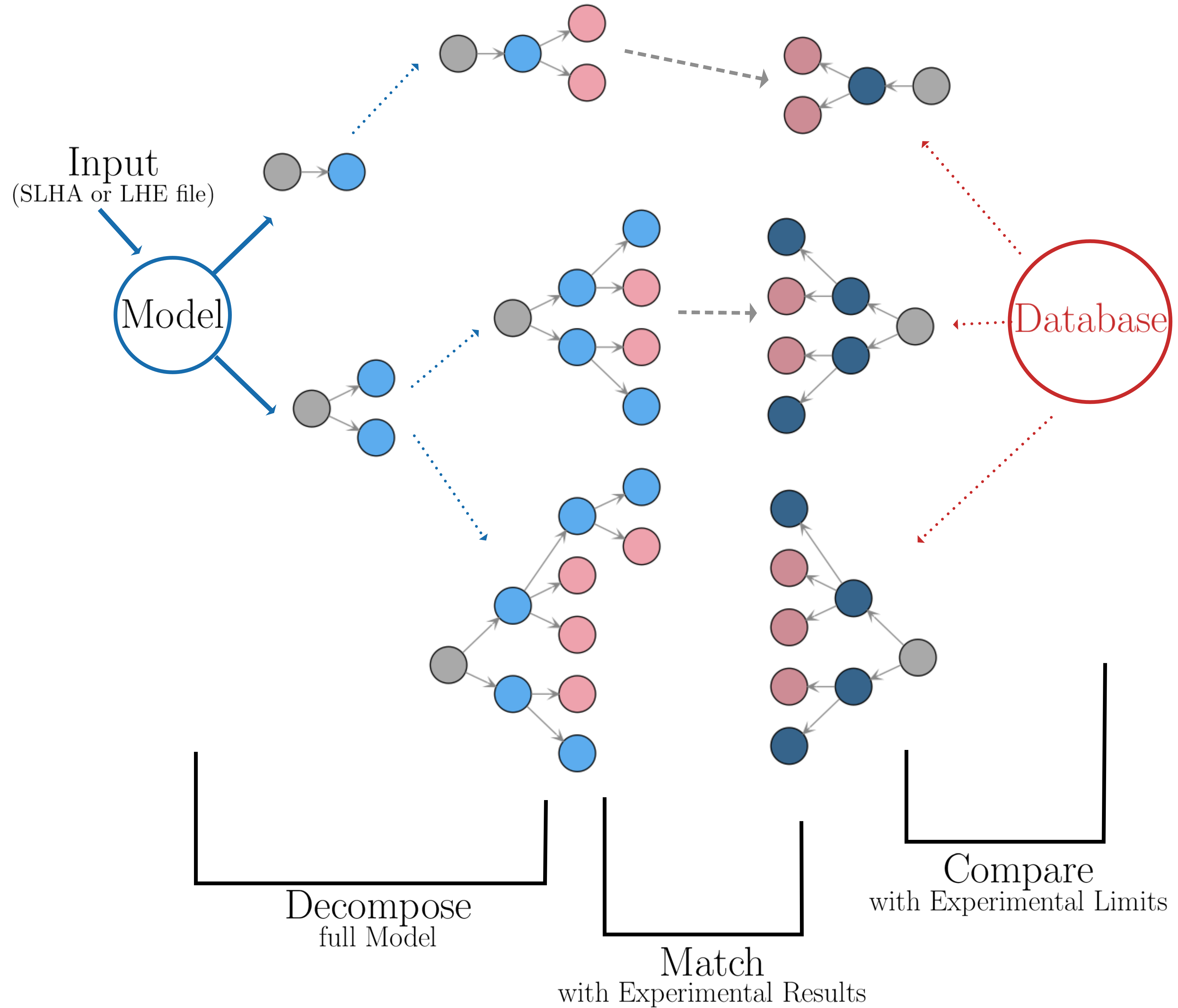
SModelS is an automatic, public tool for interpreting simplified-model results from the LHC. It is based on a general procedure to decompose Beyond the Standard Model (BSM) collider signatures into Simplified Model Spectrum (SMS) topologies. Our method provides a way to cast BSM predictions for the LHC in a model independent framework, which can be directly confronted with the relevant experimental constraints. The main SModelS ingredients are
- the decomposition of the BSM spectrum into SMS topologies
- a database of experimental SMS results
- matching between the decomposition and results database, including the tools to perform various kinds of statistical inference
as illustrated in the scheme below.
- For code and database releases, see download


