



English | 中文
A project-level, cross-session flow framework where the program — not the human — supervises the AI agent. You prompt once, walk away, and come back to a finished deliverable.
tianluo is named after the Snail Girl (田螺姑娘) of Chinese folklore: a farmer comes home each day to find the housework quietly finished — the spirit did the work while he was away, never asking, never interrupting. That is this tool's contract. You call it by its short name: the command is luo.
tianluo (formerly published as se3; the methodology is still called SE 3.0) is not a single-session prompting tool, a skill, a subagent, or a dynamic workflow. Those are in-session aids that augment one human-in-the-loop turn. tianluo sits one layer above: it is a CLI engine + persistent state machine + a code-first knowledge system (code-index + charter + why-comments) that supervises an AI coding agent across many sessions, on many machines, until the work is actually done.
Five load-bearing bets, each with the one line of evidence that makes it real rather than aspirational.
1. What it saves is human attention, not tokens. A flow is measured by how few times it makes a person read, judge, and decide — not by how cheap the LLM calls were.
Evidence: the only point where attention is structurally required is the opening prompt — everything from plan through commit runs with nobody watching, and even the grouping gate after plan is something you opt into.
2. The program is the supervisor; the human is out of the loop. The thing that decides what happens next is a deterministic Python state machine, not the model and not a person at a terminal.
Evidence: tianluo/state/engine.json persists step / attempt / context / fix-loop history, so a flow survives terminal exits, machine restarts, and hand-offs between machines — and resumes at the exact interruption point with luo run --resume.
3. Code is the single source of truth. Knowledge is exposed through three colocated artifacts — code-index, charter, why-comments — all anchored to the code itself, never a prose mirror of it.
Evidence: the tianluo/specs/** mirror and its entire governance stack (luo sync, verify_spec, update_spec, spec_gate, per-requirement drift baselines) were retired; what replaced them is a deterministically-enumerated structure map plus two anchored checks.
4. It does not assume the LLM will be conscientious. Every property the system depends on is enforced by code that runs whether or not the model cooperates:
-
Step routing is a deterministic state machine. The step pool and the per-task-type default sequences live in
engine/models.py;engine/state_machine.pywalks them. The LLM never chooses the next step. -
code-index completeness is a property of the enumerator. A filesystem walk + AST symbol enumeration decides who is on the map; the LLM only writes the one-line summary for symbols it is handed, so it cannot omit one.
-
invariant_checkhard-guardsWHY:/INVARIANT:comments. A diff that deletes or rewrites one without restoring it — or without declaring the new rationale in an updated marked comment — returnsREVISION_NEEDED. -
A check-step finding has exactly one destination: the fix loop, now. There is no discard channel, no severity-based pass-through, no "file it as an issue and fix it later" (the
out_of_scopeescape hatch was removed). -
test.critical_testsblocks skips masquerading as passes. If a configured critical test is skipped rather than run, the test step fails instead of reporting green. -
The test baseline is captured deterministically before
implementwrites anything. It is frozen by the engine, so an inherited red test can never be re-labelled as "caused by this change" — nor the reverse. -
investigate's net-zero diff is verified by the engine, not promised by the model. The workspace is snapshotted before and after the step and compared; a mismatch fails the step. The engine never resets or checks out anything itself, because the tree may hold unrelated uncommitted work. -
The PLAN decomposition decision is write-once. The doctrine and granularity a flow runs under are resolved at flow creation and persisted; a resumed flow keeps executing the grouping it already entered, whatever the configuration says later, and the engine never re-judges it mid-flow.
-
version_analyzeerrors out whensuggested_versionis missing. There is no silent patch-bump fallback; the flow stops and asks for a human.In short: anything that would otherwise hold only because "the LLM should remember to" has been rewritten to hold because the code makes it hold.
5. It is not tied to one agent. The AgentRunner abstraction already has three shipped adapters, and which one runs is a per-step configuration decision.
Evidence: claude-code, claude-interactive, and codex are all live runner types; the agents registry mixes vendors and price tiers in one pool; and llm_caller.steps.<step> pins a specific chain to a specific step, with automatic rotation within that chain.
The long-form version of all five is below: Design Philosophy for the paradigm, The knowledge system for the code-first bet.
Skills, subagents, and dynamic workflows make a single AI turn smarter or more parallel. They are valuable, but they assume a human is present, reading output and steering after every step.
tianluo makes a different bet. The unit of work is not a turn; it is a project task. Between luo run "…" and the final commit there may be dozens of LLM calls across discovery / analyze / (investigate) / plan / confirm / implement / test / self-check / invariant-check / charter-freshness / version-analyze / commit / summarize steps, multiple agent rotations, fix loops, and even multi-machine collaboration via the daemon and central server. The supervisor of all this is the tianluo engine — Python code running a deterministic state machine — not a person watching a terminal.
| Tool class | Scope | Who supervises | Where state lives |
|---|---|---|---|
| Skills / subagents / dynamic workflows | One session, one turn (or a fan-out within one turn) | Human in the loop, reading output | Conversation context |
| tianluo | A project task spanning many sessions / machines | The program (engine + daemon) | Persistent files (tianluo/state/, tianluo/history/, tianluo/issues/) |
LLMs are not the bottleneck. Human attention is. The cost of any agentic system is measured in how often it forces a person to read, judge, and decide. tianluo's north star is save human attention.
The ideal tianluo session looks like this:
- Prompt — you type
luo run "…"(or open a discovery session with--discover). - Discover — the engine asks a few targeted clarifying questions until requirements converge.
- Confirm the plan — opt-in, off by default — with no
confirmation.steps.planentry the flow runsplan → implementwith no gate at all. Addconfirmation.steps.plan: {reviewer: human}and you get a manual grouping gate: you approve howplancarved the work into task groups, or send it back for revision. - Fire-and-forget — you walk away. The engine implements, tests, self-checks, checks the diff against recorded invariants, flags any charter drift, decides the version, and commits.
- Pick up the deliverable — you come back to a clean commit on a branch, with the version, history, and code-index already aligned.
Steps 1–2, plus the optional gate in step 3 if you turn it on, are the only places where human attention is genuinely required. Everything else is the program's job.
A program-as-supervisor paradigm only holds up if the framework provides four things that in-session tools cannot:
-
Cross-session state machine —
tianluo/state/engine.jsonpersists the exact step, attempt, context, and fix-loop history of every flow.luo daemonkeeps a resident process supervising localluo runflows;tianluo-serveraggregates many daemons into one web view;luo run --worktreeruns the identical flow on an isolated git worktree and merges it back on success. The flow survives terminal exits, machine restarts, and hand-offs between machines. Why this paradigm needs it: without durable state, "walking away" loses the work. -
A code-first knowledge system (code-index + charter + why-comments) — the source of truth is the code itself. A
tianluo/code-index.mdstructure map (auto-maintained, self-freshening) gives the agent an orientation map of what modules and symbols exist and where; a small hand-maintainedtianluo/charter.mdcarries only the high-altitude facts every step needs in full (project identity, top-level architecture, project-wide invariants); colocated why-comments carry intent the code cannot express. Why this paradigm needs it: a long-running unattended agent needs to orient itself in the codebase cheaply on every step without a curated mirror of the code rotting beside it. See The knowledge system below for why this beats the spec-mirror it replaces. -
Failure recovery built in —
luo salvagerescues a crashed session by committing dangling changes, filing follow-up issues, and archiving the state. The test-baseline cache distinguishes a new regression from a pre-existing red test. Issue discovery promotes any unresolved concern into a trackedtianluo/issues/record. Why this paradigm needs it: when no human is watching, the framework must catch its own failures rather than leak them. -
Portable substrate — the engine is pure Python over the file system, and the LLM call layer is a thin
AgentRunneradapter. This is no longer a single-vendor bet in principle only: three adapters ship today and have run across vendors —claude-code— a one-shotclaude -psubprocess (src/tianluo/claude_runner.py). The default.claude-interactive— a pexpect-driven interactive PTY session (src/tianluo/claude_interactive_runner.py). Opt-in only: it needs a real terminal, so it is never auto-selected.codex— the OpenAI Codex CLI (src/tianluo/codex_runner.py).
The abstraction (
AgentRunner/RunResult/InfraErrorType) stays provider-neutral, and the boundary is deliberate: rotation and fallback across commands belong toLLMCaller; a single runner never rotates on its own. Each adapter only knows how to make one call to one CLI, translating intent throughbuild_call_args, so a new vendor plugs in without touching any caller above it. Why this paradigm needs it: a paradigm bet should not be a single-vendor bet.
Dynamic Workflows solve in-session parallelism: deterministic fan-out, judge panels, pipelines, all inside one orchestrating conversation. They make a single turn comprehensive and confident.
tianluo solves cross-session project governance: persistent state, a code-first knowledge system, failure recovery, and a portable substrate that outlives any single conversation.
The two compose. A future tianluo step can delegate its in-step parallel work to a Dynamic Workflow without changing tianluo's outer state machine. We deliberately do not pin to specific DW API names here, because DW is still in research preview and its surface will evolve.
Earlier tianluo versions kept a parallel corpus of tianluo/specs/**/spec.md files — a curated prose mirror of the code — plus an entire governance machine to keep it from drifting: luo sync rounds, per-requirement drift baselines, verify_spec / update_spec / spec_gate flow steps, and the whole sync_* analyzer/loop/state/discovery stack. tianluo replaced that mirror with three colocated artifacts whose source of truth is the code itself.
-
code-index — a structure map of the project. Its structure comes deterministically from the code (a filesystem walk + Python AST symbol enumeration: directory/package → file/module → class → function/method); a one-line LLM summary, synthesized bottom-up (a directory's summary from its files', a file's from its symbols'), is attached to each level. It lands as one self-sufficient file,
tianluo/code-index.md— the authoritative product, committed to git. It is the map, and it is whatluo code-indexrenders and what gets injected into every flow step. Because it is plain text in a diff, a wrong summary can be spotted by a human reviewer and corrected, and the correction lands durably. Each node line also carries an embedded content fingerprint (a terse, render-invisible HTML comment), so the committed md alone decides what changed: on rebuild only fingerprint-changed nodes are re-summarized by the LLM, unchanged nodes reuse their existing summary (so human corrections survive), and the md is flushed periodically during a build so a crash resumes from where it stopped. There is no separate cache file — structure, summaries, and fingerprints all live in the one committed, human-diffable file.The structure comes from the code, not from any cache; display reads only the
.md. The optimization goal is structural coverage, not summary depth — the map answers which modules/symbols exist and where, and deliberately does not descend into implementation detail (that is the source code's job; copying it into the index would just reproduce a worse-than-code mirror). -
charter —
tianluo/charter.md, the slimmed, renamed successor of the old base spec. It is injected, in full, into every step, and doubles as the conventions channel for sandboxed sub-processes (which cannot readCLAUDE.md). An altitude gate admits only what is un-sayable in code and needed in full by the whole project: project identity, top-level architecture, and project-wide cross-cutting invariants. The per-module locator index that used to bloat the base spec is gone — that job belongs to code-index. A byte threshold is a monitoring light, not a hard wall: because charter content is decoupled from project size (it grows with architectural complexity, not LOC), full-loading it stays cheap even on large projects; if it ever grows hard to load in full, that is a red flag that low-altitude content leaked in — not a reason to build an index over the charter.A charter scaffolded by
luo init/luo migratestarts out carrying one ready-made coding convention: tests the flow generates must be parallel-safe — no dependence on inter-test execution order, no shared mutable global state, and unique paths for temporary resources (files, directories, ports, database names). It is stated up front so a project can later turn on parallel test execution (test.parallel) without first having to unpick an order-sensitive suite. Like the why-comment discipline it is a soft, prompt-level convention — there is no hard check gate behind it. -
why-comments — colocated comments that carry only the why/intent that code cannot express, updated only when the why changes. They are not a source for code-index, so there is no per-change synchronization tax; the implement step's prompt simply asks the agent to update the colocated why-comment when a change's intent changes. This is honestly a prompt-level soft convention (same strength as the other conventions), pressing the comment-discipline surface to its minimum rather than eliminating it. The subset marked
WHY:/INVARIANT:is the exception: those are hard-guarded by theinvariant_checkstep.
This refactor does not make code descriptions more semantically correct: an LLM-generated summary can be wrong in exactly the same way a hand-written spec was. The real gains are elsewhere:
- Source of truth returns to the code. Navigation and intent live next to the code, not in a separate corpus that has to be kept honest.
- Staleness is eliminated. code-index regenerates incrementally with zero discipline required: a deterministic enumerator re-walks the tree every build, so a newly added symbol is enumerated, a deleted one is pruned, and only fingerprint-changed symbols are re-summarized. Completeness is a property of the enumerator, not of LLM diligence — the LLM only summarizes the symbols it is handed and never decides who is included, so it cannot omit a symbol, and a mis-summarized line still appears on the map.
- The governance maintenance surface collapses. The entire
sync_*stack,verify_spec,update_spec,spec_gate, the per-requirement drift baselines, and the oldspec_checkall retire. What remains is two cheap, anchored checks:invariant_check(does the diff violate any already-recorded binding invariant — anchored to {task description, charter, the touched code's why-comments}?) andcharter_freshness(an advisory that flags only when the diff plausibly touches one of charter's content classes, and otherwise passes for free). - Granularity and admission become explicit knobs. code-index granularity bottoms out at each file's smallest natural semantic unit (code → function/method; structured non-code → its natural unit; opaque files → one file-level line), with line/byte chunking only as a last-resort degrade mode gated behind three simultaneous conditions. Charter content is gated by an admission standard you can read and enforce. Both are dials you turn, not emergent behavior you fight.
- Charter volume is decoupled from project scale. It grows with architecture, not lines of code.
- The failure floor is higher than the old system's. Even if every soft discipline lapses, the one automatically-maintained artifact — code-index — stays self-fresh. The system's worst case is therefore strictly better than the old system's worst case of a rotting spec corpus + grep.
Take the old spec_index.py (~1130 lines — itself retired by this very refactor) as a worked example. Suppose you need to answer a navigation question about it: where is it, what does it do, what are its key symbols?
Without a code-index, you have to read the whole ~1130-line file into context to answer even that. With a code-index, you first read the few map lines about that file — for instance, "builds an item-level spec index, incremental invalidation via mtime + size + sha256; key symbols load_or_build / _make_summary / _extract_locator / _h4_dividers." Navigation questions never touch the source. And a precise question — say, the exact boundary condition of one heuristic — needs only a pinpoint read of those ~30 lines, not the whole file.
The comparison with spec-index is the sharpest point. A spec / spec-index has an upside that is fundamentally capped by living one layer above the code: even assuming a spec were perfectly accurate and perfectly complete, it still sits at spec altitude and cannot surface the actual code-level detail — so after it locates the file for you, you still have to go back and read the code, and to be thorough you have to read all of it. The spec's likely inaccuracy and incompleteness is merely insult on top of that injury; it is not the reason it loses to code-index. code-index is not subject to this cap at the root, because its source of truth is the code and it walks you straight to those ~30 lines.
This is exactly the coverage > depth bet cashing out: the map's job is to tell you which ~30 lines to flip to — not to replace those ~30 lines. And that context saving is not a one-time win: it compounds on every step of every flow, which is precisely the cost code-index exists to cut.
Historical decisions and retained-but-removed intent (e.g. a feature pulled out while its intent is kept on record) do not enter the charter; they continue through the issue channel (
luo issue). Cross-file architectural decisions with no single owner enter the charter, hand-maintained, accepting that they cannot be auto-synced.
# Core CLI (Python 3.9+)
pip install tianluo

# With the central server / web console
pip install 'tianluo[server]'

# With the headless-browser acceptance test (needs `playwright install chromium` afterwards)
pip install 'tianluo[browser]'
The installed console scripts:
| Script | Purpose |
|---|---|
luo |
The command. Short for tianluo — you write tianluo down, you call luo to work. |
tianluo |
Full-name entry, identical to luo (docs, demos, discoverability) |
se3 |
Transitional alias from the rename; prints a migration notice, removed in 13.0.0 |
tianluo-server |
Central web server (only with the server extra) |
se3-server |
Transitional alias for tianluo-server, removed in 13.0.0 |
The core CLI never imports the web stack, so installing without [server] keeps the dependency surface minimal.
Prefer a two-letter command?
alias tl=luo— we deliberately don't shiptl(the Teal compiler owns it, and two competing short commands would split the docs and community vocabulary).
Two migrators are registered. Which ones you need depends only on how old the project is — pick your row:
| Your project was last set up on | Run, in this order | What it does |
|---|---|---|
Before 11.0.0 (the tianluo/specs/ spec-mirror era) |
luo migrate run spec-to-new-system, then luo migrate run rename-to-tianluo |
First retire the spec mirror, then rename the layout. |
11.x (already on code-index + charter, still named se3) |
luo migrate run rename-to-tianluo |
git mv se3/ → tianluo/, config renames, .gitignore rewrite. |
| 12.0.0 or later | nothing | Already on the current layout. |
luo migrate list          # every registered migrator, with its id and description
luo migrate run <id>      # run one, as a single reviewable, `git revert`-able commit
Order matters for the oldest projects: spec-to-new-system converts the legacy
tianluo/specs/ corpus to the code-index + charter + why-comments system, and
rename-to-tianluo then moves the runtime root and configs onto the new names.
Nothing breaks in the meantime. Through all of 12.x the compatibility layer is
still honoured: the se3 / se3-server commands, a legacy se3/ runtime
directory, and se3.yaml / se3.local.yaml configs all keep working. All
legacy fallbacks are removed in 13.0.0 — migrate before then.
# 1. Initialize a project (creates tianluo.yaml, tianluo/charter.md, .gitignore, git repo)
cd your-project
luo init

# 2. Optional: explore vague requirements through multi-turn discovery first
luo run --discover "I want a CLI tool that does X"

# 3. Run a task end-to-end (see the state machine below)
luo run "Add JWT authentication"

# 4. Resume an interrupted flow exactly where it stopped
luo run --resume

# 5. Navigate the codebase via the structure map
luo code-index                              # adaptive root map: a budgeted, zoomable directory tree
luo code-index index src/tianluo/engine     # drill one literal level (a directory's immediate children)
luo code-index show src/tianluo/cli.py # one file's full function/method detailThis is the full-sequence shape (feature, bugfix, and --discover runs).
Every node name is the literal step identifier you will see in logs, in
tianluo/state/engine.json, and in luo history show:
stateDiagram-v2
    direction TB

    [*] --> discovery: discovery mode
    [*] --> analyze: normal run
    discovery --> analyze: requirements converged

    analyze --> investigate: bugfix with unclear root cause
    analyze --> plan: root cause already clear
    investigate --> plan: root-cause report

    plan --> confirm: gate configured
    plan --> implement: no gate configured
    confirm --> plan: revision requested
    confirm --> implement: approved

    implement --> test
    test --> self_check: no new failures
    self_check --> invariant_check: no findings
    invariant_check --> charter_freshness: no violation
    charter_freshness --> version_analyze
    version_analyze --> commit: suggested_version
    commit --> summarize
    summarize --> [*]

    test --> implement: fix loop
    self_check --> implement: fix loop
    invariant_check --> implement: fix loop
Three things in that picture are easy to miss:
investigateis conditional, not a fixed stage. It is inserted beforeplanonly whenanalyzeclassifies the task as abugfixand reportsroot_cause_clear = false. (Thesurveytask type is the other way in — it carriesinvestigatein its default sequence unconditionally.) The step runs under a net-zero-diff contract that the engine verifies by comparing a workspace snapshot taken before it against one taken after.confirmafterplanis opt-in. It is inserted only whenconfirmation.steps.planappears in your config — declare it (withreviewer: humanfor a manual grouping gate) and a rejection sends the flow back toplan, not forward.- The fix loop is shared.
test,self_check, andinvariant_checkall route failures/findings back intoimplement. A check-step finding has no other destination — it cannot be waived, deferred, or downgraded.
luo run --type/-t accepts exactly five values — feature, bugfix, small,
review, survey. An unrecognized value is rejected with an error, not
silently coerced. Omitting --type leaves the run on the pending sentinel,
which means let analyze classify it.
discovery is not a --type value: it is a run mode you enter with
luo run --discover / -d, and it prepends a discovery step to the full
sequence.
--type |
Default step sequence | Notes |
|---|---|---|
feature |
analyze → plan → implement → test → self_check → invariant_check → charter_freshness → version_analyze → commit → summarize | The full chain; also the fallback for an unknown persisted type. |
bugfix |
same as feature, plus a conditional investigate before plan |
The only type that can gain investigate conditionally. |
small |
analyze → implement → test → charter_freshness → version_analyze → commit → summarize | No plan, no self_check, no invariant_check. |
review |
analyze → invariant_check → summarize | Read-and-judge only: no implement, no test, no commit. |
survey |
analyze → investigate → summarize | Deliverable is a conclusion, not a diff — so no implement/test/commit, and no version_analyze. |
(--discover) |
discovery → the feature chain |
Entered via --discover, not --type. |
The sequences above are the literal defaults declared in models.py, which
contain no confirm entry. A confirm step is inserted only after the
steps listed under confirmation.steps — plan included: it is an ordinary
opt-in gate like any other, so with no confirmation.steps.plan entry a
plan-bearing type runs plan → implement with no gate between them.
analyze may still adjust the selected sequence; the table is the starting
point, not a frozen contract.
There is one path, not two. feature, bugfix and discovery flows always run
ANALYZE → PLAN → IMPLEMENT; no configuration removes PLAN from a sequence. What
varies is what PLAN emits, and — wherever the granularity left the group count
to PLAN — the execution shape is read off the group count:
- one group → IMPLEMENT runs the whole task as a single autonomous implement call;
- two or more groups → the dependency DAG applies: independent groups run in parallel in isolated worktrees and are merged back, dependent ones run in order.
plan_granularity: single is the one pin that is a guarantee, not a hint to
PLAN: however many groups PLAN emits, the whole task is delivered by one
autonomous call.
workflow.plan_decomposition picks the doctrine PLAN follows:
capability(default) — coarse groups whose unit is the task: one coherent task per group by default, and mutually unrelated tasks each get their own group so they can run in parallel. A task is split further only at the capability edge — PLAN positively judges that a single autonomous implement call cannot complete it, or that forcing it into one call would substantially degrade execution quality. PLAN never pre-cuts a task along implementation phases, implementation paths, or artifact types (no separate test, docs or config group): testing is part of what each group itself delivers. PLAN emits no per-task listing — a group carries onlygroup_id/name/description/group_order/depends_on, and the runner decomposes it against the real code at execution time with its own planning and subagent machinery. Both runners support headless subagents (claude -pexposes the Agent tool; codex ships subagents enabled by default) — though codex only spawns them when explicitly instructed, so the implement prompts state that permission explicitly.granular— the retained legacy doctrine: fine-grained per-task listing, LOC-driven merge and DAG thresholds, requirement→task review at the gate.
workflow.plan_granularity applies under capability only: auto (default)
sizes the group count as the number of independent tasks, single pins
exactly one group whatever the task's size, and conservative lowers the
splitting threshold and errs toward more groups.
Priority: explicit CLI (--plan-decomposition / --plan-granularity) or web
request → project config → capability + auto. The decision is made once at
flow creation and persisted with its reason — a resumed flow keeps the doctrine
it already entered and its groups are never re-judged mid-flow.
The whole-task single-call shape works with every writable agent runner; no
runner-native goal loop is used — every runner executes the call through its
ordinary autonomous interface, and completion pressure stays with the flow's
own gates (TEST / review / fix-iterations), never with runner-side state. A
partial result or non-empty incomplete_tasks
never advances to TEST — the flow re-enters IMPLEMENT through the normal
retry/resume machinery and a later caller continues in the existing workspace.
An optional gate on the grouping is available by declaring plan under
confirmation.steps; reviewer: human makes it a manual grouping gate. Under
capability that review asks whether the group count equals the number of
independent tasks (and whether every further split names a capability-edge
reason that holds), whether any group was cut along a forbidden artifact type,
and whether the depends_on declarations hold. The count half of that follows
the flow's plan_granularity: single pins the count as a configured
guarantee, so the review leaves it alone, and conservative ordered the extra
splits, so they are not defects — the gate only asks for a regrouping where the
count was PLAN's own call.
SELF_CHECK is judged against the effective task description (original task or
discovery refinement, user interjections, adjudicated description) plus the
charter and WHY:/INVARIANT: constraints — PLAN, task groups and the
implementation summary are scheduling hints only. Reviews run scoped rounds
built from a recoverable baseline: the first round is full over everything the
flow changed, post-fix rounds are incremental over the fix's exact diff, and a
clean incremental round is always followed by a full closure round before the
flow advances; any change to the effective requirements forces full again.
TEST always runs the project's complete configured tests — review scope never
shrinks them — and every validated finding always enters the fix loop.
Pressing Ctrl-C during a run — or pushing an interjection from the web
console — does not abort the flow and does not quietly append a note to the
next step. Both do the same thing, because they are the same path:
- The in-flight call is stopped gracefully. The agent's subprocess runs in
its own process group, so the interrupt does not kill it outright. The
runner waits for the next stream message boundary (a settled tool result, or
an assistant turn that issued no tool call — bounded at 30s), then sends
SIGINTto the child's process group so the CLI can close its own turn, and escalates toSIGKILLonly if it does not. That ordering is what leaves the provider session resumable. In a DAG-parallel implement step every running group is stopped the same way before control returns. - You talk to the agent that was doing the work. The dialog resumes its
provider session under a read-only tool lock, so it answers with its full
working context — the files it read, the reasoning it was midway through,
the edit it had half made. If that session is unreachable (a non-LLM step
like TEST / COMMIT, a runner without resume,
resume_strategy: rebuild), the dialog falls back to a standalone read-only assistant given the flow's context and the step's reconstructed conversation. - The conversation settles into a decision you confirm. The agent proposes
one of
continue/restart/exit, with an optional one-offinstruction, an optional completerevised_description, arestart_step_idandkeep/resetworkspace handling. Nothing executes until you confirm, and you can edit any field first. An empty reply means "change nothing, resume now" and costs no LLM call; typingcontinue/restart <step_id>/exitskips the conversation entirely.
restart rewinds the flow to the current step or any earlier one in its
history (a later entry is not a restart target and is rejected): the steps from
there on are deleted and the target is rebuilt and run as a fresh call, with
derived flow state (fix counters, review rounds, scope, and the step sequence
itself, including any adjudication or confirmation slot spliced in later)
restored to what it was when that step was first entered. Flow-level facts —
the task description chain, the baseline commit, invariant anchors, the task
type, the plan doctrine, and the session's usage ledger — are never rewound. A
step the flow entered before this mechanism existed has no such entry state
recorded, so a restart to it is refused rather than performed half-way.
Restarting a parallel IMPLEMENT step also deletes its group worktrees and leaf
branches, under keep as well as reset — "keep" only ever meant the flow's
own tree. What each group holds (its commits and its uncommitted edits) is
listed in the confirmation panel and saved to
refs/tianluo/discarded/<flow_id>/<timestamp>/groups/<branch> before anything
is removed.
workspace: reset additionally returns the working tree to its pre-flow state.
You are shown the working-tree status and the flow's commits before you
confirm; everything discarded is first saved to
refs/tianluo/discarded/<flow_id>/<timestamp>/workspace, and the recovery command is
printed afterwards. Restoring untracked files depends on the pre-flow snapshot
taken at flow start — a flow that has none (an older flow, or a failed capture)
restores tracked files to the baseline commit only, leaves untracked files
alone, and says so.
A revised_description becomes the newest layer of the effective task
description — it replaces what the task is, rather than appending to it — so
the quality gates accept against the corrected requirement.
The same path is available while the run is already stopped at a gate: the
confirmation gate and the post-failure Retry/Skip/Abort menu both keep watching
for interjections while their prompt is on screen, so one pushed after the
menu appeared still cancels the wait and opens the dialog instead of sitting on
disk until the gate is resolved some other way. continue there means "go back
to waiting at this gate".
While DISCOVERY is paused the rule is different and simpler: you are already at a conversation prompt, so a pushed interjection is delivered as your next discovery reply rather than opening a second conversation inside the first.
Every continuation — after an interjection, after a failure you chose to retry,
after luo run --resume, and on the engine's own internal retries — first tries
to continue the agent's existing provider session instead of rebuilding the
conversation into a new prompt. The working directory a call was opened in is
recorded to the step's history before the subprocess starts, and so is the
session id itself for the Claude adapters, which pre-allocate it and pass it in
as --session-id — an interrupted Claude call therefore always leaves an
addressable session. Codex is capture-only: its CLI mints the thread id and
tianluo first sees it in the thread.started event, so the id is written back
onto that attempt's records the instant it streams. An attempt interrupted
before thread.started has no thread to resume and simply rebuilds.
Resume is used when the recorded session's agent is still in the configured
chain, its runner supports it, and the session was opened in the working
directory this call runs in (a DAG group's session lives in its own worktree);
otherwise, or if the resume itself fails for any reason, the engine falls back
to the reconstructed-context path without failing the call. Rotating to a
different agent always rebuilds. Set llm_caller.resume_strategy: rebuild in
tianluo.yaml to force the rebuild path for troubleshooting.
The fallback changes only how the earlier conversation is supplied. Whatever the continuation has to carry — the dialog's one-off instruction, the notice that the task description was replaced, the "you were interrupted, check the workspace before you continue" framing, and the step's output contract — is sent on both paths.
luo run --worktree— Run the identical flow inside its own git worktree: same steps, same state persistence, same--resume, same--type. On success the heavyweightluo mergeorchestrator merges the branch back into the originating branch automatically. Several--worktreeruns can execute concurrently — the flow body holds no lock — and they contend only at their final merge, where the main-worktree mutex (tianluo/state/merge.lock, blocking queue-and-wait) serializes them against each other and against any synchronous run. Leaked worktrees from terminal runs are reclaimed byluo worktree gc.luo daemon start— Launch a resident background process that supervises every localluo run, aggregates state undertianluo/state|logs|calls|issues, and (optionally) dials out to a central server over a single outbound connection. Lets you check on a flow from anywhere.tianluo-server— A FastAPI + WebSocket central server (with a bundled static web console at/) that merges many daemons into one multi-machine view. Useful for fleets, remote launch, and watching long-running flows from a browser. Defaults to127.0.0.1:8080.
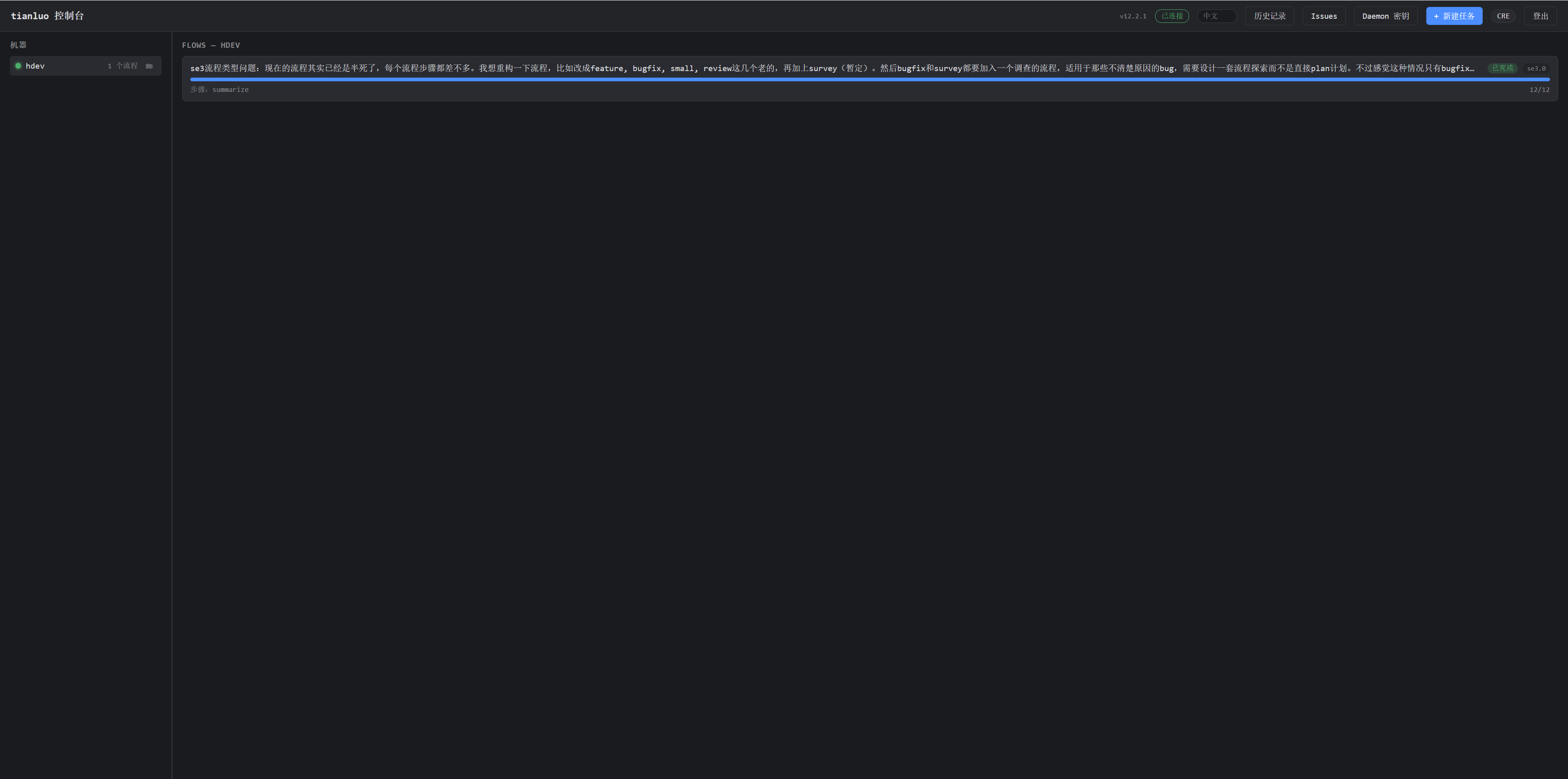
The console is not a log viewer bolted onto the CLI — it is the second full control surface, and for the out-of-the-loop workflow it is usually the one you live in. What it gives you:
- Fleet overview across machines. Every daemon that has bound itself to your account shows up in one list, with its projects and its live flows. One browser tab covers a laptop, a workstation, and a build box at once.
- Launch new tasks from the browser. + New Task picks a target machine, a
registered project root (or a manually entered absolute path — the daemon
runs
luo initthere first if it is not a tianluo project yet), a task type (orauto), and the task text. You never need a shell on the target machine. - Answer discovery from the web. A
--discoverrun's multi-turn requirement clarification is fully answerable in the browser; the checkbox "Start from discovery step" is available both on the new-task form and when launching a flow from an issue. - Human-intervention gates. A flow that needs you shows up as PAUSED /
needs response; you reply inline, approve or reject a plan confirmation
(
approve/reject, or any other text as a revision request), interject an instruction into a still-running flow, then Resume — or End the session and archive it. - History. Finished sessions are browsable step-by-step, with per-step records and the total tokens and cost the session consumed.
- Issues panel. Browse open and closed issues across machines and projects, filter by source / project / type, create issues, close them with a reason, and launch a flow directly from one.
- File uploads, inlined into the prompt. Drag, paste, or pick files; they
are relayed to the owning daemon and stored under the project's
tianluo/uploads/as<content-hash>_<filename>(20 MB limit per file). The path is inlined into the prompt text the agent receives, and image attachments additionally render as inline thumbnails under the message — the thumbnail is an addition to the prompt text, never a substitution for it, and one click opens the full-resolution image. - Mobile layout. The console is responsive down to phone width, so the approve/reject gate is answerable from wherever you actually are.
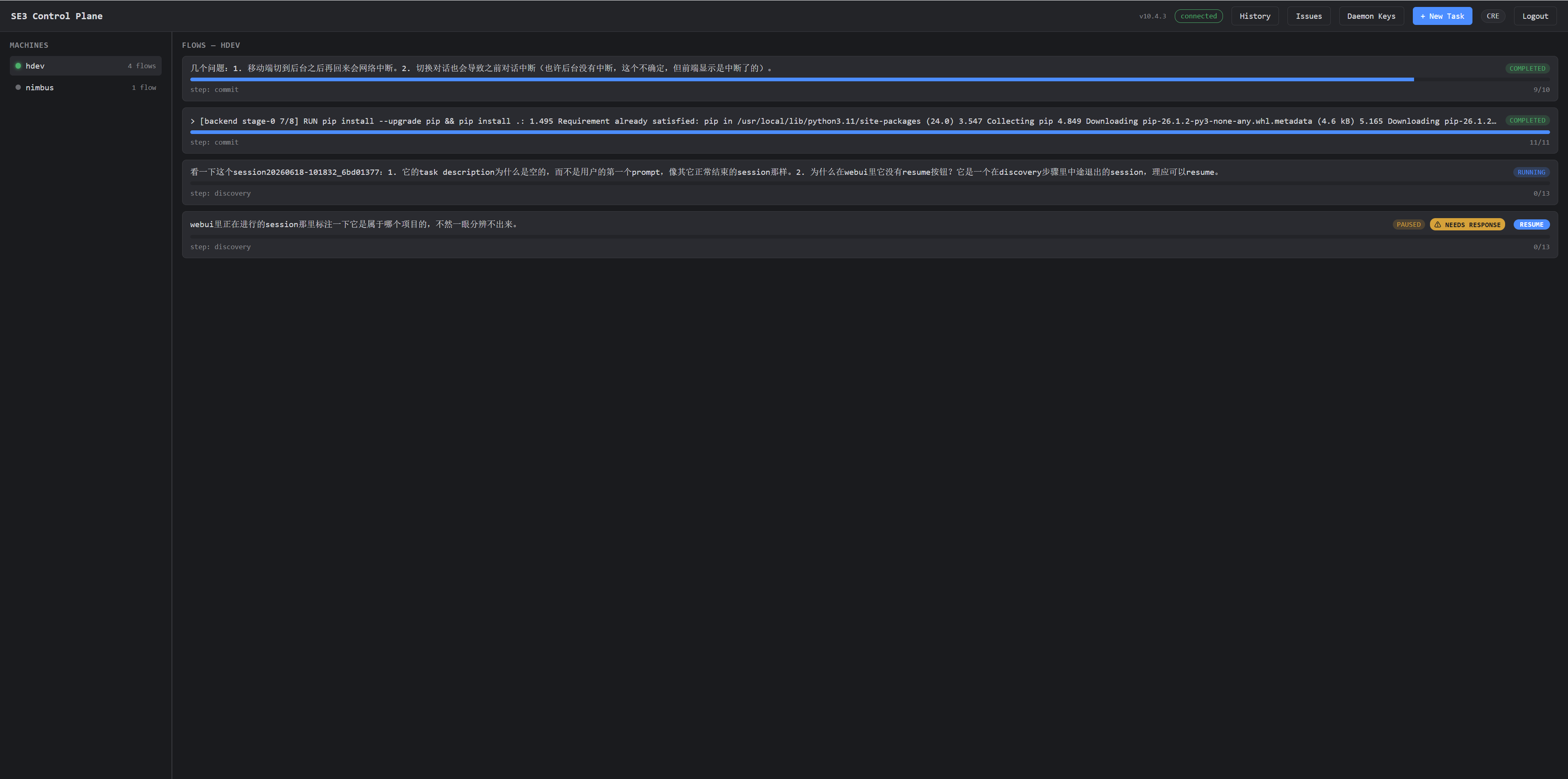
The fleet overview: several machines, their projects, and every live flow in one view. Screenshot taken on an earlier release, before the rename — the UI still carries the SE3 branding.
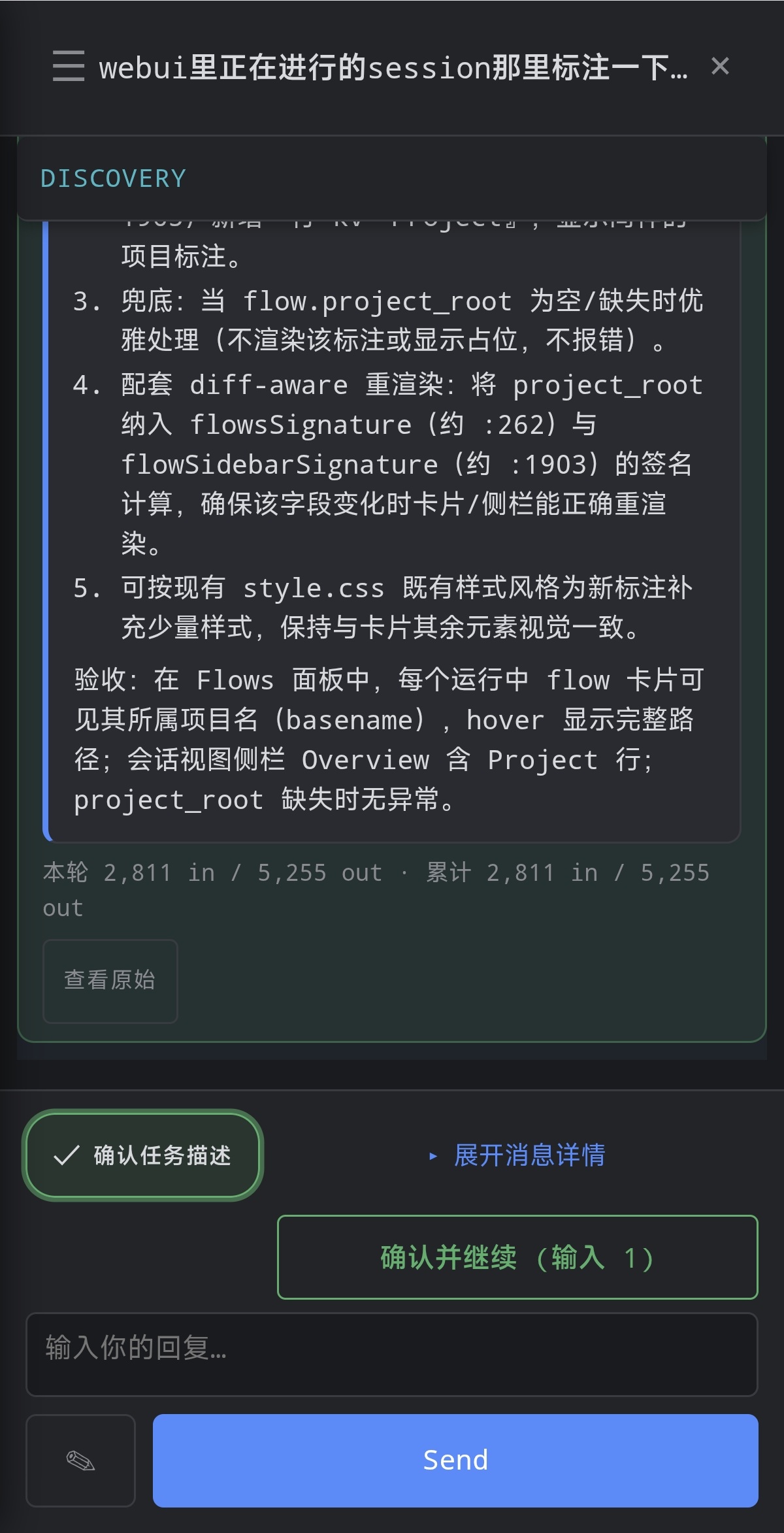
Answering a confirmation gate from a phone. Screenshot taken on an earlier release, before the rename — the UI still carries the SE3 branding.
The central server is a multi-tenant control plane — the web console and REST API require a login, and every machine / flow is scoped to the owner that owns it. The first-run flow is:
- Mint a break-glass admin token — run
tianluo-server bootstrap-tokenonce; it prints a one-time admin token to the console. - Log in — open the web console and exchange the token for the break-glass
admin session (
POST /api/auth/breakglass). - Create local users — as admin, invite/create accounts (
POST /api/users). v1 has no public self-service registration. - Issue a daemon key — each owner self-mints a daemon key in the UI
(
POST /api/daemon-keys), then binds a worker withluo daemon start --daemon-key <key>. The owner only ever sees their own machines and flows.
See docs/daemon-and-server.md for the full end-to-end auth walkthrough and configuration keys.
Every command below is registered in src/tianluo/cli.py or one of its
sub-typers.
| Command | Purpose |
|---|---|
luo run [TASK] |
Unified entry point. Drives the flow-engine state machine (see the diagram above). Flags: --resume / -r, --type / -t, --change / -c, --flow-id, --discover / -d, --from-issue, --output-format, --preset, --worktree. |
luo init |
Initialize a new project: writes tianluo.yaml, tianluo/charter.md, .gitignore, and runs git init if needed. Flags: --project-root / -p, --name / -n, --force / -f. |
luo merge <branch> [<branch> ...] |
Sequentially merge branches into HEAD with LLM-driven conflict resolution, then reconcile the final version from the merged-in intents. Flags: --strategy / -s fast|safe|strict, --delete-merged / -d, --no-delete-merged. Runtime data under tianluo/ is synchronized per the tiered policy. |
luo merge-respond <call-file> |
Apply a human decision file produced by luo merge when a conflict escalated to a human call. |
luo merge-unlock |
Inspect and release the project's merge lock (tianluo/state/merge.lock). Always reports the holder PID, its liveness, and the lock path. A stale lock is cleaned up automatically; a lock held by a live local process is refused unless --force / -f is given. A lock owned by another machine is never auto-broken — releasing it is always an explicit operator decision. |
luo salvage |
Best-effort recovery of an abnormally terminated session: tolerant state load, commit dangling diff, file follow-up issues, archive the session. Flag: --project-root / -p <path>. |
luo end-session [FLOW_ID] |
End and archive a session: terminate the live luo run process (clearing its pid file) and archive the state. A --worktree session is archived like a completed run — worktree archived, terminal state promoted, history synced, isolation branch and worktree removed — but its unfinished work is not merged. Flags: --project-root / -p, --pid, --no-archive-worktree. |
--preset <name>— Run a task from the preset prompt library instead of typing the prompt. Presets come from two layers merged into one registry: the built-in layer shipped inside the package, and a project layer of markdown files undertianluo/prompts/(committed with the project), whose metadata —typeandprompt_file— is declared in thepresets:block oftianluo.yaml. The project layer overrides the built-in layer on a name collision.luo run --preset listprints every available preset with its type and layer. A preset carries its own task type, so it is mutually exclusive with an explicit--type.--from-issue <id>— Start a flow whose input is an existing issue fromtianluo/issues/, and write the outcome back to that issue when the flow finishes (a completed flow resolves it). This is the intended follow-up path afterluo salvagefiles issues for unfinished work.--plan-decomposition capability|granular— The explicit decomposition doctrine for a new flow (see the PLAN decomposition section above). Omitted, it falls back to the project config and then tocapability.--plan-granularity auto|single|conservative— The explicit group-count pressure for a new flow; effective undercapabilityonly. Omitted, it falls back to the project config and then toauto. Both options are ignored on a resume: the flow keeps the doctrine it was created with.--implementation-strategy auto|direct|planned— Deprecated, removed in the next major version. Kept for one version and mapped onto the two options above (direct→--plan-granularity single,planned→--plan-decomposition granular,auto→ the new defaults), with a deprecation warning. An explicitly-typed new option wins over the mapping.
| Subcommand | Purpose |
|---|---|
luo code-index |
Render the adaptive root map from tianluo/code-index.md: a byte-budgeted, zoomable directory tree (top level always shown; code directories expanded a few levels deep within the budget). This is the same map injected into every flow step. Reads the committed map (reports "not built" until you run rebuild); flow steps keep it fresh lazily/incrementally. |
luo code-index index [PATH] |
Render exactly one literal level at PATH: a directory's immediate children (subdirs + files), or a file's functions/methods. No argument → the literal root level. Unlike the bare command, it never auto-expands. |
luo code-index show <path> |
Print one file's full function/method detail (and any degraded chunks) from the structure map. |
luo code-index search <pattern> |
Grep the map's item lines — a drop-in for grep tianluo/code-index.md, except a matched symbol line carries its owning file's full path (relpath::local_id) and no fingerprint comments leak into the output. Grep-aligned syntax: regex by default, -i / --ignore-case, -F / --fixed-strings, -m N / --max-count, -n / --line-number. Exit code follows grep (0 = matched, 1 = none, 2 = bad regex). |
luo code-index rebuild [--force] |
Rebuild the code-index, flushing the md periodically as a checkpoint. Incremental by default (only fingerprint-changed nodes are re-summarized); --force re-summarizes everything. |
luo code-index inspect |
Show code-index stats (file / symbol / degraded-chunk counts) from the on-disk map. |
| Subcommand | Purpose |
|---|---|
luo history / luo history list |
List flows across active state, archived state, and history-only directories. Flags: --active-only, --archived-only, --json. |
luo history show <flow_id> |
Show structured step-by-step details. Flags: --detailed (LLM call breakdown), --verbose (full tool-call stream), --json. |
luo history restore <flow_id> |
Resume a specific flow by ID (delegates to luo run --resume --flow-id). --dry-run prints the command without executing. |
luo history archived |
List only archived flows. --json for machine-readable output. |
luo history show <flow_id> also prints a dedicated usage / cost region —
per LLM call/attempt, per step and flow totals (input / output / cache tokens,
provider actual cost, estimated cost, unknown counters and completeness), plus
the flow's plan mode (decomposition, granularity, group count) and the
self-check scope audit. Provider
actual cost stays authoritative and separate from the estimate column; missing
usage, models or prices show as unknown/partial, never a misleading $0.
--json emits the same structured summary. The web console's history view and
live-flow sidebar show the same backend figures.
| Subcommand | Purpose |
|---|---|
luo issue / luo issue list |
List open issues (default). --all includes closed; --type <t> filters by type. |
luo issue show <id> |
Render an issue's full details. |
luo issue create |
Interactively create a new issue (title, description, type, priority, tags). |
luo issue edit <id> |
Open the issue in $EDITOR (falling back to vi) and write back the edited YAML. |
luo issue close <id> |
Close an issue. --reason <text> records why. |
luo issue reset <id> |
Reset an in-progress issue back to open. |
| Subcommand | Purpose |
|---|---|
luo migrate list |
List the registered migrators — currently spec-to-new-system and rename-to-tianluo. |
luo migrate run <id> |
Run one migrator as a single reviewable, git revert-able change. See Migrating an existing project for which to run. |
| Subcommand | Purpose |
|---|---|
luo worktree gc |
Garbage-collect leaked luo run --worktree runs: enumerates worktree runs under tianluo/worktrees/ whose engine state is terminal (COMPLETED / FAILED) and idle at least --max-age-hours (default 24), then per run archives it, promotes its terminal state into the main archive, and removes the worktree. A branch is deleted only when provably merged; an unmerged branch's ref is always retained and reported with a loud warning. Flags: --max-age-hours, --dry-run, --project-root / -p. Exits non-zero if any run errored. |
| Subcommand | Purpose |
|---|---|
luo daemon start |
Start the daemon. --foreground keeps it attached; --server-url <ws://…> registers with a central server; --daemon-key <key> binds this machine to an owner on a multi-tenant server. |
luo daemon stop |
Stop the running daemon. |
luo daemon status |
Report run state, machine id, server URL, real connection state, and tracked flows. --json for machine-readable output. |
Everything under tianluo/ is gitignored by default except the whitelisted
sub-paths shown below (the code-index map, charter, issues, scripts, prompts,
version-intents, and version-rules.md are tracked; runtime state and logs are
not).
your-project/
├── tianluo.yaml                   # Project config (tracked)
├── tianluo.local.yaml             # Local override — WHOLE-FILE, not key-merge (gitignored)
├── pyproject.toml                 # Single source of truth for project version
├── VERSIONS.md                    # Changelog (maintained by documentation-updater)
├── scripts/                       # Helper scripts
├── .gitignore                     # Written / extended by `luo init`
└── tianluo/                       # tianluo runtime root
    ├── code-index.md             # ✅ tracked — authoritative structure map (LLM-injected, human-reviewable)
    ├── charter.md                # ✅ tracked — project identity / architecture / invariants, injected in full every step
    ├── issues/                   # ✅ tracked — open/ and closed/ YAML records
    ├── scripts/                  # ✅ tracked — optional project version script (version.py / version.sh)
    ├── prompts/                  # ✅ tracked — project-level preset prompt bodies (luo run --preset)
    ├── version-intents/          # ✅ tracked — per-flow version intents consumed at merge time
    ├── version-rules.md          # ✅ tracked — optional, not present by default
    ├── state/                    # ❌ runtime — engine.json, merge.lock, run.pid, …
    │   └── archive/              #   archived engine snapshots
    ├── history/                  # ❌ runtime — per-flow per-step jsonl conversations
    ├── logs/                     # ❌ runtime — execution logs (incl. logs/llm/ traces)
    ├── calls/                    # ❌ runtime — pending human call files
    ├── collab/                   # ❌ runtime — collaboration artifacts
    ├── uploads/                  # ❌ runtime — web-console attachments, `<content-hash>_<filename>`
    ├── cache/                    # ❌ runtime — derived caches (build locks, etc.)
    ├── tmp/                      # ❌ runtime — transient prompt/response snapshots
    └── worktrees/                # ❌ runtime — `--worktree` isolation worktrees (+ .archive/)
The code-index is the index into this codebase. Start at the root view and drill down — you read the map's few lines first, and open source files only when you need the implementation detail behind a specific symbol:
luo code-index                                         # the adaptive root map (budgeted zoomable tree)
luo code-index index src/tianluo/engine                # one level: the engine package's immediate children
luo code-index show src/tianluo/engine/code_index.py   # that file's full symbol tree
luo code-index search 'merge.*lock'                    # find items by keyword or regex
The same root-view map is injected automatically into every flow step, so the
agent always carries a project-wide orientation map; deeper function-level
detail is fetched on demand. Charter (tianluo/charter.md) is injected in full
alongside it and carries the high-altitude facts — project identity, top-level
architecture, and project-wide invariants — that every step needs to see whole.
| Document | What it covers |
|---|---|
| docs/configuration.md (中文) | The authoritative configuration reference: how the config file is resolved, then every block and every key with its type, default, meaning, and pitfalls. Read this before writing anything into tianluo.yaml. |
| docs/daemon-and-server.md (中文) | The optional always-on control plane: installing and running luo daemon and tianluo-server, the connection model, multi-tenant auth, TLS reverse-proxy deployment, and the bundled web console. |
tianluo.example.yaml in the repository root stays a deliberately small
starter config; it is a starting point, not the reference.
- The version lives in
pyproject.tomland nowhere else. It is decided by the engine'sversion_analyzestep and written bycommit— do not hand-edit it, and do not copy it into other files (the badge at the top of this README reads it live frompyproject.tomlfor exactly that reason). - License: Apache-2.0.
- See VERSIONS.md for the full changelog.